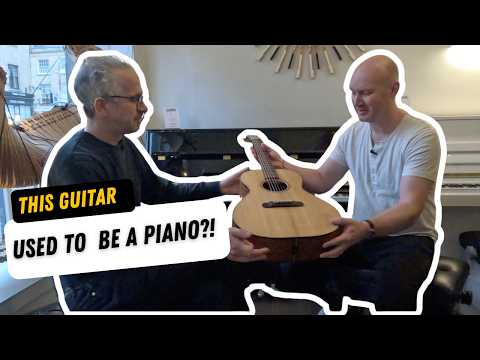
[0:01]Today, I find myself in beautiful Bath to meet renowned luthier Gary Leddington. We'll be talking about a special art project he's been involved with at the piano shop. bringing together broken pianos and talented artists. piano shop in Bath, and this is a guitar that I've built for them, basically. They have a project which they've been doing for a couple of years now called play and remade, which is um, so one of the services that they offer is that they scrap guitars for people, so sorry, not guitars, pianos. They scrap pianos for people. Um, if the piano's not worth restoring, if the man hours or the labor that's going to go into it is just not worth the the resale value, then the the other service they offer is that they will scrap the piano. And at some point, they started getting really uncomfortable with the idea that all this material was going to waste. So they started offering it out to artists and craftspeople, um, and various other, you know, artisans and things. And some of the projects you can see on the wall here are a result of that. Um, I saw them advertising this, um, project in a magazine a while ago. So I contacted them, it was about a year and a half ago now, I think, and I contacted them and I said, you know, I introduced myself, said I'm a Luther in the area, and I would um, really like to build a a guitar out of all piano. So yeah, we we struck up that relationship and this is the result. So this guitar is almost entirely made from old pianos, from various different components of old pianos. Um, yeah, obviously you've got the spruce soundboard, which every piano has a soundboard in there. I think we went through about three pianos before we got a suitable soundboard. That was actually the hardest bit because, um, I think the first one we got, that wasn't possible to get the soundboard out. The second one, once we'd stripped all the French polish away, it turned out that the wood was like really punky and weird, and it wasn't good. So it took the third piano to get the the soundboard out of it. Um, but then the rest of the guitar too is all completely from old, almost completely from old pianos. So we've got like walnut back and sides, which came from a, I believe 100 or 150-year-old grand piano lid. Nice. Um, that was originally veneered in rosewood, um, Brazilian rosewood, I believe. And at first when I saw it, I thought, oh, have we got a solid Brazilian piano? No, it wasn't. The dream. Yeah. But what we there was a few parts on it which were solid rosewood. So there was like some trim around the edge, which was solid rosewood. And then there was also this kind of underneath the grand lid, or not all grand lids, but some grand lids have got this kind of support bar. Okay. And this support bar, like almost like a brace, um, was solid rosewood. So we managed to get the fingerboard which is yeah, solid rosewood and the bridge and the bindings all from that from that Brazilian rosewood. I think it was Brazilian rosewood, I'm not entirely. It must have been a challenge to work with it and to sort of plan, obviously, because piano's nothing like a guitar, so you've got to really plan what you're going to do your cuts and everything, how you're going to use it. Yeah. Absolutely. That was, that, that was, I mean, the soundboard of a of a of a piano is quite big. It's probably like a meter 50 by a meter or something like that. And realistically, you can probably get like one guitar and a couple of ukulele's out of it because they've got all these braces going across it, which are all bolted through and it means there's all these holes everywhere. And some of those holes you could incorporate, incorporate aesthetically, I think, but um, some of them are just structurally completely in the wrong place. So, yeah, planning all the cuts like that was definitely with the fingerboard, for example. This, that also had bolts through the braces.
[3:51]Right. You can really see it just the center of the head stock, that's the only one I picked out. No. So that finger joint there is kind of a nice little reference back to it used to, used to be in the piano. That's also part of it is a nice design touch as well, isn't it? It's got. Yeah. Yeah, that's definitely like a kind of integral part of the project I think, in a way, trying to figure out how to make it.
[4:16]look and function like a guitar and not just be full of old pianos. And I think what's stunning with it, with this instrument is that it doesn't look like something that's been cobbled together out of an old piano. Yeah. You can see the craftsmanship is absolutely superb. Yeah. Every time I kind of look over, I notice something here. I'm like, oh, hello. Well, that was the aim really. Um, that the, I wanted it to look like a guitar that you would buy in a shop as a kind of, you know, first-hand guitar, let's say. Um, there are some elements to it which I've left in to sort of harken back to that history of it being, of it previously being a piano. I'm not sure this camera will pick this up, but here you can see a finger joint from one of the original boards that became the neck. That's it's a 100-year-old mahogany neck and it's made from four pieces, but it's kind of jointed, it's jointed in a way that you don't really see it unless you look carefully. You can really see it just the center of the head stock, that's the only one I picked out. Oh, that's nicely done. Yeah.
[5:41]I never knew that was brass. I, I, well, I don't know if they are these days, but yeah, obviously the old stuff is. Yeah. Such a nice. And it's incredibly well inlade too. So this was that's actually maple that was dyed black. Um, there was some kind of touch-ups that I had to do to the to the black dye when I was working with it, but it's it's The inlay was just incredible. There was like there was barely a Oh, it's so fine as well to do that. Obviously, brass is quite pliable as well, isn't it, bro? Yeah, those lines are so fine and crisp. Yeah, and then there's another one on the on the end of the guitar there too. So it says upright and grand, which would have been the model of the the guitar of the piano that it came from. Um, yeah, it's a really classy touch, isn't it, Scott? I really appreciate this instrument. It's a stunning. Yeah, I mean, I think it was just important to have some of those elements that sort of related back to it being a piano really. And you said it's got brass binding as well. Um, yeah, so it's got brass binding. So there's a few elements on this that aren't actually, um, from a piano. And you keep saying guitar. Um, there's uh, the bridge pins, the strings, the saddle, the nut, um, and the rosette centering and the binding, sorry, the purfling around the edge of the guitar there. That's all not and the frets of course, too. That's all not piano. Um, but the tuner buttons, they are all old piano. So we collected a lot of old brass, melted it down and then and recast it into rods and then turned it on a lathe to get the the right diameter for those. So the tuner buttons themselves, they are old piano, but the the mechanics are not. They're they're they're they're, yeah, everything, the craftsmanship that's gone on is just incredible. You must be really proud of it. Yeah, I am. Yeah, it's uh, it's uh, I mean it sounds great, it looks great. I'm really pleased with it. Beautiful. Yeah. Beautiful. We have, do I give it a little demo? Yeah. Yeah. Sure. Let's do it. I'm just going to sit back and enjoy. So I play bluegrass music mostly, like fiddle tunes and stuff. So I play, um, I'll try and play one cup of whiskey before breakfast.
[8:32]Something like that. That's brilliant. That's brilliant as well. Thank you. Stunning. Brilliant. Thank you, sir. Yeah. Every spot you look at you think, oh, that's nicely done. That's nicely done. I get to see a lot of guitars in my, uh, line of work. Sure. It's, it's really, a piece and a half this, so it's. So it wasn't without its challenges. Like, obviously, some of the ones I told you about already, like, um, grain matching and filling holes, and, you know, making the wood kind of structurally sound. But one big thing that happened was, um, so I told you before that I moved back to the UK about three years ago. Yeah. And, um, when I lived over in Europe in Belgium, I used to use this, um, a particular type of nitrocellulose lacquer, which is really, really hard to get over here because it's made in Spain, and since Brexit and all that. Um, so at the the recommendation of an older luthier that I know, I started using another brand. And I, mostly I've used it up until I made this guitar. I've mostly I've used it for like touch-ups and repairs and stuff. So not in kind of an extensive way. Um, this one, obviously, I sprayed the entire guitar. I left it the kind of requisite four to five weeks to to fully cure. When it came back to it, I put my finger on it, and it just smooshed still. It hadn't cured. And, um, I, yeah, I decided to to give it another four weeks. It was so same again, fingerprint just went into it. It hadn't cured. I'd heard before that sometimes Nitro can be a bit weird. There have been occasions before when other builders have said, well, it took like six months for it to fully cure, but even after six months, it didn't fully cure. So in the end, I had to strip all the lacquer off. Do all the poor filling, all the sanding, all the poor filling. It doesn't quite set. It's not like just sanding it. You just come strip it off. It was just horrible. Yeah. Horrible gummy stuff. Yeah. Oh, that must have been a hard part. Yeah. So it was quite a challenge this one, but I mean, really worth it in the end. Super. Yeah. I'm super pleased with it. Yeah. No. So you do, uh, commission builds as well? Yeah. Yeah. So what's the process of someone wants to get hold of you and commission a guitar? Well, um, they basically just contact me via either Instagram or my website or whatever. And, um, yeah, then we usually talk about the various things. I think I, what I try and do with my guitar, I I what I try and do with my guitars is add like small custom elements. I'm not trying to reinvent the wheel or something in terms of like body designs and things like this. But for me, it's about all the little details that I put in. So one of the things that I really like doing with clients is, um, finding small little details and elements and things that are personal to them and putting them in the guitar so that when they're playing it and they pick it up and they look at a certain thing, it reminds them of a certain sort of. Oh, true. You know. Um, with a luthier called Robinton a couple of weeks ago and he does a similar sort of thing where we call it like little players touches and it's just those things that you the public don't see and you go like like maybe a little touch like the, I've seen some of your guitars like little touches like that. That's right. So one little bit of the audience gets that. Yeah. No, it's just a place that that that it's just a nice little treat to yourself. And, uh, Robinton did, um, multi-laminate fretboards, so you got a nice, beautiful ring around the around the edge of your fingerboard and it was just real nice touches that nobody would see. So I think that's what custom luthier is all about really. Yeah. I mean, sometimes it's not it's not necessarily something personal or meaningful, but it's a detail that they've chosen. Yes. You know, it's a detail that they've chosen that you wouldn't normally get on like a kind of stock guitar or from maybe one of the bigger brands. Um, so it really feels like a a one-off instrument. You know, it might be a dread or an OM or something like that, but all the little details means that there's no other one like that in the world. So Nice. Yeah. Brilliant. So I'd find your Instagram. It's probably, yeah. Instagram, Leddington Guitars or LeddingtonGuitars.com. Yeah. I can see a couple of Great British guitar shows next year as well. Yeah, definitely. Yeah, yeah. I'll be there. Brilliant. I've been in Oxford and, uh, the Oxford show and Wiltshire one. Yes. Looking forward to it. Yeah. That's about it. Brilliant. Yeah. Thank you very much. Yeah.