[0:03]Good morning class. Today in science, we're going to be doing our, continuing our work on waste management. We'll be looking at this one here, uh, called High-Density Polyethylene, commonly known as plastic bags. So, uh, today's lesson, uh, we'll all be about cause and effect. Um, the cause is, um, why do we use so many of these in our country? And the effect is, um, what's the effect on the environment? Uh, the other thing we're going to look at, of course, is the solutions. What has the government done to try and curb the use of these plastic bags? And the other thing is, we as individuals use a lot of these, what can we do as individuals to try and reduce the amount of plastic bags that we use? To help us through today, we're going to be doing a couple of things, um, a little "Think, Pair, Share" first up this morning. Um, a cause and effect map. Um, you guys are going to be, um, designing out of, um, uh, newspapers some alternative to plastic bags, that's something that we can do as, um, as individuals. Um, and then you're going to, um, try and improve upon that design that I'm going to give you. In front of you, you have a piece of paper with seven questions on it, seven statements. And those seven statements, all you have to do is write true or false next to each one of those. Uh, once you have done that, I'll give you about one minute. Uh, then with your partner, you'll share your responses in our usual way, and then for the share part, we'll go through the answers as a group.
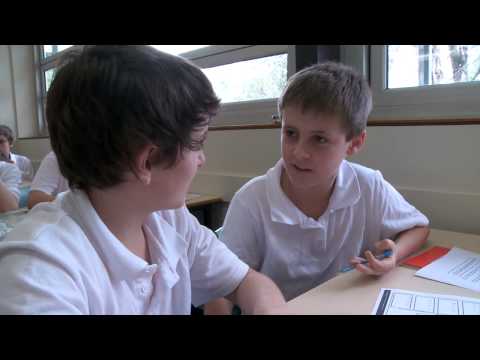
[1:46]I said false, um, because I don't think 75% of it comes from the supermarket because it had to come somewhere before I went to the supermarket. Plastic bags is only used for five minutes, so it can take up to a thousand years to break down. Well, that's true because, um, plastic bags are made out, are made from high-density polyethylene. Okay, question number one. Uh, the average bag, plastic bag only lasts for five minutes but takes a thousand years to break down. These things take a thousand years to break down.
[2:24]Um, in Australia, we throw away over 7,000 of these plastic bags every one minute. True.
[2:35]And, uh, one of our states, South Australia has banned plastic bags from all supermarkets. True or false? True. The next step we've got to look at is our, uh, is our cause and effect map that you, uh, that you have in front of you. Think of many reasons as you can on your cause and effect map is why do we use so many of these? Over 7,000 a minute in Australia. So, guys, on your cause and effect map, starting at the left-hand side, write down as many reasons why we can get of those, um, production of, uh, plastic bags. You can hold objects. They are reusable.
[3:20]They're strong.
[3:23]They use power to break down.
[3:28]Yeah, but then you have what power, like, the nature. Nature has to play a big part in breaking them down.
[3:39]Let's go around the class, please. Lock, uh, Luke. They're easily stored. Thank you. Lydia. Um, since they're made of polyethylene, they, um, they're cheap for supermarkets to buy or produce. They're cheap to produce. Thank you. They're easy to carry around and stuff. Whereas paper might, yeah, it might break if it gets wet. Okay, thank you. And for all these reasons, science has made a material like this one that's just so fantastic, isn't it? It covers all these things, so we produce a lot of them. Science has also created a problem for us. Because they've got all those qualities which we love so much, they're not biodegradable. So, folks, can you go through, please, and list down as many sub-effects as you can.
[4:39]I think you might have come up with the fact that they're light. What does that also mean on windy days? They can flow easily. So, they can flow hundreds of, hundreds of kilometers. Um, put it in the, you know, the landfill, or whatever. Oh, yeah, well, and then it stays there. Plastic bags, they're not, not biodegradable. And we know one of the effects is on marine animals. They can mistake this for food, eat it, and they can suffocate. What else, what are some other sub-effects of plastic bags? It can get caught on animals' wings, feet, or fins, and that can affect their, their walking. So, it doesn't kill them, it can maim the animal. Yeah, so well done. So, what we thought was a fantastic scientific invention, in effect, has been a environmental disaster. So, what we're going to be doing now is something that we can do as responsible individuals to break this whole cycle now that we fully understand the problem. So, uh, let's have a look to see how newspapers, how we can make a really good bin liner out of this, which is biodegradable. This one will break down and it won't do, have any of these harmful effects that we have here. You'll do this in pairs. One person from each of the group come out here and get four sheets of newspaper. And then we'll go through the steps on how we can, um, on how we can make it. And then after that, you're going to make up, you're going to redesign it and come up with your own newspaper and you're going to give it a really good marketing name as well. So you can sell the design of these on the internet. One person, please, come out to the front and, and get four pieces of paper. One, two, three. Just see how you go with that one. Uh, so, guys, one way you can make this is as follows. Uh, you put your four sheets of paper together like this one, so they're, um, nice and aligned. We have to make a square out of this. So, you can either use scissors, and you can just trim, um, down the side to make a square, or you can just sort of fold it over to, uh, to make a square.
[6:49]And, and, folks, once you've got your, um, square made, the next step in this process is to make a triangle. So, you fold one corner from here down to the other corner.
[7:03]Students, once you've done that, the next thing is, you fold, uh, one corner from here, and you fold it down to the halfway point on the opposite side. So, this corner down to your halfway point.
[7:20]So, students should be looking like that at the moment. And the next thing is, you fold about three sheets of paper down one side. Once we've done that one, we open it up, and we have our environmentally friendly, biodegradable bin liner.
[7:51]So, Luke, uh, do you think this one's as good as the plastic bin liner? Yeah. Yep, that looks pretty solid, doesn't it? That's a great one. Well done.
[8:02]And that one looks very steady, and very steady. Yeah, okay. Well done. All right, folks, in science, that was our first go at the, uh, at a biodegradable bin liner. But we're going to see whether we can improve on that, on that initial design. So, what I'd like you to do is we're going to use a "Pros, Cons, and Questions" to analyze our bin liner and therefore to see whether we can improve. Is it, like, is the material as strong as plastic? Even try to rip it. See, it was really hard for me to do. Yeah. I really, it didn't, it didn't completely rip through, whereas this just tears. What are some of the pros of your organic bin liner, please? Biodegradable. It can be environmental. They are. So, what are the cons? Ethan. Um, with the newspaper one, it is, it is messier than plastic bag. The commercial ones? Yeah. Can you explain that a bit more, please? And this one, like, couldn't fit in a big bin. So, using the "MAS" strategy, see if you can now write down some points to say how you can redesign it. Once you think you've got some good points down, come out the front, get some newspapers, and see if you can troll your new redesign.
[9:26]You need paper. Yeah. Well, maybe we could use cardboard for extra strength. Gave it a two and a half out of five because it isn't the best. It's small. Liquids will soak through and things like that. And like a lot of, because people use a lot of cooking materials and different things after they're cooked to put in their bins. Sure. Um, and that could leak through. You add staples to make it sturdier. Give it extra strength. We want to make it bigger for, because that won't fit the square, already.
[10:10]So, make it a bigger square and, therefore, a bigger bin liner.
[10:18]So, you might need that staple for extra strength. Yes. Okay. Yeah. Yeah, we can make handles for everyday use. So, staple for extra strength.
[10:33]I'll ask, I'll ask Sydney and Lydia to come out and just, um, take us through their bin liner. We've added handles to our bin liner. When we take the rubbish out, we, um, it's, it's, it'll be easier. It can also not only be used for bin liners, it can be used at supermarkets. A round of applause for Sydney and Lydia. Lock and Luke, take us through your bin liner. We've made it a lot bigger. It's harder to fit in this smaller bin, but it can fit in larger bins. We've added staples and more paper to make it stronger, so it'll hold heavier items. Have you got a name for your bin liner yet? Bio bin liner. Bio bin liner, a round of applause for Locklin and Luke, rather. Everybody, uh, today's lesson was all about waste management. But those plastic bags, we've discovered we've used so many of them, they cause lots of really harmful effects in the environment. Hopefully, the other really big thing we've learned today is the actions by ourselves, individually, we can do something to stop that harmful effect on the environment by creating those biodegradable bin liners. Well done today, guys. Can you just pack up nice and neat, please? Pack up the gear and get ready for morning tea. Thank you.