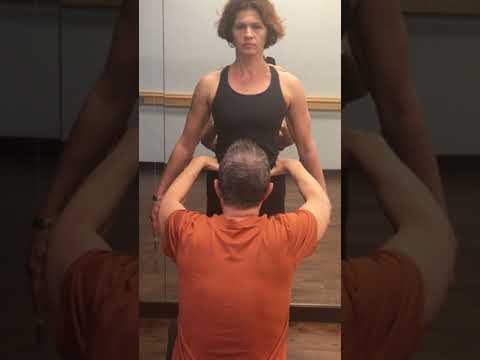
[0:00]Okay, so we're going to start with the plum line analysis. We want to line you up such that the plum line intersects just in front of your ankles. So, come in close to the line. Come in even look. Yeah, as close as you can get without touching it. Okay. What we want is for that line to intersect just forward of the ankle. So, great. And fortunately, it is moving slightly, but there we go. That's pretty still now. Okay. And then bring this foot forward just a touch there so they're both lined up there. Very good. And that looks like that is right. Just forward of the uh lateral malleolus, okay. And then from there, I want to look at where the plum line intersects. The head, the big parts, the head, rib cage, pelvis, okay? And it looks like it goes pretty much right through the center of the head. Uh, maybe the rib cage is just a tiny bit forward of the plum line, and then through the pelvis, it looks pretty good, right through the center of the pelvis. We're looking for big deviations there, right? And then even through the knee, it looks like it goes through the center of the knee and even the shoulder. So, looks great. The only thing I would say is maybe the rib cage is just a tiny bit forward of the plum line, okay? And then the other thing to look at here is that the pelvis, rib cage, and head are in alignment with each other, and they are. They look pretty good. And again, we could say the rib cage is slightly forward of the pelvis, but pretty good alignment there of those three big, uh, bony masses there, okay? And then we're going to go through the, uh, parts of the, uh, go from the side view, um, and start with all the joints from the side view. Starting at the ankle, what I like to look at is, does the tibia look like it's vertical, okay? And so, looking just straight down to the center of the knee, coming down to just forward of the lateral malleolus. The tibia looks pretty vertical, okay? So, that looks good. Okay. Moving up, uh, and you can step forward away from the plum line. We don't actually need the plum line anymore. So, you can step forward, you can come out away from it, like, you, you can step forward, you can go a little more, so I can get in there. There we go. And then for the knee joint, I'm going to find her greater trochanter. Okay? So, hers is actually pretty easy to feel, I can put my flat hand in there and find that bone there. There it is right there. It's really easy to get my hand around that, okay? And then, I'm going to go and go from there and come down to just forward of the ankle joint there, and you see there that the knee joint, it looks, it looks like it's a little bit behind the, um, uh, the line there. So, you can see that, the, it looks like her knee is in just a slight bit of hyper extension. I would call that a hyper extended knee there, okay? And then moving up the body here, with the pelvis and the lumbar spine and hip, I'm kind of taking like, there's four measurements, and uh, so the first one I want to see is, I'm going to get on to the PSIS and ASIS, okay? So, I like to put my hands onto the, the wings of the, um, the ilium here. Come down and here my thumbs will be close to her PSIS. And I think I'm right on it right there. So, I'll keep her there. And the front view, I like to go and get my flat hand into here and look at the ASIS, okay? And then get on to there. And I see if I put my fingers horizontal here, they look pretty in line. This one, the, the PSIS is just a tiny bit above the ASIS, but close enough that I would call that neutral. And then if you want to do the triangle with the, um, uh, outer part of the hand, the heel of the hand onto the ASIS and the fingertips onto the PSIS. And if I look from that from the down, looking down on that, that looks pretty vertical also. So, it looks pretty good there. Okay? Again, so far two things indicating a neutral, uh, pelvic position. Let's continue to palpation on the lumbar spine. A little bit of curve there. It's a real gentle, uh, little bit of concave curvature from the back view there. And then I'll go back and do one more quick measurement here and that was to get back to the ASIS, PSIS. And if we go to the trochanter here, go up to the center of the iliac crest here, does that look like that's above the greater trochanter? I think it is. We look at that. It looks pretty much lined up on top of each other there. So, all of those measurements are pretty much, uh, congruent saying, she has a neutral pelvis, neutral hip, and even a neutral lumbar spine, okay? And then moving up here, she's going to palpate through the thoracic spine. So, we have a little bit of concave curvature in the lumbar spine. And then moving up through the thoracic spine, it looks pretty good. Yeah, nice curvature through the thoracic spine. So, I even say the lower and upper thoracic spines are neutral, okay? And then moving up there and looking at the neck there, a little bit, okay? Uh, the neck also looks like it has a nice neutral curve, just a little bit of concave curvature from the, from the back, right? And then can you pull your hair back just a second there, Sandra? Oh, yeah. Yeah, very good. And then it looks like the ear is pretty much on top of the crest of the shoulder. The acromion process is gone. You can think of that as just the crest of the shoulder, the highest point there. And the ear looks like it's nicely lined up above that. Very good. Let's go ahead and turn around and do a few of those. We'll go up to the hip again, up to the pelvis again, uh, from the side view. You don't need plum line. Yeah. From this, the only really need it at the very beginning, okay? So, again, uh, looking at the, uh, line, I like to look from a little bit of a distance back here, looking at the, uh, um, uh, line of the tibia. It looks like it's coming pretty much straight down, okay? It might be tipped forward just a slight bit, but we do allow up to about a 10 degree variation there before we would call it, uh, dorsi flexed or plant, or the 10 degrees the other way, planet flexed. So, I'd say you're within normal range there, okay? And then going up to the knee joint here, we again go from the greater trochanter. Go ahead and find your greater trochanter here. This is again pretty easy to find here. Good bone there. You can really feel, okay? And if we go from that, down to just forward of the ankle joint here, we see on this side it actually looks like it goes right through the center of the knee. So, this knee on the left side, her left knee, uh, we call it a neutral knee joint, okay? And you can actually see from the side view, you can kind of see the difference between the two. You can see that the calf muscles, the gastrocnemius, behind, is behind on her right side. So, you can kind of see that that one's neutral, the other one's a little bit hyper extended, right? And then moving up here, uh, moving up to the pelvis, we're repeating our measurements there. We like to find the PSIS here. I go on to here. My thumbs land pretty close to them. There it is. Okay? And then the ASIS, flat hands into here, right? And get on, get on to that. And maybe a little bit higher on this side than it is on the other side, but I would still call it within reason and still call it a neutral, uh, uh, measurement there. If you wanted to repeat your ASIS and, uh, pubic symphysis measurement there. Yeah, there you go. And again, that looks pretty vertical. And then, um, uh, we did the lumbar spine, which we've already felt. Again, uh, neutral, and then our final measurement would be that distance from the PSIS. Find it again here. I think I'm on it. There we go. The ASIS, and if I come to that mid point there of those two, that looks like it is in line with the trochanter there. So, again, we would say all that's neutral. Come around, turn to the front view here. Look from the front. The feet, a good, a good thing to do with the feet is to look from a distance on the feet here, okay? So, what, one of the things we can look up from the front view is, generally, do the, does the lateral side ankle, the lateral malleolus, line up with the lateral edge of the foot? Okay? And it looks pretty good. They actually look like that lateral side of the ankle is lined up right on top of the edge of the foot. So, I would call the feet neutral here, okay? Bring the knees together. Bring your legs together. Yeah. And we see that the ankles come together or the feet come together and the knees are touching, and we would call that a neutral knee. If we had a little bit of space between the knees, we would call that bowed. If the knees were together, but the ankles apart, we would call that, um, knock knee, right? Okay. Moving on up here to the pelvis, okay? We're going to look for a level pelvis here. So, I get onto the horizontal hand right under the tops of the iliac crests, and we see that they are pretty level there. My hands look like they're pretty much in line with each other. And then we get on to the ASIS bones here and look down on that, we can see that those are about the same, um, uh, distance from knee. I could look down there. It's not rotated this way or this way. It is right in that kind of coronal plane there, okay? And then moving on up to the rib cage here, if we get up and under the ribs here, and feel that. I am so ticklish. Sorry. Sorry. And then it looks pretty level right there. Actually the rib cage looks pretty good. So, as far as, uh, level or elevation of one side of the rib cage, they look pretty good. Um, moving on up here, uh, we can look for, from a distance here, look for a rotation of the rib cage. So, I would look at the sternum as a good indicator here.
[9:50]So, her sternum looks like it's pointing right at me, okay? So, it's not turned over to the either side. It's right pointing at me. And then I'll look to see as the head rotated, is there any tilt the sides and is there any shifting going on there?
[10:18]And so, from the front view, it looks like it is pointed straight forward. There might be a slight tilt so her right, after think about that to your right. Slight tilt there. And then I don't really see any signs of a shift or anything there. Very good. Looking great, okay? And let's go ahead and turn around and do a back view here. Now, from the back view, again starting down at the feet and ankles there. Um, and this one is a really easy one because you can just look at the line of the Achilles tendons, okay? And so, what we're looking for is, come, come again looking from a little distance here, and do the Achilles tendons look like they're vertical, or do they do kind of a bell shape? The two of them come down and one, they each bow outward, or they kind of bow inward, almost like a pair of parentheses, right? And so, um, on her, uh, let's see, her right foot, it looks like it is slightly pronated, okay? The left one looks pretty good to me. Maybe doing just a slight pronation on the right foot from the back view here, okay?
[11:19]Um, moving on up to the knee joint here, we're really looking to see, when we measure at the knee here, we're really looking for a rotation, that would be at the hip joint, okay? So, if you come down here, you can feel the the tissue of the muscles coming down here. And then at the bottom of the tibia, the femur kind of flares outward, and we can get into the sides of the, um, femurs there, the condyles. I like to put a flat hand onto here and feel, where's the, where's the widest point on the on the bottom of the femur there, okay? And then we're looking for that axis of those two to really be right in her coronal plane, and it looks pretty good. Yeah, they look right in, that looks right in there. And then, I'm going to say the same, you probably guess the same thing on this side. Let's take a look here. And again, I get in there and really feel that widest point, get my fingers onto there. Again, that looks like that's right in her coronal plane, okay? Moving on up here, repeating the pelvis measurement here, going on top of the iliac crests, okay? They look like they're pretty level, okay? We look for a rotation here by getting under the PSIS. There we go. And looking down on that, it looks like, again, there's no real rotation. They both look like they're right in, we could say in her coronal plane, okay? Moving on up to the scapula here. So, the first thing, um, look at retraction and protraction, elevation and depression, upward rotation and downward rotation, and then any, any kind of ways to look, the scapula pull away from the rib cage. That would be a winging or an anterior tip, okay? So, um, let's compare our finger widths here. So, my, my three fingers, um, are, hers are maybe just a little bit narrower than mine. So, I'll, so I'll go ahead and use mine as a good reference there. If I'm right under the edge of the spinal process and come out here to the her scapula there, um, it's pretty good. I mean, it might be a slight bit of protraction there. We could call that a little bit protract, because my fingers are still a little spacing between my fingers and your scapula. So, yours are going to be a little narrower than mine, okay? So, on the left side, a little bit protracted, and a little less so on the right side. I would say still a little bit protracted, but a little bit less so, okay? And then, uh, as far as elevation depression, if you want to, I'm going to find your C7. Just stick your head forward, which is C7. Which is the first process below that is T1, and then the next one is T2. Hers are pretty easy to feel. Thank you for having nice spinous processes there. And I'm going to go to T3 in this case and then measure to the, to the, um, if I follow the the spine of the scapula, I mean, hers is pretty visible and easy to palpate. Come up to the edge of that and it's T3 and that at the same horizontal level. And they look like they are. And then I'll do the same thing on this side. Come out there at the very edge of that, to the root of the spine of the scapula. And again, it looks pretty level there. Very good. So, as far as elevation, depression, she looks pretty neutral there, okay? Um, and then, let's look for upward and downward rotations. So, if I find the upper corner of the scapula, right about there. And then the inferior angle of the scapula, right about there. And then that looks like those are pretty much on top of each other in a vertical line there. And so, we wouldn't call any upward or downward rotations on that side.
[14:38]And same thing over here, I'm going to guess. Let's see. Let's see if that upper angle there. Pretty easy to palpate your scapula. Okay. And then again, there is her inferior angle there. And if we look at that again, pretty vertical there. We'd be looking for these lines to be this way for an upward rotation, or this way for a downward rotation. They look pretty good. As far as pulling away from the rib cage, um, there is a little bit of winging in here. There is a little bit.
[15:07]You can feel that, you can see, um, that medial border of the scapula there, on the, um, left side. And again, on the right side. You can see both of those, okay? So, a little bit of winging on both sides there. Um, I wouldn't say that it pulls away any more near the inferior angle than it does all along that whole edge. So, I wouldn't call it an anterior tip. I would just call it a little bit of winging, probably due to the protraction of the scapula a little bit, okay? And then, um, uh, the humerus, what everyone always forgets, the humerus. Okay. So, um, we're looking now to see the electron process, which is really the the point of the elbow, that it's pointing back and not like way out to the side. It would be back and maybe out a few degrees. Uh, is within normal range, and hers look like they're pointing straight backwards, very good. Fantastic. And then let's get you to face the side here, Sandra. And then, um, from there, go ahead and let's just watch from the side view here. Go ahead and nod your head and sequence through the spine. Roll through the spine. And we're looking for any flat spots there. We're looking to see that there's even flexion. Let's drop your head down there, great. And then we can see there, a little bit of flatness in the lumbar spine. So, if you look through her lumbar spine, it's fairly straight line there. Then the curvature really begins when we begin to get to the thoracic spine. And then go ahead and curl back up there, Sandra. And then one more quick check here, and that'll be from the back view to look for an imbalance between the two sides. So now, it's exhale, and we'll go from the back view here. Nod the head, and roll through. Great. And that looks pretty even there and level. And if we look back here, it looks pretty level. Maybe a little more developed on the right side than the left side, but overall, I don't see any rotations or curvatures. You actually look pretty straight here. No, no curvatures and no real rotations. Maybe a little more muscle development on your right side extensors there. And then you can come on back up there, Sandra, up to tall. And we are all done.


