[0:00]Hi there. Now before we jump into the video, I have a very important question for you. Have you subscribed to our channel? If not, then subscribe right now to stay updated with the latest and brand new skadia.com lectures and click on the bell icon to stay notified about new releases. So, that being said, now that you've subscribed, let's return to the lecture. Hi everyone, and welcome to skadia.com. Today we'll be talking about how the development of the mandible takes place. So, the mandible is the largest bone in the human skull and it holds the lower teeth in place. It also assists in mastication and it forms the lower jawline. So now to understand the development, let's go through the anatomy of the mandible. Now, the mandible is composed of the body. Vertically attached to the body is the ramus. Between the ramus and the body lies the angle of the mandible. Over here marked in red is the mandibular foramen. Through the mandibular foramen runs the mandibular or also known as the inferior alveolar nerve. Now this inferior alveolar nerve is going to pass through the mandibular canal and it's going to emerge from the mental foramen. Now, when it emerges from the mental foramen, it converts to mental nerve and the incisive nerve. Now the incisive nerve branches supply the lower incisors, whereas the mental nerve supplies the lower lip. Now let's look at the mandible from another angle. Over here is the coronoid. The coronoid process is attached gives attachment to the temporalis muscle. Over here is the temporalis muscle and we can see that one end is attached to the neck of the coronoid. Then we have the condyle. Now the condyle is basically going to articulate with the temporal bone and it is going to form the temporomandibular joint. As we can see in this picture, the condyle is articulating and there's a disk between the temporal bone and it is forming the temporomandibular joint. Now over here we have the alveolar processes. Now this is a thick ridge of bone and it holds the tooth socket and the tooth socket contains the tooth. Now we have the mental protuberance also known as the chin. So, now let's move on to the development of the mandible. So basically the neural crest cells are very important. These are multipotent cells that these cells contribute to a formation of a wide range of tissues. So, when these cells migrate to the head and neck region, there are going to form a wide range of tissues. Now in the fourth week of intrauterine life, the first pharyngeal arch forms, and eventually this arch differentiates into the Meckel's cartilage.
[3:40]Over here, we can see the first pharyngeal arch. Now what is the Meckel's cartilage? The Meckel's cartilage is a basically non-ossifying template for the early growth of the mandible. This just acts as a mold, it's going to degenerate later on. So around the 7th week, a primary ossification center appears. Now, this primary ossification center lies lateral to Meckel's cartilage, at the bifurcation of the inferior alveolar nerve and artery.
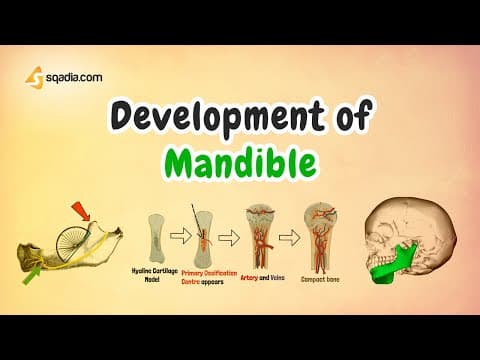
[4:21]So, the point where the inferior alveolar nerve is going to divide into the mental nerve and the incisive nerve, that is where the primary ossification center lies. Now, intramembranous ossification takes place. This proceeds ventrally to the body and dorsally contributing to the mandibular ramus. As we can see in this picture, this picture is going to show how the ossification takes place. So, it is moving ventrally towards the body, as shown by the red arrow and dorsally, so backwards and upwards, contributing to the mandibular ramus. Now, what is intramembranous ossification? Intramembranous ossification basically occurs when the bone is going to be directly deposited on the mesenchymal tissue. So, the Meckel's cartilage over here is the mesenchyme. So, bone is directly going to be deposited by the osteoblasts. Now secondary cartilages are going to appear at different times of the intrauterine life. So, first of all, we have the coronoid process, which is going to arise at around 18 weeks, the condylar head at around 12 weeks and the mental protuberance around the 20th week. Now these secondary cartilages are going to ossify by endochondrial ossification. Now, let's look at what endochondrial ossification is. So basically the extracellular matrix of the cartilage is going to be invaded by the blood vessels and the bone cells, which consists of osteoblasts, osteoclasts and the bone marrow cells. So, all of these are going to get deposited on the cartilage and eventually there is going to be ossification. Now let's look at it diagrammatically. Over here, we have the hyaline cartilage. This is a model. It's going to act as a mold. Then a primary ossification center appears within the bone. Eventually blood vessels are going to invade. The osteoblasts, the osteoclasts and the bone marrow cells are going to come in and eventually ossify to form the bone. And over here, we have a complete compact bone. Then at around 24 weeks, autolysis occurs within the Meckel's cartilage. Autolysis is basically an enzymatic digestion of cells by the action of its own enzymes. So, the cartilage is now going to disappear and the mandible is going to develop around it by intramembranous ossification. So when the Meckel's cartilage regresses, it is going to leave behind the perichondrium, which is the outer layer of the bone. Now the perichondrium is going to form some of the remnants. First of all, we have the ligaments. We're going to remember this by ALM, Ants Line the Mountain. And we're going to remember the second ligament is the sphenomandibular ligament by Sheep Moves in a line.
[7:46]Some fun mnemonics to help us remember them. Now let, now let's look at it diagrammatically. Over here, we have the traces of the Meckel's cartilage. Right here is the spine of the sphenoid bone. So over here between the spine of the sphenoid bone and the malleus, we have the anterior ligament of malleus. Then we have the sphenomandibular ligament between the spine of the sphenoid bone and the lingula. The sphenomandibular ligament attaches to the lingula of the mandible. Then some of the smaller nodules, they break away from the proximal part of the cartilage and form two of the middle ear bones. The incus and the malleus. Now let's see how the mandible grows. Now presence of the teeth are going to help the mandible grow vertically by the growth of the alveolar processes. Now there are some depository surfaces and some resorptive surfaces, which help the mandible grow in different directions. The depository surfaces include the chin and the lower border of the mandible. Also, the posterior surface of the ramus, the alveolar processes, as well as the mandibular notch. The resorptive surfaces are the symphysis menti and the anterior surface of the ramus. And the condylar cartilage also grows and contributes to the growth of the mandible. Now the condylar cartilage is a heterogeneous tissue, meaning it contains different cells. It consists of fibroblasts, osteochondral progenitor cells and the chondrocytes. This hybrid tissue may play an important role to regulate the different bone formation and this is going to help in the intramembranous and the endochondrial ossification just like we discussed before. So, the condylar process grows from anterosuperior to posterior, increasing the length of the ramus. Now let's discuss how the mandible changes with age. So, at birth, when the baby is born, the mandible is present in two halves. It is a fibrous cartilage, which ossifies at the end of first year. Also, the angle of the body and the ramus is obtuse. It is around 170 degrees. The coronoid is higher than the condyle. Also, the mandibular canal through which the inferior alveolar nerve passes and the mental foramen lies at the lower border of the mandible. This is because there are no teeth as yet. So, it lies at the lower border. Also, the sigmoid notch is the shallowest at this time. Now as we move on to adulthood, the coronoid is going to is going to move higher than the condyle. Also, the angle of the body and the ramus is going to be less obtuse. It is going to be around 110 to 120 degrees. The mandibular canal and the mental foramen is going to lie in the middle. See how this mandibular canal moved upwards because of this this is because of the presence of the teeth. The alveolar processes has helped the body grow in height, so this mandibular canal has moved upwards. And also the sigmoid notch. This is the deepest at this age. Now when we get old, the condyle is at a lower level than coronoid. The angle of the body and the ramus becomes even more obtuse. It is around, it is around 140 degrees and the ramus is inclined posteriorly. The mandibular canal and the mental foramen lie at the upper border of the mandible. Because there is loss of teeth, so this is going to cause resorption of bone and eventually the mandible is going to lose height, so it has moved upwards. The sigmoid notch is now shallow. So guys, this was everything about the development of the mandible. I hope you guys learned.


