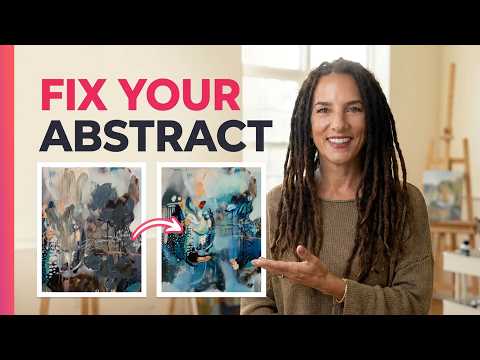
[0:00]So you love making abstract art. It's super fun. I get it. But how do you know if you are actually making good art? Because sometimes you look at abstracts and you're like, ah, I mean, I kind of like it, but it kind of looks messy. I don't quite understand it. Is it actually any good? Uh, and I think that there are, you know, actual frameworks and rules and uh, very interesting information that's very useful that can help you determine whether or not you're making a good abstract. And so, uh that is what this is all about. I'm going to explain it, I'm going to show you lots of examples. Uh first a little quick intro, I'm Ellie Milan, I've been a professional artist for the last 30 years. And when I first started, I tried to make abstracts because they looked so fun and I saw a bunch of abstracts out there that I liked and I could see that abstract art was selling really well. But I could not make a good abstract to save my life. And I knew when I looked at it, that is not good. I could tell looking at my abstracts, they weren't good. And I just knew something was wrong. They looked just kind of cheesy and um, one-dimensional and I don't know, I couldn't figure out color and I didn't know what to do with empty space, and I was just very lost. So I used to think that, um, you either were an abstract artist or you weren't. And you either painted imagery and, you know, maybe realism or, you know, impressionism or something like that, and that's how you were wired. And then there were these special people that were wired for abstract art and they their mind could just go there. And I didn't realize that anybody can learn how to do it and how to do it well. So later on in my career, there was actually a point for about five years all I did was abstract art. And I sold them and I I figured out the key. I figured out, um how to actually create a good quality abstract that was sellable, that looked sophisticated, that wasn't just a big mess. Uh, and that's what I want to share with you in this video. And I must have sold probably more than 5,000 uh abstracts, um over my career. And um, they they are still popular today. Everybody loves abstracts and they're very sellable, especially uh in the interior design market. Uh, people are, you know, decorating their homes and they love big giant abstracts on their wall. Uh, it makes them feel like it's contemporary. Uh it fits, you know, with their, you know, their house and the way they they design it. And uh so abstracts are really great and I know that you are going to learn a lot from this. So let's get started. Um, I promise by the end of this, you're going to have a clear understanding of what are the attributes of a good abstract. So that when you are creating your abstracts, you can literally go off a checklist and know, yes, I have done it and and my abstracts are are, you know, falling in line with that and so, you know, this is good. And you're going to see great improvement to your abstracts. Um, and so what I'm going to do is, uh, the plan is, I'm going to, um, show you the three common mistakes that most people make. What I made, the common mistakes I made when I made bad abstracts, and, uh, what are the three simple, um, you know, sort of frameworks or concepts that you can apply very easily, no matter what your skills are at. And, uh, if you apply those, they're going to greatly improve your abstracts. Um, you're also going to know when your abstract is finished because it's kind of easy to tell when a portrait is finished, right? Like the nose is in the right place, uh, you know, the skin tones all in there, you got your values. It looks like the person or who you, you know, were trying to to paint. Uh, and so you know, okay, this, this portrait is finished. But on an abstract, it's much more ambiguous and you really, um, a lot of artists are lost and they're not sure, is it done? And it's hard to know and it's something you, you feel like you just have to feel. But I believe that there are some definitive, um, things that need to be in place. I'm going to tell you what those are, uh and if they are, then your abstract is finished. So, um, these are the three common mistakes why abstracts fail. The first thing is no color story. No matter what you're painting, you should have a color story, but particularly with abstracts. The thing with abstracts is everything counts more because you don't have imagery to, uh, sort of, um, cling to. And, uh, Kandinsky said that, um, that abstract is the most sophisticated form of art because you have to master the elements of art and above all be a poet. So, uh, I agree. I do think that abstracts are, you know, in some ways easy, but also the most difficult because everything counts a lot. Uh, if you don't have your color right on a painting, um, you know, say a landscape. Uh, the colors a little off or it's kind of cheesy or there isn't any kind of color story, but you painted a beautiful landscape and all the values are right and there's depth and, you know, it has all, the trees look like trees. People will overlook the color and, you know, they might fall in love with the way you painted the trees. But on an abstract, if you don't have a color story and it's a big mess in terms of your color, then, you know, it it sticks out like a sore thumb and it will immediately make your abstract not look like good quality. So, uh, you don't want just random, um, colors there. You want an actual color story. So what does that look like? Um, oh, we're going to go into color in just a minute, um, and kind of flush that out a little bit. But first, number two, because I said there's three common mistakes. So the first one is no color story. The second one is no compositional framework. So there's no focal point, there's no visual path that leads your eye around, and, um, everything has equal weight. Now, there's a big sort of, um, misconception about focal point because of the way it says focal point. Right? You think, oh, that's the bull's eye I go right to, the first thing I notice. And that is not the focal point. The focal point is where your eye lands. So, usually, something grabs your attention near the edge, pulls you in on a good composition, will lead your eye around, and then it will land and fall somewhere and it'll rest. And where the eye rests is the focal point, not the first thing that you look at. So, um, so that is really important that you have a good composition. If you don't have a good composition on a landscape painting or a portrait or, you know, wildlife or something that you're painting that has imagery, I mean, you could get a pass if you painted it really well or your color's really nice or something like that. But on an abstract, if you don't have a good composition, that's it. It's it's, you know, nobody's going to, it's not going to look like a sophisticated abstract. It's going to look like a bad abstract. So you really have to, um, you know, create differentials in there. So your eye leads around, and you can see by these examples, where the one on the left is like everything is sort of the same size. The color, the the, the weight of things is is equal. So your eye is not led and your eye doesn't land anywhere on a focal point. Whereas the one on the right, it has all of that. You come in, you move around, your eye follows, and then it lands. And so, um, so composition is really important. Number three, no value range. So you don't have any darks, you don't have any lights, everything is towards the middle gray. Uh, and there's no contrast and there's no sort of, um, sophisticated value map within your, uh, abstract. And so it tends to look muddy or flat and unresolved and basically unfinished. So you can see here, uh the abstract on the left, you know, there's really no value or, uh map or no contrast, right? So there's no real light light areas, there's no real dark dark areas, everything is kind of in the middle. Whereas the painting on the right, there's a lot of good value differential and that works with in conjunction with the composition as well as the color story. So all three of these key points, um, where a lot of artists make the mistake and in fail in one or more of these three points, they all work together. It's not like they're separate points, they're they're, there's a synergy between each of them. Okay, so three simple fixes to creating a successful abstract. What are they? Um, number one, pick a good color story. So we talked about what uh not having a color story and the colors being random or colors that don't work together, uh or colors that are, um, sort of notoriously, uh combative and, you know, make people feel uneasy. Um, so rather than doing that, choosing a good color story that is rich and pleasing to the eye and something you really want to live with. You can just tell even even somebody that doesn't know much about art, uh when they look at a painting that has a good color story, you can just feel it. It's very inviting, it's very rich. You just want to put it on your wall and live by it. Where is a painting that doesn't have a good color story and it's all over the place or it's too boisterous and none of those colors work together. Um, you can feel it. It just makes you feel uneasy and kind of edgy and you don't want to have it on your wall. So, uh, it's really important to understand color and not only color like and how to mix color, that's that's a whole another thing. But how to create an actual color story where you are intentional about the palette that you choose and the nuances between those and knowing what colors work well with other colors and the proportion of those colors. So, um, color really determines the mood and the energy of a painting, um, and uh it's a good idea to really start with the feeling, especially on an abstract. What feeling are you trying to, um, put out there on your abstract? Uh, and a lot of people don't think about that. They're just, they're just painting, they're just throwing paint down and, you know, it is what it is and how it comes out, it's how it comes out. But you get to decide. You're the artist. Do you want it to be joyful? Do you want it to be energetic? Do you want it to be about possibilities? Do you want it to be, you know, kind of moody and dreamy? Do you want it to be sort of moody and solemn and peaceful or or peaceful, maybe? Um, are you going for tranquility? What feeling do you want in your painting? If let's say you were going for tranquil, are you going to make an orange and red and yellow painting? Probably not, right? It's going to be more blues and grays and slate and maybe some green or something like that. It's going to, um, give you that that peaceful, tranquil feeling. So, think about the feeling that you want to start with. Another thing you could do is just choose a dominant color. Um, I want the dominant color to be red. I want the dominant color to be green. Uh, whatever, whatever dominant color you choose and starting with that dominant color, then you can build your palette around that dominant color. Um, so you can also, um, pick just a, a already proven color story, um, that that you know works. So, um, this is just some ideas. This is not, uh, actually in our mastery program, our one-year program that, uh, teaches artists how to become a professional artist. We have an entire section all about color story and we go through probably 20 different types of color stories that you can use and develop, uh as an artist. So this is just a little taste of that. This isn't by any means exhaustive. This is just, you know, to to kind of get you in the right direction. So, um, one dominant color plus an accent color. So, as you can see here, the dominant color is blue with the accent color being yellow. Um, you could work with a complementary palette. So you don't want those to be equal. You don't want the same amount of violet as you have yellow. Uh violet is the dominant color and less proportion in the yellow. If they are equally proportionate and you have just as much violet as you have yellow, then it feels like they're they're, um, combating each other. It feels uh sort of jarring to have an equal amount. Uh, so you do want to choose one that is more taking up more real estate than the other on a complementary palette. Then you have a split complementary. So this is an example of that where you have, uh, you know, yellow with sort of the violet and blue as the split complementary, uh between the two.
[16:20]Uh another is just a neutral palette with some sort of accent, just a touch of green, just a touch of red, just a touch of rust, a touch of violet. Um, or a touch of eggplant or something like that. So a very neutral palette, a lot of, you know, grays and stone color and earthy colors, um, with some sort of a little accent to it.
[16:47]So that's an example of, uh, different types of color stories that you can go with. But I think the key with an abstract is to be intentional from the very beginning about your color palette. Uh, if you are much more intuitive and all of that planning really rubs you the wrong way, uh, then I would say you can, uh, sort of intuitively create the beginning of your abstract and lay down various colors and then stand back and look at it and say, okay, what, what color story does this painting want to have? And and sort of, um, take a critical eye to what you've done and decide what colors need to be tweaked, what colors need to disappear, uh, what new colors do you need to bring out in order to, uh, achieve the palette. But at some point, there has to be intentionality to it. Otherwise, your very liable to end up with just a random, um, color palette that doesn't actually work. And that will immediately make your abstract look not very good quality. Okay, so now a compositional framework. There's tons and tons of compositional ideas. Um, there's so many that are out there, uh and you can use, you know, really any of them. So, uh, you could work, you know, of course, with the golden ratio, uh and, uh, and sort of, um, use that, uh, to divide up your space. Um, you could divide up your space into three unequal parts. Uh that's always a great way to accomplish a good composition. Uh, you could, um, use the rule of thirds, uh so that your focal point just sort of lands on one of those dots. And you have some dynamic entry points to lead the eye around. You could use, um, sort of dynamic symmetry, uh, where it's, it's, it's sort of offset. Uh, if you divide up your painting in three unequal parts, um, whether that's color zones, value zones, uh, however you want to divide it up, uh, that will sort of achieve, uh, a bit of that dynamic symmetry. So, uh, there's a lot of different compositions that you can look at, you can follow, you can use as a framework. A great idea to really achieve a good composition is to do thumbnail sketches, just with graphite or charcoal, um, of your abstracts. Basically laying in very, with value, you don't even have to do color, just values, um to sort of frame out how you want your composition. And let's say you did nine different thumbnails of nine different compositions. You could kind of circle the ones that are, you know, workable and you're like, yeah, this composition works. My eye really leads around and then there's the focal point. So, um, so planning your composition, I think is really key. Uh if you again are more the intuitive type and you don't like all the plans, uh at some point early on, uh, I would say at least a third of the way into your painting. Don't go halfway or all the way, right? Just a third of the way in, you need to make some judgment calls on your composition. And stand back, really look at it, decide how the composition wants to be, uh push and pull and make, make a pleasing, good, yet dynamic composition out of what you have. That is a possibility if you're more the intuitive type. Um, but otherwise, working with thumbnails or references for composition will already help you not make those, those common mistakes that most artists make creating a not so successful abstract.
[21:26]Okay, so here are some, um, more compositional ideas, uh or or, um, examples. So, this is something I used in my career. Um, this isn't something I picked up anywhere, this is just like how I thought of abstracts and how I arranged my compositions. Um, and if this sounds good to you, you're welcome to try it. So I had this sort of, um, idea of this kind of, um, land and sky. So, basically, what is atmosphere, what is the far, far away is near the top? Now, that could be two-thirds of the painting, that could be a third of the painting, but there's an area at the top, um, that is the far away. And then everything in the bottom is either mid-ground or foreground. So I, so here is an example of what I'm talking about. Um, that sort of white area at the top is the far away stuff, and then you have kind of the green and the peach, the light peach is the mid-ground. And then you have the bright orange and that bright pop of the, of the purple as the foreground. Now, if you look at the next one, the belt, uh, that is basically somewhere running through the painting either horizontally-ish or vertically-ish is sort of a line or a belt that you hang all of your mid-ground and foreground objects on it. Everything else around it is going to be atmosphere or background. Uh, and so here is an example of what I'm talking about. Um, that dark sort of span that goes through it is where all of the mid-ground and foreground objects or forms sort of hang along that belt. Um, now this belt can kind of wave through, it can start at the top, kind of drop off and move to the bottom, but basically anchoring your mid-ground and your foreground edge to edge is the key. That's what makes it a belt. So edge to edge with your anchoring of your mid-ground and your foreground. Um, and so this is an example of that. Uh, now the last one is a little bit tricky and kind of hard to understand, but it's, I call it the blanket. And so how I imagine it is imagine, you know, in in the good old days you you washed an old tattered blanket. It's an old quilt, you know, it came from your great-grandmother and there's thin worn spots where there's actually holes in it and you can see through to the sky behind it. And you hung it on a line, okay, you have to imagine this, you hung the blanket on a line to dry out in the sun. And you're seeing the light go through it and all of those sort of holes that are in this old blanket are the atmosphere. It's what's far, far away. You can see the sky through it, it's far, far away. Um, and then everything that is sort of, uh thinner and thinned out, uh but you can see some light coming through, that's going to be your mid-ground. And then the dense parts that are still fully intact, the that part of the quilt is is still fully intact, those shapes. That is your foreground. So it has this sort of all-overness with little size scale differential, holes in it that give you that atmosphere. So this last one is sort of an example of of that type of, um, idea of a blanket.
[25:50]So, um, that's just kind of one way you can think about, uh, various compositions and approaches to constructing an abstract. But I would say the main key is to think about your background, your mid-ground and your foreground, because you ultimately want five fields of depth. Uh, and if you were painting, you know, a portrait or you were painting an animal or a bird or a landscape or whatever it is you were painting, you would have many fields of depth. So the problem with a lot of abstracts that aren't very good quality is there's no depth. Everything is just foreground or everything is just mid-ground or everything is just background. And they don't have that sort of atmosphere and and then solid form and subject, right? You don't, you don't see that, um, in unsuccessful abstracts, but the successful abstracts, you're always going to see that. You're always going to see the depth. So depth is really, really important and it's closely related to composition. Your composition is what, um, uh, creates that that depth. It's sort of how, um, the background, the mid-ground and the foreground sort of hang. And so, um, so anyway, those are good things to keep in mind. Okay, now number three, mastering the seven elements of art. So that sounds scary. I got to master something. Like I'm just I'm just getting started and I just started abstracts and I jumped on this YouTube video so I can make better abstracts and now you want me to master something? Yeah, that's your, that's your goal for, you know, over the next 5, 10 years is to to begin mastering these things. Does that mean that forevermore until you master them, you're going to make bad abstracts? No. You can make great abstracts, but once you have mastered the elements of art and you're really, really adept and good at all of them, you are unstoppable at that point. You will make the most exciting, amazing abstracts the world has ever seen. So that is your goal. That's what you're working towards. And there's a spectrum, right? You, wherever you're at right now, you can start today, learning about the elements of art and getting really good and building your skill. And as your skills build and and and you learn more, your abstracts will improve and get better and better over time. So, even starting today, three days from now your abstracts will be better. 10 days from now your abstracts will be better. A year from now your abstracts are going to be, you know, out of this world. Seven years from now, you could change the world with your art. So that's really what I mean by master the seven elements of art. If you want to paint good abstracts, start today by mastering the elements of art. It is a process. It takes time to get really good at them, but you will see drastic improvement immediately by learning. So don't stall, don't put it off. Um there is immediate payoff for building skill. That is probably the my my biggest thing. I mean, I'm kind of going on a little bit of a rabbit trail, but it's such an important rabbit trail that I'm super passionate about.
[30:16]So, uh, all the skills that you can collect as an artist, whether it's drawing skills, whether it's color mixing, whether it's being able to render form. Whatever it is that that you need to pick up and and add to your skill set, it will give you an immediate return. It is immediately gratifying. There is an immediate, um, um benefit to it. You know, if if you learn how to measure proportion in just one drawing, it could greatly improve your skills. So getting the skills is really crucial and I would not put it off. If you feel like you're low on skill and you just need more skills, start today. Just start today building those skills. Uh, you will not regret it. It'll give you tremendous creative freedom. It'll lower all the stress and self-doubt that you experience in the studio. You will have the answers instead of a bunch of questions. So, uh, really learning skill is crucial. There's there's no, um, there's no workaround. There's no skipping that part if you want to be a good artist, if you want the freedom that you can experience creatively, it's, it's all about getting the skill. A lot of people go into abstracts because they think it doesn't require skill. Like I don't know how to draw. I don't know how to paint stuff. I don't know how to like render form. So I'm just going to do abstracts. I'm an abstract artist. Well, even Picasso, if you look at his very early work, he could render form, he could paint realistically. He learned it, he he had the skill. If you know what you're abstracting from, right, then you're going to create better abstracts. So, uh, no matter what, I don't care, even if you want to be just an abstract artist, you still need to learn skill. And mastering the seven elements of art is absolutely crucial. So what are they? They're line, shape, form, color, value, texture, scale. Being able to use these poetically, beautifully, in synergy with each other, like a dance, okay, is is how you really will achieve masterful abstracts. So, it matters a lot, um, to to be able to, um, to use the elements of art with proficiency.
[33:41]Um, so I think that, um, I think that when it comes to line, um, any of the elements of art, a real key is diversity and, uh don't do the same thing. Don't just repeat the same thing. So, uh as long as there's variety to each of these, you're going to be already in a better place. So if even starting today, after you watch this video and you go to make an abstract, even starting today, if all you do is take this list of the elements of art, and when you're making line on your abstract, you think, okay, wait, there has to be variety. I have to have, uh interesting line. I have to have light line, I have to have dark line, I have to have thin line, I have to have thick line, I have to have smudgy soft line and I have to have graphic line. I need black line, I need pink line, I need yellow line. I need to vary my line. I need organic, you know, um, sort of, uh organic shape line and and scribbly line and then I also need straight graphic line. So creating as much variety within line is how you're going to get a sophisticated abstract. Um, so same thing with shape. Having a variety of shape, not all the same shapes, right? If you have circles everywhere and they're all the same size, that is super boring. But if you have, you know, sort of oblong circles, oval circles, you have, uh, you know, organic kind of messy circles, you have tight really, you know, um, perfect circles. And you create as many varieties of a circle, you, you try to create a hundred different types of circles, your shapes are going to be very interesting. So, um, creating a lot of variety within shape of positive and negative space, uh, overlapping the shape, uh, creating all kinds of differentials with the shape, creating depth with the shape. Some shape is sort of faded and in the background or the mid-ground, and some of your shapes are popping forward. Having the depth and the shape work together is going to make your abstracts much more sophisticated. Um, same thing with form, color. If you, if you're using say orange in your, in your painting and that's one of your colors in your color palette, if you use the same orange again and again and again and you mix a orange, you mix a big pile of that orange and you're like orange, orange, orange, orange, orange, orange, and it goes all over the place, the same orange. That is not going to look sophisticated. But if every time you go to make a brushstroke, you've already mixed a unique orange. There's a little more yellow in it. Well, next time you put a little yellow ochre. Okay, that orange has some raw umber in it. That orange has a little blue in it. Whatever you do, you tweak that orange so that your orange transitions throughout the painting, that is going to look sophisticated. That is going to look like you know what you're doing. So color needs variety within each color family.
[37:44]Um also value, right? We already talked about, you know, if you don't have highlights, you don't have shadows, um or the dark darks and the light lights and everything is sort of in that middle gray, it's not going to be sophisticated. So you want all 10 of the values in the value scale represented. Do they have to be equally represented? No. No, it can be very unequal. In fact, it's better if it's unequal. But you want all of the values there. You can't, um, not represent all 10 values. Uh, so again, variety, a variety of texture. Some of the texture is visual texture. Some of the texture is tactile and you could feel it. Some of the texture is, um, you know, uh thick and heavy. Some is, you know, even within the texture, there's scale, right? You can have sort of textural marks that are really small, textural marks that are big and and flatter. So, uh, having a variety of texture and not just the same like you stamped the same texture all over the painting. So a variety. Scale, if the tendency in most people, especially with abstract, is to make everything the size of the palm of your hand. Isn't that crazy? That that's what we do. If we just go into default and we like zone out and we're not being intentional and we're not, you know, learned, uh, we are going to make everything the size of the palm of our hand. And you're going to see repetitive scale. A really good sophisticated abstract is going to have a differential of scale. You'll have big objects, you'll have medium objects, you'll have tiny objects, you'll have a bunch of things piled up here and then less over there. There's going to be a variety of scale. So, uh really visual hierarchy is is the whole point of scale. Without visual hierarchy, uh, you're not able to lead the eye around. You're not able to draw somebody into the painting. Uh I always think of, uh an artist, um making paintings as like a director of the movie. Uh, you know, you have your your your shining star actress, who's the lead role. And then you have, you know, sort of the supporting actress that point to that main, your main, um, event and then you have the extras that are in there. They're there to sort of fill the space and point to the main scene that you're trying to, you're trying to express. Um, so scale is a great way to, uh to be able to express that through through visual hierarchy. Um, okay, so now let's talk about the five-point checklist to find out if your painting is finished. So, how do you know when the painting is done?
[41:41]That's a lot of, uh, a lot of people ask that question even on paintings that have, um, imagery in it, but it's even more difficult with abstracts. By the way, if you are an abstract artist, I just want to applaud you because it is the most difficult. Some people go into it thinking it's going to be easy because you, you know, you think, well, I don't have to draw. I don't have to paint stuff. I can I can paint out of my head, um, but to pull off a successful abstract is very difficult. So if you are doing that, you are already on your way and you should be very proud of yourself. If you are just getting started and you're not sure you're making good abstracts or not, you can learn and you can apply the things that I'm talking about. And, uh and and improve your abstracts greatly.
[42:50]So, um, only 100 people can sign up each week, uh, because that's where we know we can give quality coaching and feedback. So, you're not alone in this. It's it's it's probably like the best sense of the word challenge. If you ever wanted to be challenged as an artist, especially in your skills and experience a giant growth spurt, this is for you. If you have been searching and wondering, how do I get my art up a level? How do I improve myself? I'm so stuck. I just keep watching one YouTube video after another and I try it and I I just can't do it and my art's not going anywhere. This is for you. Do not miss this opportunity. This is a fabulous way for you to like skyrocket your skills and revolutionize your art. Um, I absolutely promise you that. So, um, I think there's even a money-back guarantee, so you can read about that, you can see what it is, uh, and, uh, and yeah, so in the, in the below this video, there is a link where you can get more information about it. It's where you can sign up for the challenge, um, and, uh, there's limited spots each week because we are providing coaching and feedback as you go through it. So we can't just have, you know, a thousand people, um, sign up for this because we don't have enough coaches, uh, to to help that many people at one time. So, um, only 100 people can sign up each week, uh, because that's where we know we can give quality coaching and feedback. So, uh, now one of the lessons in those five lessons is an abstract lesson, um, and so you we walk you step by step, uh through how to create an abstract from start to finish. And you'll see me creating an abstract right before your eyes and you can follow what I do step by step, uh, and and create a really nice sophisticated abstract. So, now, it is a challenge and it's it's a two-week challenge. So you have two weeks to complete these lessons. And there's all so many things that are, um, included in this. Um, there's feedback and coaching, there is, uh, um, so it's it's your ticket, your opportunity to dive deeply into something and watch your world radically change over two weeks. Earlier I was saying, get started today. Get started today. Don't don't put off, don't think, oh, I got to master the elements of art. I mean, before I can actually make anything. No. You can get started today and three days from now, your art will be different than it is today because you've learned stuff. Um, and in two weeks and five lessons of the mastery program, it'll blow your mind. Where you are today as an artist and where you will be in two short weeks will be revolutionary, absolutely revolutionary. Um, I absolutely promise you that. So, um, I think there's even a money-back guarantee, so you can read about that, you can see what it is, uh, and, uh, and yeah. So in the, in the below this video, there is a link where you can get more information about it. It's where you can sign up for the challenge, um, and, uh, there's limited spots each week because we are providing coaching and feedback as you go through it. So, we can't just have, you know, a thousand people, um, sign up for this because we don't have enough coaches, uh to to help that many people at one time. So, um, only 100 people can sign up each week, uh, because that's where we know we can give quality coaching and feedback. So, uh, now one of the lessons in those five lessons is an abstract lesson. Um, and so you we walk you step by step, uh through how to create an abstract from start to finish. And you'll see me creating an abstract right before your eyes and you can follow what I do step by step, uh, and and create a really nice sophisticated abstract. So, now, it is a challenge and it's it's a two-week challenge. So you have two weeks to complete these lessons. And there's all so many things that are, um, included in this. Um, there's feedback and coaching, there is, uh, um, so it's it's your ticket, your opportunity to dive deeply into something and watch your world radically change over two weeks. Earlier I was saying, get started today. Get started today. Don't don't put off, don't think, oh, I got to master the elements of art. I mean, before I can actually make anything. No. You can get started today and three days from now, your art will be different than it is today because you've learned stuff. Um, and in two weeks and five lessons of the mastery program, it'll blow your mind. Where you are today as an artist and where you will be in two short weeks will be revolutionary, absolutely revolutionary. Um, I absolutely promise you that. So, um, I think there's even a money-back guarantee, so you can read about that, you can see what it is, uh, and, uh, and yeah. So in the, in the below this video, there is a link where you can get more information about it. It's where you can sign up for the challenge, um, and, uh, there's limited spots each week because we are providing coaching and feedback as you go through it. So, we can't just have, you know, a thousand people, um, sign up for this because we don't have enough coaches, uh to to help that many people at one time. So, um, only 100 people can sign up each week, uh, because that's where we know we can give quality coaching and feedback. So, uh, now one of the lessons in those five lessons is an abstract lesson. Um, and so you we walk you step by step, uh through how to create an abstract from start to finish. And you'll see me creating an abstract right before your eyes and you can follow what I do step by step, uh, and and create a really nice sophisticated abstract. So, now, it is a challenge and it's it's a two-week challenge. So you have two weeks to complete these lessons. And there's all so many things that are, um, included in this. Um, there's feedback and coaching, there is, uh, um, so it's it's your ticket, your opportunity to dive deeply into something and watch your world radically change over two weeks.