[0:00]Hello, I'm Lucy Hockings. Good to have you with us on BBC News Now. Let's take you back to our top story this hour to China. They have held a massive military parade in Beijing, the biggest ever, unveiling what appears to be a new arsenal of high-tech weapons.
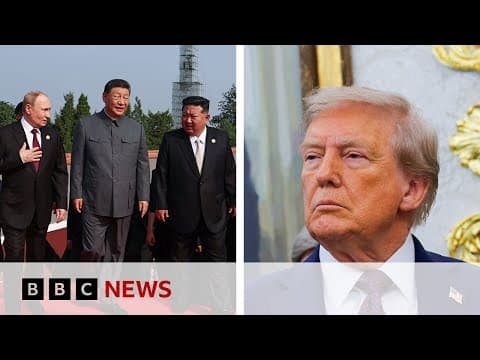
[0:15]celebrating the end of the Second World War in Asia. Our China correspondent Steve McDonald has the latest for us. So the parade is over here and we are seeing traffic return to the streets of Beijing. It's not as busy as a normal working day yet. But the city's starting to get back to normal, and now it's a time to reflect on what this was all about. Now, naturally, it was a parade to mark the end of World War II in Asia. The Chinese government has also used it to show off its latest military kit. We've seen jets, helicopters, tanks, armored cars, underwater drones, lasers, intercontinental ballistic missiles. For this reason, some have questioned the event and said, Really, should we be worried that this country might start using this weapons as it flexes its muscles on the world stage? Xi Jinping would say no, you shouldn't be worried because this is actually peace through strength. Well, that's his argument anyway. Then there's the political aspect of this. China's leader with these other world leaders, including the likes of Kim Jong Un from North Korea, and Vladimir Putin from Russia. Now, he's accused of being a war criminal after invading Ukraine. And yet there they all are. It's a kind of challenge to the West saying we don't care about your sanctions, we can gather like this. And the argument would be that the West's influence is in decline because of the collapse of the leadership of the United States under Donald Trump. The US is going it alone, it's putting tariffs on its allies. Here's Xi Jinping with a message of stability. You can rely on this country and maybe it would be appealing to other countries. And yet others would say that really what Xi Jinping is doing is offering support to other authoritarian leaders. They might not mind though. There they all are up on Tiananmen Gate, watching the parade going through. And yet some in China have also questioned, is this how their country should be betrayed to the rest of the world? Military parades in this day and age. Isn't it something out of the Cold War? What about the new China, the China of ideas? Whatever happened to that? And yet others of course, especially those with a bit more of a nationalist bent, might love it. They might think, you know, people used to walk all over us. Now China fears no one and look at all that equipment. Of course for the Chinese government, if the worst from all of this is that others would fear them, maybe they'd take that because one of the key messages from today is that you can't push China around anymore. Steve McDonnell there in Beijing. President Trump, of course, not at the parade. He's made his views clear though on social media, talking about how many Americans died in China's quest for victory and glory. Let's have a look at this post on true social where he said President Xi and the wonderful people of China have a great and lasting day of celebration. But then he ended the post by saying, please give my warmest regards to Vladimir Putin and Kim Jong Un, as you conspire against the United States of America. The Kremlin's responded saying that Mr. Trump's comments were probably an ironic joke. Let's speak to Naomi Lim now, White House reporter at the Washington Examiner. A lot of different views on what exactly it is President Trump meant in this social media post, Naomi. What do you think, what are others saying? So I have asked the White House for clarification on it because it is a little bit different from what we heard him say in the Oval Office yesterday. A BBC colleague of yours actually asked him, you know, whether he is worried that China is setting itself up as a sort of, um, you know, an option, another option, um, in terms of leadership in the world. And he downplayed the concerns. He sort of said, no, he doesn't believe that that is the case. You know, in fact, China needs the US, you know, whether it's economically, particularly as the tariff war, um, and trade deals are are ongoing. And so I think that, you know, there's this sort of, um, you know, approach to foreign policy within the within the Trump administration that I think they're still figuring out because we even saw in the Oval Office yesterday. I I assume going into the day that they would try to, you know, portray strength or something like that to, you know, create this political split screen from what we've been seeing all weekend from China. You know, not only was the meeting, uh, there were high-profile meetings between President Xi and President Modi of India. But now obviously this huge military display. And we were sort of surprised yesterday because it was mainly an announcement about, um, the US Space Force. And so I think we'll see sort of an adjustment with that today, particularly after we saw this, uh, truth, uh, social post from the President.


