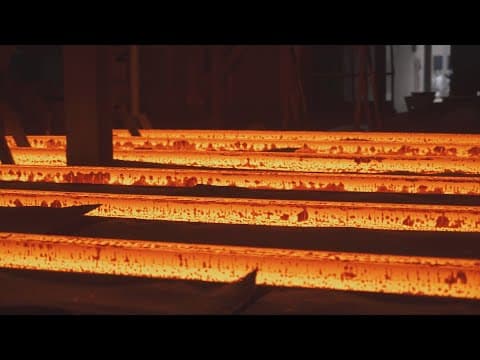
[0:00]Steelmaking began around 1800 years ago in ancient China, but it became more widespread with the advent of the Bessemer process in the mid-19th century. The most famous early steel-made object is the Eiffel Tower in Paris, completed in 1889. It was one of the first large structures to be made from wrought iron and steel, showcasing the strength and versatility of steel in construction. Steelmaking often starts with a powerful magnet capable of lifting up to 5 tons of scrap metal. This metal, once collected, will undergo a transformation into steel bars or pipes. The scrap is then placed into a large basket, which weighs itself a hefty 30 tons, yet has the capacity to hold up to 60 tons of metal. Now the metal is ready to be melted in a furnace that reaches temperatures around 1600 degrees Celsius, hot enough to turn the metal into a molten liquid. It is heated by electrodes and natural gas burners. The contents of the basket are poured into the furnace, where the metal pieces mix with the molten steel, which remains at the bottom. At these extreme temperatures, the 60 tons of metal will melt in approximately 1 hour. This process triggers a reaction, while an aeration system works to vent the smoke generated. Next, the cover is placed on the furnace, and the ventilation system, including the fume hood and exhaust fans, is activated to manage the fumes. This system draws out the smoke produced during the melting process. As the metal melts, impurities within the liquid rise to the surface, where they form a layer. At this point, a technician collects a sample of the steel and assesses its chemical structure. Next, a supersonic oxygen lance is employed. The lance injects oxygen into the molten steel, lowering its carbon content, homogenizing the mixture, and accelerating the melting process. A ladle is placed beneath the furnace to receive the molten steel. The liquid steel flows smoothly from the furnace into the ladle. The ladle can hold up to 115 tons of molten steel. An overhead crane, capable of lifting 180 tons, transports the ladle filled with steel. Additives are then introduced to achieve the desired steel composition. At this stage, the electrodes are removed from the furnace ladle. The pouring nozzles of the distributor are opened, allowing the molten steel to flow through the four pouring holes into the molds. As it enters the molds, the steel rapidly cools and begins to solidify. Steel billets are produced in lengths that can vary widely. Typically ranging from several meters to over 10 meters. The billets are transferred to the flattener, where powerful rollers compress them, shaping them into the required form and size. As the production process nears completion, the steel shapes move along a conveyor at a controlled pace. Once they reach their target dimensions, they're placed on a cooling bed, ensuring they cool evenly across their entire length. Thank you for watching, and see you in another episode.
How Steel Is Made
How It's Made
3m 44s500 words~3 min read
YouTube auto captions
Transcript source
YouTube auto captions
This transcript was extracted from YouTube's auto-generated caption track. The transcript below is server-rendered so it can be read, searched, cited, and shared without opening the original YouTube player.
Pull quotes
[0:00]Steelmaking began around 1800 years ago in ancient China, but it became more widespread with the advent of the Bessemer process in the mid-19th century.
[0:00]The most famous early steel-made object is the Eiffel Tower in Paris, completed in 1889.
[0:00]It was one of the first large structures to be made from wrought iron and steel, showcasing the strength and versatility of steel in construction.
[0:00]Steelmaking often starts with a powerful magnet capable of lifting up to 5 tons of scrap metal.
Use this transcript
Related transcript hubs
Watch on YouTube
Share
MORE TRANSCRIPTS


