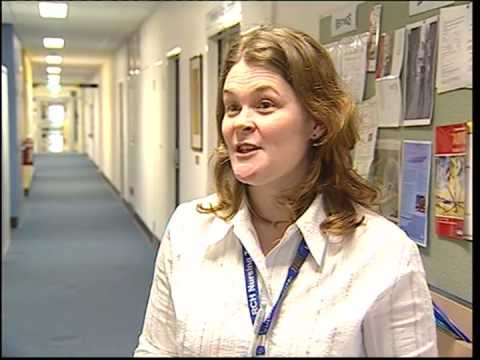
[0:04]How you going? Good, thank you. How are you? Great. Are we all ready to come in? Yep. Okay, what we need to do is just uh get you weighed. You okay? So come down this way. The Royal Children's Hospital in Victoria is one of the world's leading hospitals in the treatment of epilepsy. The nurses who work in the hospital's neuroscience ward are specialists in epilepsy nursing and use their skills to help families negotiate both the management of their child's condition and the hospital system. Well, I work in the Neuro Science Centre here at the Children's Hospital and so we are uh managing families and children who have a variety of neurological conditions. Our department is one of the leading epilepsy um communities within all of Australia and actually internationally. We bring families from different countries, from Fiji, from New Zealand, even from the United States to come here for our specialized treatment. Without the Children's Epilepsy program, um there'd be a lot of children out there who wouldn't strive to make the best of having epilepsy or for actually having their epilepsy cured. Epilepsy is a disorder of the brain where the electrical activity is not working properly. Um and often um it presents as some sort of seizure and most people in the community would um recognize a seizure as when someone falls to the ground and will have um movements of um their arms and legs, sort of shake and may make um noises. Um but but seizures can um present in in very in many sort of types. From just blank staring to perhaps just one arm moving or maybe just their head turning to the side. So, I guess that's how I would describe it.
[1:56]My role as an epilepsy nurse coordinator and um so I'm involved with educating families um in management of epilepsy at home. We coordinate families who are coming for what we call video EEG monitoring. So that's a special um EEG that needs to be conducted as an inpatient in the hospital where they're video camera, they're video tape um with electrodes on their head so we capture the seizure electrically and also um in full view of the camera. And we also are involved in coordinating families who are coming for surgery and a surgical workup.
[2:33]Families have have um different ways that they have to cope with seizures. Um they also have to deal with investigations and often lots of appointments with doctors and other therapists maybe. Um so uh as part of our role, we try to um coordinate that type of process so that families get to see the doctors and the therapists on the same day and get to see us um as well. And it's my role to be there as a person to find resources for them. Or even just to be a person on the end of the phone when they ring up and say they've just done this and I'm not quite sure and I just reassure them. And go and find the doctors and just to coordinate everything like that and to support the families on a day-to-day basis. Where we need to go and these epilepsy nurses are passionate about their job. And have the satisfaction of knowing that they can make a real difference to the families they deal with. Well, I hope that they've a got someone they can call to call any time that they're in trouble. We um we often do a lot of phone um contact with families. So we're almost like a first point of call for some of them. Um I like to think we make a difference for them when we are trying to coordinate appointments. Um that's all streamlined. So they don't have to come uh you know, five different days for different appointments, can all be on the one day. And I like to think that the families and I we've developed a relationship and a rapport and um that they can um call about not just I guess medical problems but to talk about other issues that might be out there. And that I'll hopefully have a sympathetic ear and um that's how I hope to make a difference. Neurosurgery and epilepsy, I find exceptionally fascinating and it's just developing more and more each year. Um we're seeing so much progress and so many benefits for the children these days that we weren't seeing even a decade ago. Um so I suppose that's why I love my job and to chat to the families and I love children. Um so I get to combine it all really. I love that every day is different. There is we come to work and it's not the same. Um I can be uh thinking I might be going to be doing one thing one day, say perhaps just going to clinic. But then my day um changes dramatically if say I need to help a family or um some staff need help with education on the ward or something like that. So it's just so varied and and very challenging and dealing with um kids, best part of my job.