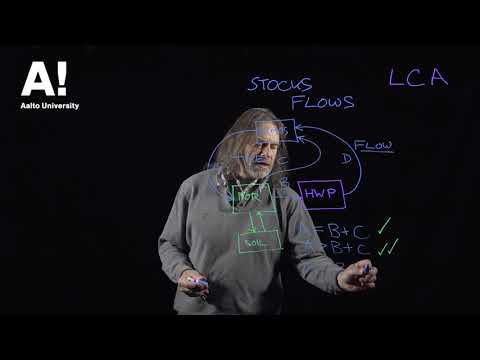
[0:10]So, I can't emphasize enough that we need to know the difference between stocks and flows, we need to remember the difference between stocks and flows. So I drew this diagram before, there's the atmosphere, and then we have the forest, which I'll do in green. So there's the forest. Now, when we look at the forest, we might be looking just at the trees in the forest because that's what's called the above ground biomass. But the forest above ground is communicating, when I say communicating, it means there's a carbon flow with the soil. This isn't a course on forestry but forest soils are extremely important when we look at the carbon cycle and we have an exchange of carbon between the soil and the forest. And of course we have a flow of carbon between the atmosphere and the forest. And rather than draw that line where the trees are decaying, carbon dioxide is being given off by aerobic respiration, the carbon dioxide is returning the atmosphere, we will put another box in there. And we will call that harvested wood products. HWP and the carbon or some of it is taken from the forest and goes into harvested wood products. Over a period of time that wood may be burnt, maybe. Um and possibly we're using that for energy recovery so eventually that carbon will return to the atmosphere. So the important thing when we do an analysis of that type is to consider the length of time that the carbon's in these different pools and also to measure what the flow is. So the rate at which this goes in and empties will determine whether this pool is getting bigger or smaller. Okay, so here we have a very simple carbon flow system. Um we've got the atmosphere communicating with the forest, so we've got this flow A into the forest. And then we've got flows out, we've got this natural flow which is to do with wood decay, um loss due to storm damage such as wind, just senescence trees getting old, maybe fire. And eventually all that wood will turn into carbon dioxide and that will return to the atmosphere and then we have this flow into this harvested wood products pool and then eventually the harvested wood products will be taken out of that pool. Uh they will be oxidized and that carbon dioxide will return to the atmosphere. The soil forest communication is pretty complicated and it isn't really part of what I want to talk about. So for this flow to be um in balance, so that the atmosphere and the forest is in balance, we want the flow A into the forest to be equal to the flow out of into the into the harvested wood products pool and the natural flow. To at least be equal. So that situation is okay, that's an equilibrium situation, everything's in balance. Even better would be if the forests are actually increasing so that we're getting more wood, more carbon stored in the wood and the soil of the forest then is flowing out through natural processes and through harvested wood products. That's a even better situation from the point of view of climate change mitigation. This is the situation for nearly all forests in Europe at this time, they're actually increasing in size, that that increase yearly increase in in timber is called the increment, the yearly increment. However, if we have a situation where the flow into the forest is less than the flow out, so that this flow A is less than the flow B plus C. That is not a good situation, it means the forests are decreasing in size and eventually of course they would disappear entirely. So if you want a nice simple definition of sustainability, this is sustainable, this is sustainable and this is not sustainable. So stocks and flows of natural um materials, carbon flows is a very good way of thinking about sustainability. And this type of material that we produce in the forest is referred to as a renewable material. And as I say, under these situations that one and that one that is also then sustainable. You will see the word sustainable used far too much and you see it associated with all sorts of things that really aren't sustainable. But under the situation here and here, that is sustainable production of timber.
Life Cycle Assessment (3) Carbon stocks and flows
Aalto University - Wood Science
6m 2s742 words~4 min read
YouTube auto captions
Transcript source
YouTube auto captions
This transcript was extracted from YouTube's auto-generated caption track. The transcript below is server-rendered so it can be read, searched, cited, and shared without opening the original YouTube player.
Pull quotes
[0:10]So, I can't emphasize enough that we need to know the difference between stocks and flows, we need to remember the difference between stocks and flows.
[0:10]So I drew this diagram before, there's the atmosphere, and then we have the forest, which I'll do in green.
[0:10]Now, when we look at the forest, we might be looking just at the trees in the forest because that's what's called the above ground biomass.
[0:10]But the forest above ground is communicating, when I say communicating, it means there's a carbon flow with the soil.
Use this transcript
Related transcript hubs
Watch on YouTube
Share
MORE TRANSCRIPTS


