[0:05]In the aftermath of the First World War, Germany stood amid physical ruin and moral disorientation. The war had ended not with a decisive victory or negotiated settlement, but with sudden collapse. To many Germans, the armistice of November 1, 1918, felt less like an end than a betrayal. The army had not been decisively defeated on German soil, and this perception gave rise to the belief that the nation had been stabbed in the back by internal enemies, rather than overcome by external force. This myth, though false, took deep root in the public imagination and became a powerful emotional framework through which later political rhetoric would operate. The Treaty of Versailles intensified this sense of humiliation. Germany was stripped of territory, deprived of its colonies, limited in its military capacity, and held solely responsible for the war. The reparations imposed were widely perceived as crushing and unjust, not only by nationalists, but also by ordinary citizens struggling to survive. These terms were experienced less as diplomatic penalties and more as a collective punishment, fostering resentment toward both the victorious powers abroad and the new democratic leaders at home who had signed the treaty. Economically, the situation was catastrophic. Demobilized soldiers returned to cities where factories were closing and jobs were scarce. Inflation steadily eroded wages and savings, culminating in the hyperinflation crisis of the early 1,920 seconds, when money lost value so rapidly that salaries were spent immediately before they became worthless. Middle class families saw lifetimes of savings vanish, and social status collapsed along with economic security. This destruction of stability bred anger, fear, and a desperate search for explanations. Politically, the new Weimar Republic struggled to establish legitimacy. It was associated in the public mind with defeat, surrender, and foreign domination. Parliamentary democracy, unfamiliar and fragile, appeared weak and indecisive in the face of crisis. Governments rose and fell with alarming speed, reinforcing the impression that the nation was being governed by incompetence rather than authority. Street violence between rival political factions became common, further undermining confidence in democratic order. In this atmosphere of chaos, extremist movements found fertile ground. The far left promised revolutionary transformation modeled on the recent Bolshevik Revolution in Russia, alarming conservative and middle-class Germans who feared social collapse. The far right, meanwhile, promised restoration of order, of pride, of national greatness. It was within this volatile space that radical nationalist figures began to attract attention, not because they offered realistic solutions, but because they spoke with certainty in a time of doubt. Psychologically, the population was prime for messages that simplified complex realities. War, economic collapse, and political instability were difficult to comprehend as the result of interconnected global forces. It was far easier to accept narratives that assigned blame to identifiable groups or individuals extremist. Rhetoric thrived by reducing history to moral struggle, portraying the nation as an innocent victim and its enemies as deliberate conspirators. Social divisions deepened as trust eroded. Veterans felt abandoned by the state they had served, workers felt exploited and insecure, the middle classes felt dispossessed and humiliated. Traditional institutions monarchy, church, and imperial authority had lost their former power to unify society. In their absence, radical ideology stepped forward, offering identity and belonging to those who felt displaced by modernity and defeat. Public discourse itself grew harsher. Political meetings were loud, emotional, and confrontational. Speeches were designed less to persuade through reason than to mobilize through passion. The line between truth and exaggeration blurred, as audiences demanded not careful analysis, but emotional release. In such settings, figures who spoke with dramatic intensity and moral certainty were rewarded with attention and loyalty. Cultural anxiety also played a significant role. Rapid social change, urbanization, and the perceived breakdown of traditional values created fear of moral decline. Modern art, new gender roles, and cosmopolitan culture were seen by some as symptoms of national decay, rather than expressions of freedom. Extremist movements exploited these anxieties by presenting themselves as defenders of tradition against corruption and chaos. By the early 1,920 seconds, Germany was not merely suffering from hardship. It was suffering from a crisis of meaning. Many Germans no longer believed that existing institutions could explain their suffering or guide them toward recovery. In this vacuum, radical narratives flourished. They offered clarity where reality was complex, certainty where democracy hesitated, and identity where social cohesion had fractured. It was this convergence of humiliation, economic despair, political instability, and psychological vulnerability that made post-World War I Germany exceptionally receptive to extremist ideologies. Scapegoating has long been a recurring feature of political life in times of crisis, but in post-World War I Germany, it assumed a particularly dangerous form. Faced with military defeat, economic collapse, and social fragmentation, political actors seeking power found it easier to redirect public anger than to confront the true causes of national failure. Scapegoating provided a simple and emotionally satisfying explanation for complex problems, transforming uncertainty into certainty and fear into directed hostility. In this environment, political rhetoric increasingly relied on identifying internal enemies, rather than addressing structural weaknesses. Economic hardship, inflation, unemployment, and social change were not explained as the result of global forces, wartime devastation, or policy failure. Instead, they were reframed as deliberate acts carried out by specific groups, allegedly operating against the nation's interests. This strategy allowed leaders to position themselves as defenders of the people, while absolving themselves of responsibility for realistic solutions. Scapegoating function by personalizing abstract crises. A collapsed currency is difficult to understand, a named enemy is not. By attaching national suffering to identifiable targets, politicians could give shape to public frustration and offer emotional release. Anger that might otherwise be directed at the state, the military leadership, or economic systems was redirected toward minorities who lacked the power to defend themselves. This redirection preserved existing hierarchies, while appearing revolutionary. The effectiveness of scapegoating depended on repetition and simplification. Complex historical narratives were reduced to moral dramas in which the nation was portrayed as innocent and virtuous, while the scapegoated group was depicted as corrupt, parasitic, or disloyal. These narratives did not require factual accuracy. They required emotional resonance. Once embedded in public discourse, they became self-reinforcing, as economic hardship or political instability was continually interpreted as confirmation of the original accusation. Language played a central role in this process. Political speeches avoided nuance and embraced absolutes. Words such as betrayal, degeneration, and conspiracy replaced measured analysis. Metaphors drawn from disease and decay were used to describe social problems, subtly framing targeted groups as threats to the body of the nation. Through such language, prejudice was transformed into a perceived necessity for national survival. Scapegoating also served an organizational purpose. It created a sense of unity among supporters by defining identity through opposition. To belong to the political movement was to reject the scapegoated group. Loyalty was demonstrated not through constructive participation, but through shared hostility. This mechanism was especially powerful in a society fractured by class, ideology, and regional differences, as it offered a unifying enemy when positive consensus was difficult to achieve. Importantly, scapegoating did not emerge spontaneously from the population alone. It was actively cultivated. Political leaders, propagandists, and sympathetic media amplified existing prejudices and recast them as political truths. Longstanding social biases were repackaged into modern ideological frameworks, giving old hatreds a new sense of urgency and legitimacy. What had once existed on the margins of society was brought into the center of political life. The strategic value of scapegoating lay in its ability to deflect accountability. As long as national problems could be blamed on an internal enemy, failed policies and ineffective governance escaped scrutiny. Each new crisis was explained not as evidence of flawed leadership, but as proof that the enemy was still active and must be confronted more aggressively. This logic created a cycle in which increasing repression was justified by the continued existence of the scapegoated group. Social consequences followed quickly. Trust between communities eroded as suspicion replaced solidarity. Ordinary social interactions became politicized, and neighbors were encouraged to view one another through ideological lenses. The idea of shared citizenship weakened as belonging came to be defined by conformity rather than participation. In such an atmosphere, exclusion appeared not as injustice but as protection. Scapegoating also reshaped moral boundaries. Actions that would previously have been considered unethical or illegal were reframed as defensive measures. Discrimination was described as necessity, exclusion as responsibility, and cruelty as resolve. By shifting moral language, political actors normalize behavior that undermined legal equality and human dignity, while presenting themselves as guardians of the national future. Over time, scapegoating hardened into doctrine. What began as rhetorical strategy became embedded in party platforms, educational narratives, and public institutions. The line between propaganda and policy blurred as ideological claims were translated into administrative action. This transition marked a point at which scapegoating ceased to be merely a tool of persuasion and became a foundation of governance. In this way, scapegoating functioned not simply as an expression of prejudice, but as a calculated political strategy. It offered explanation without responsibility, unity without justice, and action without solutions. By exploiting fear and simplifying reality, it allowed ambitious leaders to mobilize mass support while dismantling the very principles that might have protected society from catastrophe. Propaganda that relies on emotion rather than evidence thrives in moments when societies are overwhelmed by fear, uncertainty, and grievance. In post-World War I Germany, political communication increasingly shifted away from rational debate and factual analysis toward appeals that stirred anger, resentment, and wounded pride. Emotional propaganda did not seek to inform the public, but to move it, replacing critical thought with visceral reaction, and transforming politics into a theater of feeling rather than reason. This form of propaganda worked by simplifying reality. Economic collapse, international diplomacy, and social change are complex phenomena that resist easy explanation. Emotional messaging reduced these complexities into stark moral narratives that could be understood instantly. Instead of examining inflation, global markets, or policy failures, audiences were presented with dramatic stories of betrayal, corruption, and deliberate harm. These stories were designed not to withstand scrutiny, but to provoke outrage and a sense of urgency. Fear was one of the most powerful tools employed. Propaganda portrayed the nation as being under constant threat, not only from external enemies, but from forces within. This created a permanent state of psychological alarm, in which calm evaluation seemed irresponsible. When people are afraid, they are less likely to question claims and more likely to seek strong voices that promise certainty and protection. Emotional propaganda exploited this instinct by presenting itself as the only barrier between society and chaos. Repetition played a crucial role in replacing evidence with belief. Assertions were repeated so frequently that they acquired the appearance of truth, regardless of their factual basis. The same accusations, slogans, and phrases echoed across speeches, posters, and publications, until they became familiar, and familiarity bred acceptance. Over time, repetition eroded skepticism, making unverified claims feel self-evident, simply because they were constantly heard. Language was carefully chosen to bypass reason and target instinct. Propaganda relied on charged words that carried moral judgment, rather than descriptive accuracy. Terms associated with decay, infection, and invasion were used to describe social and political challenges, triggering disgust and fear, rather than thought. By framing issues in biological or existential terms, propaganda suggested that compromise was impossible and that extreme responses were justified. Visual imagery reinforced these emotional appeals. Posters, symbols, and staged public events were designed to evoke pride, anger, and unity. Dramatic contrasts between idealized images of the nation and grotesque depictions of perceived enemies created a powerful emotional binary. These images did not argue, they asserted. They left little room for interpretation and discouraged critical engagement by overwhelming viewers with feeling. Public gatherings amplified the emotional impact. Mass rallies transformed individual emotions into collective experience, creating a sense of belonging and shared purpose. The atmosphere of crowds, music, flags, and ritual intensified emotional responses and reduced personal restraint. In such environments, skepticism felt isolating, while emotional conformity felt like loyalty. Propaganda thrived in these spaces, because it merged personal identity with collective emotion. Another key feature was the selective use of facts. Emotional propaganda did not avoid facts entirely. It distorted and isolated them. Partial truths were removed from context and presented as definitive proof of sweeping claims. Contradictory evidence was ignored or dismissed as deception. This approach gave propaganda a superficial appearance of credibility, while preventing genuine understanding. Intellectual authority was often mimicked to lend emotional claims of veneer of legitimacy. References to history, science, or economics were made without rigorous support, using technical language to intimidate rather than clarify. This false scholarship appealed to audiences who sought reassurance that their emotions were justified by reason, even when the underlying arguments were deeply flawed. The press and emerging mass media played a significant role in spreading emotionally driven narratives. Sensational headlines and provocative language captured attention more effectively than measured reporting. As competition for readership increased, dramatic stories were rewarded, further blurring the line between information and manipulation. Emotional impact became a currency, and accuracy was often secondary. Over time, emotional propaganda reshaped public perception of truth itself. Facts that aligned with emotional narratives were accepted readily, while those that challenge them were rejected outright. Disagreement came to be seen not as difference of opinion, but as hostility or betrayal. In this climate, evidence lost its power to persuade, and emotion became the primary measure of credibility. This reliance on emotion also altered political expectations. Citizens no longer demanded detailed plans or realistic solutions. They demanded affirmation of their feelings. Leaders who could articulate anger and promise vindication were favored over those who spoke cautiously or emphasized complexity. Political success became tied to emotional performance, rather than competence or integrity. As emotional propaganda deepened its hold, it narrowed the space for independent thought. Nuance was dismissed as weakness, and doubt was framed as disloyalty. Public discourse hardened into slogans and chants, leaving little room for reflection. In such conditions, propaganda did not merely influence opinion. It shaped how people thought, felt, and interpreted reality itself. Through these methods, emotion replaced evidence as the foundation of persuasion. Politics became less about understanding the world and more about reacting to it. This transformation proved profoundly destabilizing, as decisions driven by fear and resentment displace those guided by reason and empathy, altering the course of history with devastating consequences. Rhetoric often marks the earliest and most underestimated stage in the descent toward mass violence. Long before laws are written or weapons are raised, language begins to reshape moral boundaries and redefine how people perceive one another. In periods of instability, words acquire heightened power, not merely to describe reality, but to reconstruct it. When rhetoric shifts from describing political opponents to portraying groups of people as threats, burdens, or enemies, it initiates a process that gradually erodes ethical restraint. This transformation begins with dehumanization. Through repeated speech, entire communities are reduced to abstractions, stereotypes, or symbols. Individuals cease to be seen as neighbors or fellow citizens, and are instead spoken of as forces, dangers, or conditions. Such language removes personal identity and replaces it with collective guilt. Once people are discussed as a problem, rather than as human beings, moral concern for their suffering diminishes. Rhetoric also normalizes exclusion by redefining belonging. Political language begins to draw rigid lines between those who are said to represent the nation and those who allegedly threaten it. Citizenship becomes conditional, tied not to law or shared humanity, but to ideology, culture, or ancestry. This narrowing of belonging is achieved gradually, often framed as common sense or self-preservation, rather than injustice. Each rhetorical step appears minor in isolation, yet together they fundamentally alter how society understands equality. Another critical function of rhetoric is the gradual desensitization of the public. Statements that initially shock or provoke discomfort are repeated until they lose their emotional impact. What once seemed extreme becomes familiar, and familiarity reduces resistance. As boundaries shift, language that would previously have been condemned as hateful or dangerous begins to be tolerated, then accepted, and eventually echoed by others. Silence in response to such speech further reinforces its legitimacy. Moral inversion plays a central role in this process. Rhetoric reframes harmful actions as virtuous, and restraint as weakness. Aggression is described as courage, cruelty as necessity, and exclusion as responsibility. By altering moral language, speakers create a framework in which harmful intentions are perceived as ethical obligations. This inversion allows individuals to support or participate in injustice, while believing themselves to be acting honorably. Fear intensifies the effect of such rhetoric. When language constantly emphasizes danger and urgency, it creates a climate in which extraordinary measures appear justified. The repeated assertion that society is on the brink of collapse fosters impatience with legal norms and ethical constraints. Under these conditions, calls for moderation or due process are portrayed as naive or even treacherous. Rhetoric thus accelerates the willingness to abandon protections that once seemed inviolable. Rhetoric also prepares the ground for obedience. By presenting events as part of an inevitable struggle, it diminishes the sense of individual agency. People are encouraged to see themselves as instruments of historical necessity, rather than moral decision-makers. This framing reduces personal responsibility, making it easier for individuals to comply with unjust policies or orders. If actions are portrayed as unavoidable, resistance appears futile or irresponsible. The cumulative effect of such language is a profound shift in social norms. Discrimination becomes discussable, then debatable, then defensible. Violence is first implied, then justified, then demanded. Each rhetorical escalation tests the limits of public acceptance, advancing only as far as society allows. When no effective resistance emerges, the next step follows. In this way, rhetoric functions as a rehearsal for action, conditioning both perpetrators and bystanders for what is to come. Institutions are not immune to this process. Courts, schools, and administrative bodies absorb the prevailing language of the time. As rhetoric hardens, institutional language follows, translating ideological claims into bureaucratic terms. What began as inflammatory speech gradually becomes official terminology, lending authority and permanence to ideas that were once openly radical. The transition from speech to policy occurs quietly, often without dramatic rupture. Perhaps most dangerously, rhetoric reshapes memory and expectation. Past injustices are reinterpreted as necessary corrections, while future violence is framed as preventive or restorative. By controlling the narrative of time, what has happened, and what must happen, rhetoric narrows the moral imagination. Alternatives disappear, and the path toward atrocity begins to seem not only possible, but logical. Throughout history, the progression from rhetoric to atrocity has followed this pattern. Mass violence does not erupt suddenly from silence. It grows from words spoken repeatedly, publicly, and without consequence. Each phrase that diminishes empathy, each metaphor that equates people with threats, and each speech that justifies exclusion contributes to an environment in which violence can occur without moral shock. In this sense, rhetoric is not merely a precursor to atrocity, but an essential component of it. It lays the psychological and cultural groundwork that makes large-scale harm conceivable, and eventually acceptable. By the time violence begins, language has already done much of its work, reshaping conscience, dulling compassion, and redefining cruelty as necessity.
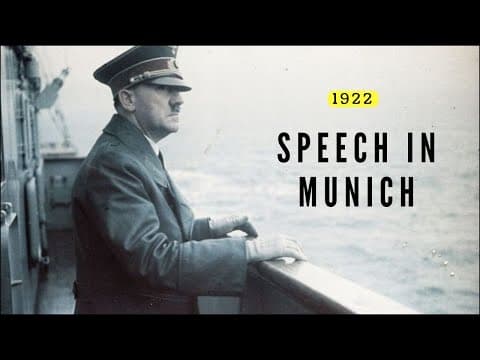
Hitler Speech 1922: "The Jewish Question"
History Retold
23m 13s3,214 words~17 min read
Auto-Generated
Watch on YouTube
Share
MORE TRANSCRIPTS