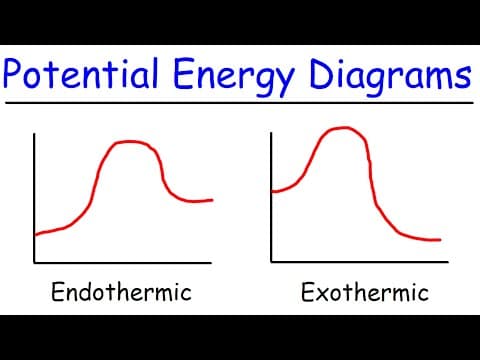
[0:01]In this video, we're going to talk about endothermic and exothermic reactions. In an endothermic reaction, the enthalpy change is positive. Heat energy is absorbed by the system. So that's the keyword that you want to take into account when dealing with endothermic reactions. Now, for an exothermic reaction, heat energy is actually released by the system and so the enthalpy change is negative for an exothermic process. Now let's talk about the potential energy diagrams for these two concepts.
[0:45]So on the Y-axis, this is going to represent the potential energy of the system. The X-axis will be the reaction coordinate. So we're going to have a graph that looks something like this. What you need to know is that the potential energy of the products is greater than that of the reactants for an endothermic reaction. The energy of the system has to be going up. The enthalpy change is the difference between the energy of the products and the energy of the reactants. At the top, this is known as the transition state. In order for the reaction to proceed, the reactants need to acquire enough energy to reach the transition state. Now the difference between the energy of the transition state and the reactants is known as the forward activation energy. The difference between the energy of the transition state and the products is the reverse activation energy. In order to go from the reactants to the transition state, you need to have enough energy to get there. The amount of energy needed has to be equal to or greater than the forward activation energy. Now, going in the other direction, let's say if you want the reverse reaction to proceed, the minimum energy that you need is equal to the reverse activation energy. The enthalpy change of this reaction is the difference between the forward activation energy and the reverse activation energy. It's also equal to the products minus the reactants. So for an endothermic reaction, the product is going to be higher in energy than the reactants. Now, let's see what the situation is when dealing with an exothermic reaction. So for an exothermic reaction, the energy of the reactants will be greater than the energy of the products. So note that the product is lower in energy than the reactants.
[3:05]Delta H is still the difference between the energy of the products and the energy of the reactants, but for an exothermic reaction, what's different is that the product is lower in energy. Whereas, in an endothermic reaction, the product is higher in energy. But the same formula is still applied. Delta H is still product minus reactant. And this is still the reverse activation energy. The forward activation energy is still the difference between the transition state and the reactants. So that's the same for both endothermic and exothermic reactions. Now, let's talk about the effect that a catalyst has on the potential energy diagram. So, let's say we have an exothermic reaction, and this is a non-catalyzed reaction. How will this potential energy diagram change if we were to add a catalyst to the system? If we were to add the catalyst to the system, this is what's going to happen. I'm going to draw the new graph in blue.
[4:26]Let me just use a straight line.
[4:38]Note that adding the catalyst doesn't change the energy of the reactants, nor does it change the energy of the products. However, adding a catalyst does change the energy of the transition state. And as a result, note what happens to the forward activation energy. So this is the forward activation energy before the catalyst was added. And this is the new activation energy after the catalyst has been added. So with a catalyst, notice that the activation energy, the difference between the energy of the transition state and the energy of the reactants, that has been reduced. So when you add a catalyst to a reaction, the activation energy decreases. Now, how does that affect the speed of the reaction? Let's call this TS1 and TS2. TS1 is at a higher energy, so that's going to be a slow reaction. TS2 is the catalyzed reaction. Because the activation energy has been reduced, that reaction will occur faster. So the effect of adding a catalyst in a chemical reaction increases the speed or the rate at which the reaction occurs. And it does so by lowering the activation energy of the transition state. Now let's analyze another potential energy diagram. Now, this time, this is going to be a multi-step energy diagram.
[6:30]So this is the reactants, the products, this is the first transition state, and this is the second transition state. And here we have the intermediate.
[6:45]Now, which step is the slow step? Would you say the slow step is the first step or the second step? Notice that TS2 greatly exceeds TS1. So the energy of activation is very high. So the second step is the slow step in this chemical reaction. The first step is the fast step because the transition state is lower in energy in the first step than it is in the second step. So whenever you see this big hill, it that's the slow reaction. That's is going to take a lot of energy to go up that hill. So that's the slow step. Now the first step, would you say it's an endothermic step or an exothermic step? Going from reactant to intermediate, notice that we're going down the potential energy diagram. So that's going to be an exothermic process. Delta H is negative.
[7:48]Now going from the intermediate to the products, we're also going down the potential energy diagram.
[7:57]So that's another exothermic step. So overall, this reaction is exothermic, energy is being released. Now, here's a question for you: when ice melts into liquid water, is this an endothermic process or an exothermic process? What would you say?
[8:21]So ice is basically H2O in the solid state, and water is H2O in the liquid state. Is energy being absorbed or released? Well, we know the answer is you need to add heat.
[8:38]If you were to put ice on a stove and turn it up, it's going to melt.
[8:46]And so melting ice is an endothermic process. The enthalpy change is positive. And let's go over the enthalpy changes of all the phase changes that we need to be familiar with. So, going from a solid to a liquid to a gas, this process is endothermic. You need to add energy to it. So going from a solid to a liquid, that's known as melting, that's an endothermic process. Going from a liquid to a gas, that is vaporization, that's also endothermic. If you were to take liquid water, put it in a pot, increase the temperature of the stove, the water is going to boil, it's going to vaporize into steam. So you got to put energy to turn the liquid into a gas. And if we go directly from a solid to a gas, this is known as sublimation.
[9:43]That also requires energy, that's an endothermic process. A good example of that is dry ice, which is basically solid carbon dioxide. With a little heat added to it, it'll easily go into the gaseous state. Now going in the other direction, from a gas to a liquid to a solid, this is an exothermic process. Energy is released. So going from a gas to a liquid, this is known as condensation, that's an exothermic process. Going from a liquid to a solid, this is known as freezing. When you put water in a freezer, you're taking away the thermal energy from the water molecules, you're removing energy from it, and it becomes ice. So that's an exothermic process because the water molecules are giving away heat energy into the freezer. Now going from a gas to a solid, this is known as deposition. That's also an exothermic process. So that's basically it for this video. Hopefully, it gave you a good introduction into endothermic and exothermic processes, and also the potential energy diagrams associated with them.


