[0:13]So in this next module, we're going to talk about the introduction section. So after you've written your tables and figures and your results and your methods, then you're ready to write the introduction. And the good news is that the introduction section is actually a lot easier to write than you may realize. So it follows actually a fairly standard format. So there aren't so many different ways that you can write that introduction section, which makes it easier. It's also fairly short. The typical introduction section is only three paragraphs long. Now you may not have realized that before, you may have thought it was much longer than that. Generally, I recommend for an introduction section no more than five paragraphs. So somewhere in the range of two to five and again, probably the most typical is three. So uh, the biggest mistake that people make when they're writing the introduction section is that they think it's supposed to be some kind of long, exhaustive review of your general topic. You've gone through your PubMed, you've gone and collected all of these papers, you've done all this great literature search, you've read up on the topic. You've got so much information, so you may feel like, oh, I've got to, you know, impart all of this information I've collected, I've got to impart it in the introduction. Um, but that in fact, is not the purpose of the introduction. The introduction section is focused around a very specific question, the very specific question or hypothesis, or aim of your study. And you shape the whole introduction section around that question or hypothesis. And so, for example, if you're writing a paper, you did a study on breast cancer and smoking, the link between breast cancer and smoking, you wouldn't write a whole bunch of background information about breast cancer, how bad it is as a disease and what all the causes are and all of that. You don't need to put any of that in the introduction. Similarly, you wouldn't put anything in about just in general, how bad smoking is. You're not going to spend a lot of time on that saying all the other diseases that smoking links to. You're going to quickly focus right on what is the potential relationship between specifically smoking and breast cancer. And you're really only going to talk about previous studies that have addressed that specific question. So it's a very narrow section, which actually means it's a little bit more, there's, there's only so many ways you can do it. It is pretty standard, uh, and I'll give you that standard format and you'll see that it's actually not that hard to write. So a really good way to think of the introduction is as a cone, as is pictured here. I, uh, this is a, a figure I borrowed from one of Thomas Annesley's papers. I mentioned, uh, the series in in Clinical Chemistry, again, a really good series to refer to. And he draws this nice little cone, and the idea here is that you're going to start with something general, and you're going to narrow down very quickly to your specific study. So you start your introduction by giving a quick little bit of background, context, don't spend too much time on that, and giving specifically the what's known about your hypothesis or question of interest. I'll give you some examples in a minute, but it would be something like, here are the, here's a little quick summary of all the other studies that have been done on breast cancer and smoking. Here's what they found. Then you quickly move to from the what's known to the what's unknown. So you quickly move to what are the gaps and limitations of all those previous studies that look specifically at smoking and breast cancer. Then you narrow down rather quickly even further to your specific hypothesis or question or aim of your study. And you actually want to have a clear statement in the introduction section towards the end of the introduction section that says, we hypothesize that. We wanted to answer the question of, we aimed to. And it's good to use that explicit language with those little keywords in there. We hypothesized, we aimed, because sometimes readers will just skim the introduction and they're looking for that. They're looking for that statement of what the purpose of your study was. So you quickly tell them what the main hypothesis or aim of your study was. And then you tell them a little bit about your experimental approach. Um, and you're going to say, how is your experiment looking at breast cancer and smoking different and new and how does it fill in the gaps and limitations of all those previous studies? So why did you need to do your study and how are you going to improve on all those other studies to answer your question of interest? Similarly, Mimi Zeiger in her book, um, that I've referred to before, she gives a similar structure for the introduction. So she says you start with what's known, so those are the previous studies. Then you give the what's unknown, the gaps and limitations in those previous studies. And then again, you move right to the specific statement about your purpose or question that you're trying to answer or hypothesis or aim. You're going to give that clear statement. We aimed to, we hypothesized that. And then you give a little teeny bit about your experimental approach. And you say why your experimental approach is new and different and important. In other words, how does it fill in the gaps in the previous literature in those previous studies. And you can kind of think of this as roughly three paragraphs, right? So paragraph one roughly could be the what's known. You don't always have to structure it this way, but you can see how this kind of naturally fits to three paragraphs. Paragraph two could be the what's unknown, the limitations and gaps in previous studies. You'll see that sometimes authors will switch between the what's known and what's unknown and, you know, might have that in multiple paragraphs. But you can kind of see why this often ends up as three paragraphs and then all of that last part, the question statement and your quick overview of your experimental approach and how yours fills in, your study fills in those gaps, that can be a third paragraph. So that's often roughly how it falls out. Now, it doesn't mean you always have to have three paragraphs, but this is a good way to organize it. So a couple tips for writing an introduction section. So one is I've told you it's only about three paragraphs, so you might think, well, then I've got to have these really long paragraphs. No, I actually mean three short paragraphs. So these don't have to be super long, they in fact should be nice and crisp and short. So keep your paragraphs short. Try to write as much as you can for a general audience. So technical details are going to have to appear in your manuscript, of course, but leave those for the technical section, for the materials and methods. The introduction is supposed to be a friendly introduction to what you did in your study, so there's no reason to fill it up with jargon and technical material. Really keep it clear and concise.
[7:05]And, uh, again, uh, as the I've shown you in the previous slide, you want to kind of take your reader step by step from what is known to what is unknown. End with your specific question. So we already kind of outlined that. I'm just going to repeat it because it's just such a nice way to put that known, unknown question.
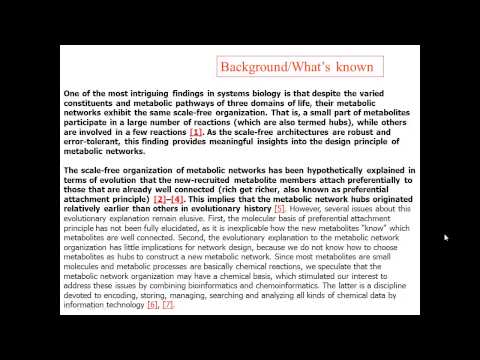
[7:29]You want to again, emphasize how your study fills in the gaps. So make sure you say specifically how your study fills in the gaps of the unknown, the, the previous literature, what's been unknown. And again, explicitly state your research question or aim or hypothesis. So say we asked whether, our hypothesis was, we tested the hypothesis that, our aims were. So in other words, as I mentioned before, your reader might skim your introduction and just look for that statement. I often do that when I'm reviewing papers. I kind of want to know exactly, well, what was their primary aim here? I'm skimming the introduction, looking for that statement. So make sure it's there and it's very clear and easy to find. The introduction section is not the place where you answer your research question. So you're not going to put results or implications in introduction. It's really setting up that question and then ending there. Another tip for the introduction section, one thing that people tend to do wrong is that they again, you've done all this literature search. You now know all these details about all these different studies and there's a temptation to go into nitty gritty detail about each study. Like you want to say, well, Jones at all did this case control study and but the problems with that study were X, Y and Z. And then Smith at all did this cross-sectional study and they're, the problems with that study were blah, blah, blah. So there's a temptation to want to go kind of through all the different studies that are out there in great detail because you've done all this research and you, you know, you now know all these details about all these different studies, you're going to be tempted to put it in, but it actually doesn't belong in the introduction section. You're going to see in the examples that I give you in a minute that for the most part, you're going to summarize at a very high level. So rather than getting into the nitty gritty details of specific studies, you're going to say, well, you know, here's the five studies that were done, you know, on breast cancer and smoking, and here's what they generally found. So you're going to summarize at a high level. You might go into some more details about those particular studies in your discussion, but that really belongs in the discussion section. All right, so let's jump into an example introduction section. And I'm just going to kind of go through it and show you, uh, notice first of all that this is only two paragraphs long and it was really easy for me to pop into a single PowerPoint slide. So that tells you that the introduction section again is fairly short. This is a particularly short one, um, but they're all close to this. They're not, they're not long. So let's kind of go through this and I'll show you all the elements that I was talking about. So first of all, this was about, um, potential, uh, risk factors for asthma. So they start with the what's known. Notice they don't give you like, well, asthma is an important problem. It affects a lot of children. We kind of all know that. So there's not a lot of kind of those high-level background information here. They just jumped right into what's known about their question of interest, which is what causes asthma. So they say exposures to secondhand tobacco smoke, road vehicle traffic, and diet are some of the most prevalent modifiable risk factors for asthma in children. So here are three things that other people previously have speculated are causes of asthma. Now, one of those we know with pretty good certainty. So the effect of parental smoking on asthma is well established. So that one we know pretty well. Um, however, now we're going to get to the what's unknown. The evidence for whether or not the road vehicle traffic and whether or not the diet and what elements of diet, the evidence there is a little bit less clear. So some studies have found that road vehicle traffic is a risk factor for asthma. Others have not found that, so there's some controversy, there's some unknown here. Also with diet, some studies, some dietary factors have been linked, asthma, but it's kind of unclear exactly which ones. So that's the unknown. Then we get back to a known. Sometimes you'll notice that authors will switch between the known and the unknown and that's okay. But they do know one particular dietary, particular dietary factor that seems to be consistently linked to asthma is fruit intake. So we've got sort of all the background, the what's known and what's unknown. Notice that the authors didn't give us any particular details about any of those studies one through thirteen that they're summarizing there. They just give you the high-level summary. Here's studies that found the link, here's studies that didn't. Now, we're going to jump right into the aim of this study. So what did they say? As part of an evaluation of the health benefits of this scheme, we have taken the opportunity to investigate notice the keyword there. We investigate the relative importance of fruit intake, exposure to secondhand smoke, and road vehicle traffic, those three risk factors, in determining the prevalence of asthma in over 11,000 children. So, they're telling you, here's our question and aim. We're going to look at those three risk factors in a really big sample of children. And it's a very clear statement of the aim of their study. Now, there's one thing I think that this very short introduction section is actually probably missing. Notice that they didn't explicitly tell the reader how this study is going to fill in the gaps and limitations of the previous studies. So they don't tell you, um, you know, how come this study is going to get it right when there's been controversy, especially about road vehicle traffic and diet in previous studies. So it would have been nice to have some explicit statement of that. You can probably make some guesses here though. Uh, this is a study of 11,000 children. I bet that a lot of those previous studies weren't so big and so maybe, uh, you know, they think the real strength is in the size of their study. Uh, it would be nice if they give us a little bit more in terms of why is their study better. All right, so here's another example. Notice again that this one is only two paragraphs long, slightly longer than the last, uh, example, but still only two paragraphs. So this one was looking at whether or not obesity and overweight was related to mortality from cancer. So they start with the what's known. So what do we know? So we know that if you're overweight or obese, that's been linked to death from all causes as well as from heart disease. That's well established. Um, we also know that there's some relationship between being overweight and obese and death from cancer. But there's a whole bunch of gaps in that. So here's the unknown. We don't know the magnitude of that relationship for all cancers or for cancers at individual sites. And the public health effect of excess weight in terms of total mortality from cancer is limited. So there's a lot of kind of unknown. So then they jump back to what is known. So we do know some things about some particular cancers. So we do know that uh, your adiposity is linked to some cancers, endometrium, kidney, gallbladder for women, breast for postmenopausal women, colon particularly in men, esophagus. However, they're jumping back now to what's unknown. Uh, there's these other cancers, pancreas, prostate, liver, cervix, etc., are actually the data are scarce or inconsistent. Notice how many studies they're citing here. They're citing a whole pile of studies. So they're giving a very high-level summary saying, well, we've got all of these other studies on these other cancers and we don't have a consistent result. That is we may, some studies may show one thing, some show next another, or there just may not be many studies on those particular organs. Now, they're going to specifically say the gaps and limitations in the previous studies. So here's a bunch of things that were wrong with the previous studies, which maybe why they were inconsistent. So one is that there's, first of all, a limited number of studies. So some some of these cancers may not have been well studied at all. And that's especially true that there are not that many studies that were prospective. And it's very important to be prospective when you're studying these kinds of things. There was also different ways that people categorized overweight and obesity. There was some potential biases introduced by smoking. And, um, people didn't do a good job maybe in these previous studies of always separating the difference between getting cancer and dying from cancer. And they specifically want to know about dying from cancer, not just about cancer incidence, that it's getting cancer. So those are all the gaps and limitations. They've nicely kind of lined them out for you. And then they get to their statement of their question of interest. So what did they do? We conducted a prospective investigation in a large cohort of US men and women to determine the relations between body mass index, the weight in kilograms divided by the square of the height in meters, and the risk of death from cancer at specific sites. So this is both a statement of what their aim was, they wanted to determine this relationship, and how what they did. They ran a prospective investigation in a large cohort. And they also tell you that this cohort's been used previously, so they're kind of verifying that this is a good dataset. They're looking at BMI rather than just arbitrarily categorizing overweight and obesity. They're looking at all these different cancers. They're investigation is prospective. So that's all the ways that they're doing better than the previous studies and they're hoping to be able to answer some of these questions. All right, so moving on to yet another introduction. So I told you that introductions are typically three paragraphs long and uh, the first couple examples I have in here actually only two paragraphs long. Um, but you can see, again, you can fit a whole introduction on a PowerPoint slide. So this one was looking at uh, a question in systems biology. So they start with giving you a little bit of background and some of what's known. So one of the most intriguing findings in systems biology is that despite the varied constituents and metabolic pathways of three domains of life, their metabolic networks exhibit the same scale-free organization. That is, a small part of metabolites participate in a large number of reactions, which are also termed hubs, while others are involved in a few reactions. They define that for you in case you're unfamiliar with this. So then they tell you that the scale-free organization of these networks has been hypothetically explained in terms of evolution. That the new recruited metabolite members attach preferentially to those that are already well connected, the rich get richer. This implies that the metabolic network hubs originated relatively earlier than others in evolutionary history. So here's some known and some kind of what people think about this topic. Now, here's the unknown. However, several issues about this evolutionary explanation that other people have positive remain elusive. That's a nice statement to tell you, hey, I'm about to tell you the unknowns and the gaps here. So here's all the gaps. First, the molecular basis of preferential attachment principle has not been fully elucidated. So we don't really know exactly how new metabolites would know which metabolites are well connected. How would they how would they kind of know that in evolution. And second, the evolutionary explanation to the metabolic network organization has little implications for network design. So that is even if we understood this well, we might not necessarily be able to use it for network design. So there's kind of some unknowns. And then we get to their study. So notice that nice statement, we speculate that that's the reader's clue that they're about to give their research question statement. So we speculate that the metabolic network organization may have a chemical basis, which stimulated our interest to address these issues by combining bioinformatics and chemoinformatics. And they actually give you a definition of chemoinformatics in case you're after that, in case you're unfamiliar with it. But again, they go from known, unknown to their specific study that nice statement of we speculate that. All right, another example. This one's actually three paragraphs long. So this one says exogenous estrogens. So these are, um, if you're taking estrogen pills, prevent or substantially retard the decrease in bone mineral density that accompanies menopause. So we know if you give estrogen pills to postmenopausal women that that will stop them from losing bone density. So that's the known. However, what we don't know, and what this particular study is interested in is whether or not if you give exogenous estrogens in the form of oral contraceptives, which is our estrogens, uh, whether or not that can affect, uh, bone density in young women. And they kind of give you a quick review of all the literature that's tried to answer that question. So several studies suggest that using oral contraceptives during the premenopausal years helps your bone density, whereas other studies have shown no effect. Notice that there's a summary here of about 17 different studies and there's no details about those individual studies. They're just it's a high-level summary, it just kind of giving you the scope of the literature. Studies, a lot of studies show some positive benefit, some show no effect. Now here's the gaps in those previous studies. So past studies have had several limitations. Some of them have focused on crude measures of oral contraceptive use, such as current, past and never, rather than measuring it carefully. Uh, many studies have failed to take into account potential confounders, lifestyle effects. And finally, few studies have looked at oral contraceptives and bone mineral density in women of races other than white. So those are the gaps. And what's this study going to do? Well, the aim of this study, so notice we're giving the clue to the reader, that's your statement of the the research aim. The aim of this study was to evaluate the associations of oral contraceptives with bone mineral density in both black and white premenopausal women. Our primary hypothesis was that there would be an association between a cumulative exposure measured to estrogen from oral contraceptives and bone density. So there's a number of ways that they're saying here that their study is going to address the gaps in the previous literature. All right, another example. This one's also, uh, three paragraphs long. So this one was, uh, talking about looking at, uh, flowers that are a byproduct of the oil industry. So they give you a lot of kind of background here because, uh, you may not be familiar with this whole process. So they give you some nice background and they tell you the what's known. So defatted flowers are a byproduct of the oil industry and in fact, those flowers that that come out when people are extracting oil, such as from sunflower. Those flowers tend to be high in protein. So, um, they're a good source of protein. And, uh, in 2009, Argentina was actually the second largest sunflower oil producer in the world. Presumably, this, uh, paper is coming from Argentina. And the largest exporter of sunflower refined oil and oil cake. Now, oil cake here, I think is just the flour. Uh among sunflower oil manufacturing byproducts, the sunflower oil cake is underused being almost exclusively employed for animal feeding in spite of its high content of highly digestible proteins with an important content of essential amino acids. So these are products again, a really good source of protein for people. Um, but the concern is, or the concern has been that there's a lot of phenolic compounds in these, uh, oil cakes, these flowers. And, um, people have to extract them. They've thought that they had to take them out. And that's the main reason that people haven't used these oil, these sunflower, uh, flowers before because they were worried about having to take out these chemicals. Uh, also these compounds reduce protein solubility and cause some bad things. So, uh, and different methods have been come, uh, you know, been invented to remove these compounds, um, or been proposed to remove these compounds. So there's different things people think might remove these compounds. So that's a lot of background and the what's known, and then we jump, however, to the what's unknown and actually, this one's a little bit more of a, of a controversy. So they're setting up the, the unknown is really a controversy here. So in parallel, however, in the last few years, the author's kind of cluing you in that they're changing modes here because they get that how, however. In the last few years, there's been increasing interest in keeping these phenolic compounds and even in adding them into formulations because they have antioxidant activity. So there's some belief that the antioxidants from these phenolic chemicals may have benefits for health. So now there's a controversy. So maybe we should actually not bother to remove these compounds from these protein flowers. Uh, maybe we should leave them in these sunflower flowers. So there's kind of a controversy here and what's this study going to do? Well, this study aims to help answer that controversy and they give you some very specific games and sometimes if you've got more than one aim, it's great to list them with numbers as they have done here. So the aims of this study were one to develop methods for obtaining from the residual pellet, sunflower protein concentrates and isolates with different contents of phenolic compounds and two to assess the effect of such compounds on the structural and physicalchemical properties, particularly water solubility of the proteins and surface hydrophobicity and the antioxidant capacity of the products. So they're kind of just getting a method for getting those phenolic compounds out. And two to assess the effect of such compounds on, um, the antioxidant capacity of the product. So they're kind of trying to help answer that controversy by adding some information by answering those particular questions. All right, one last one. This one's also three paragraphs long. So, uh, this one was on road traffic that, uh, collisions, whether or not you could prevent those by putting in, uh, traffic speed cameras. So these will, you know, kind of take a picture or capture your speed where there's no actual cop there and will say, hey, you were speeding and send you a ticket automatically in the mail. You for obvious reasons, these are somewhat controversial. So we get a kind of a statement of the problem that and the what's known. So they give you a little background about, you know, traffic, uh, collisions on the road, are an important source of mortality, morbidity worldwide. Little kind of background information. And then they get into the specific question of interest here. So measures to reduce traffic speed are important because we know that if you can get people to drive more slowly that you will reduce, um, the number of deaths, road road, uh, traffic fatalities. So, uh, but what's kind of, you know, and what's happened is that people have then implemented speed cameras to help reduce speed traffic because they believe that that's going to ultimately save lives. And this study was specifically in the in the United Kingdom. So that's the what's known. Here's the unknown. And also here, it's sort of a controversy too. So the unknown is we don't really know. We kind of know, uh, if you slow people down that you're going to save lives. But we don't know if the speed cameras really help. So maybe people, you know, maybe they because you're not getting an immediate feedback. You know, you're just getting a ticket later on, maybe it's not going to slow you down overall. So maybe they, these actually don't help. And of course, they're controversial because for obvious reasons, people probably don't like them too much. So they're saying that there's a lot of controversy here. And the problem is, nobody has any really good evidence to say whether or not they actually work. So there's lack of reliable evidence available on their effectiveness. So it's hard for people to have an informed debate when you don't have that kind of evidence. And here's the limitations of previous research. Well, there hasn't been much research and there was one small non-systematic review previously that looked at six studies. They did find a 17% reduction in collisions after the introduction of speed cameras. But there was probably a lot of problems with this study because it was non-systematic review and they tell you why non-systematic reviews might, you know, be biased. So what did they aim to do in this study? So we aimed, therefore, to systematically assess the evidence for the effectiveness of speed cameras. So they're going to do a systematic review of some that's going to improve on the non-systematic review that was done before and try to tabulate the total evidence available about whether or not speed cameras really do reduce road traffic collisions and related casualties. So that's the introduction section. Again, usually about three paragraphs long, maybe two to five paragraphs. You start with what's known, you go to what's unknown, the gaps and limitations, the previous studies, and then you explicitly state what you're going to test, what question you're trying to answer, what hypothesis you're trying to test in this study and how your study is filling in the gaps and limitations of the previous literature.
[32:41]The preceding program is copyrighted by the Board of Trustees of The Leland Stanford Junior University. Please visit us at med.stanford.edu.


