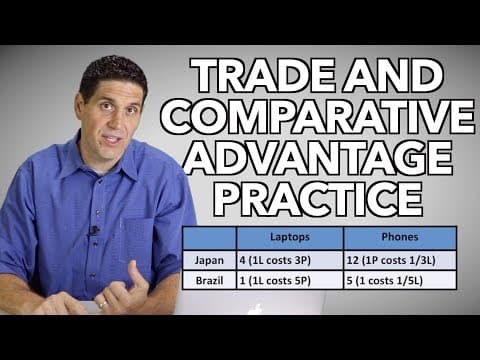
[0:00]Hey, how you doing internet? This is Jacob Clifford. Now, if you're in an economics class in college, or an AP class in high school, you're definitely going to see the concept of comparative advantage. It's usually in unit one and it's where a lot of students get tripped up. So I'm making this video to help you practice those concepts. Last students, they get confused, but it's actually not even that hard, but you just have to practice. So we're going to practice four different things. These are the four skills that you absolutely have to be able to do in these things. Number one, you have to be able to identify the absolute advantage. So which country is better at producing stuff? Then you have to be able to calculate something called per unit opportunity cost or the opportunity cost of producing one of one product, for that individual country, not 10 of them or 12 of them, but one, the cost of that, you know, individual product. Number three, you've got to figure out who has a comparative advantage. And number four, you have to do something called terms of trade. So in this video, I'm going to practice these concepts, help you get it, then we're going to do it again and again. So keep practicing and it's going to make a lot of sense. But before we jump into it, keep in mind that this stuff is not real, it's totally academic. There are no countries that produce only two things, and they definitely don't trade or barter things back and forth. They don't trade, you know, I'll trade you corn for your wheat. It doesn't work like that in real life. So you might be asking yourself, well, why are we doing something that's actually not realistic? It's more of a thought experiment. So this is something that economists and economics teachers require their students to do and learn because it's a thought experiment to help you understand the benefits of trade. If one country produces a lot of stuff and they're a better producer at multiple things, that doesn't necessarily mean they should produce all that stuff themselves. They should specialize in the thing that they have a lower opportunity cost, what's called a comparative advantage. So that is real, like there's plenty of countries that specialize in the production of certain things that they are better at producing than other countries, and that's why we have an interconnected world and a globalized economy where, you know, a lot of countries are trading other things with other countries. The first concept you have to practice is something called absolute advantage, and it is easy. I mean, it is ridiculously easy. It just the idea of who is better at producing something. So when you're better at producing something, you either can produce more of it, or you need less resources to produce the same amount as another country. So either you can make more, or you require less resources. So, time to practice. I have four different scenarios for you. For each one of these, I want you to figure out who has the absolute advantage for each different product. So, for the first one, who has the absolute advantage in planes, and in number two, who has the absolute advantage in cars, and who has the absolute advantage in motorcycles. For each one of these, figure out who has the absolute advantage. Pause the video then I'll go over it, make sure you're actually getting the easy concept called absolute advantage, all right, good luck. You're still watching me, don't don't watch me, you're supposed to pause, did you pause? Okay, for the first one here, the US produces 20 planes and France only produces 12, so the United States has an absolute advantage in the production of planes. Again, I'm not jumping into all the other concepts, you have to know, the other skills, you have to know. I'm just starting with absolute advantage, making sure you get that, and then we'll move on to other stuff. Uh and number two, Germany has an absolute advantage in the production of cars and Korea has the absolute advantage in the production of motorcycles. Again, Germany can produce more cars and Korea can produce more motorcycles, absolute advantage. In the third one, Japan has the absolute advantage in laptops and an absolute advantage in phones. And in number four, take a look at number four, because this is one of the things that can trip you up. Notice that the numbers in number three and then numbers in number four are exactly the same, right? Four, 12, 1, 5, 4, 12, 1, 5, exactly the same, except this is a new question. This is called an input question. Questions 1, 2, and 3 were all output questions because they're producing stuff, but in question 4, or scenario 4, they're asking you about hours. So, Cuba takes 4 hours to produce a TV and Mexico takes 1 hour to produce a TV. Now, which one is better? The one that takes 4 hours or the one that takes 1 hour? Well, 1 hour is better, because they have less, they require less resources to produce the same thing. So Mexico has the absolute advantage in this case. So again, keep that in mind, for input questions, things are kind of reversed round because we're looking at hours. And for uh salsa, then Mexico also has an absolute advantage in salsa because they take less hours than Cuba. Again, absolute advantage, super simple, you got it. So let's move on and do the other skills you have to know, like calculating opportunity cost, identifying comparative advantage and terms of trade. So, let's go back to that first one over again, first scenario, the US can produce 20 planes and France can produce 12 planes. So here's the questions right there. For each country, what's the opportunity cost for producing one of each product? Who has a comparative advantage in planes? And then what is the terms of trade that benefits both countries? So, can you answer those questions? No, you can't, right? And the reason why is we don't have enough information, right? The idea of absolute advantage is the idea of who can produce more. So you can figure out the absolute advantage for this scenario the way I have it written here, but you need more information if you're going to jump into the idea of comparative advantage. We have to know what else these countries can produce, right? It's not enough just to know they can produce more than the other country. So these other questions require more information and so let's add that information right here. So now you can see the US can produce either 20 planes or two cruise ships and France can produce 12 planes or two cruise ships. So now we have enough information to answer the question. So what I do with my students is I have them create a box, makes it look like this. They organize it, it helps them get it kind of in their brain a little better by organizing it, you've got the countries on the left, the products are the things they're producing at the very top and you just plug in the numbers. So when you're calculating opportunity cost, you have to figure out how much does each one plane cost for the US. And then how much does each one plane cost for France? How much does each one cruise ship cost in the United States? The point is, I know when the United States produces 20 planes, they could have produced two cruise ships. We know that, but I want to know how much does each one plane cost, not 20 planes, right, each one plane. So the idea is something called per unit opportunity cost. Think of it's the cost of what you're producing divided by what you're gaining. So what did you lose, right? Well, if you produce 20 planes, you could have produced two cruise ships. The opportunity cost, the total opportunity cost of 20 planes is the two cruise ships that you could have produced, the United States could have produced. And what they gained was the 20 planes. So the cost divided by the gain tells you each one of these planes costs 1/10th of a cruise ship. For my students, I have them actually write it out inside the box, one plane costs 1/10th of a cruise ship that's given up. That's the opportunity cost of producing one plane. Now, let's go to the other side, the other side. How much does each one of these cruise ships cost in terms of planes given up for the United States? Well, each one costs 10 planes. One cruise ship costs 10 planes that could have been produced. So that makes a lot more sense logically in your mind. Obviously, if you produce two cruise ships and you could have produced 20 planes, each one of the cruise ships is 10 planes that you could have made. So that makes sense. Also, notice these are reciprocals. If one's 1/10th, the other one is 10. If you have one that's 2/3rds, the other one is 3 halves. You can't have one be, you know, 1/15th, and the other be, you know, 40. It doesn't make any sense, they're reciprocals of each other. But my problem with my students is they they forget, okay, which one's which, like don't try to memorize it. Understand the concept. The idea is per unit opportunity cost, how much does each one cost? All right, let's do this next one right here for France. France, for each one of these planes, they give up 1/6th of a cruise ship. 1/6th of a cruise ship and each one of the cruise ships, they give up six planes. Now we've got the calculations done. We've answered the first question. That's the opportunity cost of producing each one. So now we have to figure out who has a comparative advantage in planes and who has a comparative advantage in cruise ships. So now it's to do the next level, right, the next skill. So let's start over here on the cruise ship side. So who should produce cruise ships? The one that gives up 10 planes or the country that gives up six planes, right? Well, six planes, six planes is a lower opportunity cost. In other words, France has a comparative advantage because they have a lower opportunity cost when they decide to produce uh the cruise ships compared to the United States. Now, the United States has a lower opportunity cost in the production of planes. So what that means is, the United States should specialize in making planes, they should make as many planes as possible, don't worry about cruise ships, let France build the cruise ships, and then they can trade, and they can both benefit from that trade. I want you to notice here that the United States doesn't have a comparative advantage in both, right?
[8:13]It doesn't have a comparative advantage in planes and in cruise ships because that's not possible. With the way they write these questions and they talk about these concepts, a country can't have a comparative advantage in both. That's not the idea. So once you knew and figured out that the United States should be making planes, and boom, you're done, you know that France should be producing the cruise ships. And it works that way every time. And if you have weird numbers, if it if the looking at numbers, it looks like, you know, a country has a lower opportunity cost in both the planes and the cruise ships, then you messed up somewhere because that's not how it works. Okay, you ready? All right, now we got to go to the next level, and this is the hard one, something called terms of trade. Terms of trade is the idea, the country should trade. But they trade one cruise ship for a certain number of planes, there's a right number, at least there's a range of numbers that work for both countries. And there's some numbers that don't work at all. In other words, for example, let's go 20, right? So one cruise ship for 20 planes, right? In this case, France would be all on top of it. They'd be like, that's a great idea. We we love it.
[9:07]Perfect, we'll get as many uh planes as we possibly can. Because remember, you know, France is producing cruise ships, but 20 doesn't work because US would never go for it, right? Take a look. If the US produces cruise ships on their own, it costs them 10 planes, right? So says it right there. 10 planes is the cost for the United States if they produce one cruise ship. Why would they ever give up 20 planes for one cruise ship? It doesn't make any sense. So any number above 20 doesn't work, so, you know, 20 doesn't work, 15 doesn't work, 11 doesn't work, and 10 doesn't work, right? One cruise ship for 10 planes doesn't really work for the United States, they might as well just produce those cruise ships on their own. So we know the number has to be less than 10. All right, so far so good. The number also has to be above six. If it's below six, then France doesn't want to go for the deal, they just rather produce the planes on their own as opposed to go trade them with the United States. Now, I know you're asking yourself, well, why? Well, let's pick a number. Let's say it was one cruise ship for one plane, right? So France goes, all right, let's trade one cruise ship for one plane. They shouldn't, but let's say they do. Well, each one of these planes cost them one cruise ship. But if they produce planes on their own, it'll only cost them 1/6th of a cruise ship, right? So it would make more sense to produce planes on your own for 1/6th of the cost of a cruise ship than for an entire cruise ship. So, the number has to be above six for France and it has to be below 10 for the United States. And so the way I got that is I just look right here and I spot on this side, one cruise ship for how many planes? Well, some number between 10 and six, so seven works. If one, you know, be funny on the test be like 9.282, okay, that works. But the idea is there is a range here that works for both countries. Like I said in the beginning, a lot of students get tripped up on this stuff and this video is about practice. So, you already practiced this in class, your teacher already taught it to you, so I'm not going to spend a lot of time explaining concepts over again. I'm just going to give you a chance to practice so, here you go. We got two countries, Korea and uh we've got Germany. I've already set up the chart for you, your job is to answer those questions on the bottom, then I'll go over the answers, okay? Good luck. First is right here, we've got the calculations for the per unit opportunity cost, or how much each one car costs in terms of motorcycles given up for Korea and then for Germany, then how much each motorcycle costs in terms of cars given up for Korea and Germany. And there's your numbers, there is your calculations. Next question, who has a comparative advantage in the production of cars? Well, Germany should specialize in the cars because they only give up two motorcycles and Korea gives up three motorcycles, right? Then who should specialize in motorcycles? Well, Korea should specialize in the motorcycles because 1/3 is less than 1/2. And again, you already knew that. Once you knew that Germany should produce the cars, you were done, because you know Korea should specialize and produce the motorcycles. So those are the countries that have a comparative advantage. Now, what's the terms of trade? How many cars traded for how many motorcycles would benefit both countries? Do you get it? Well, five, right? What do you think? Five? No, five doesn't work. Which country does five not work for? Well, Korea. Korea is not going to trade one car for five motorcycles because, you know, there's no reason for them to do that. Remember, they're making motorcycles, if they produce motorcycles or the cars on their own, it only costs them three. I'll say it again. If Korea produces cars, it costs them three motorcycles given up. Why would they ever trade five motorcycles for a car if they could just make them themselves and it costs them three? So the number has to be less than five. It has to be less than four and it has to be less than three, so less than three. And for Germany, the number has to be higher than two, right? So higher than two, less than three, two and a half. There you go. Do you get it? That's the right answer. Hopefully, it makes sense. Now if it didn't, that's okay, because we got more practice. Here it comes. Now, if you're having a really hard time, if you're like totally stuck, you're like, I have no idea what's going on, go back and look at over your notes. Go back and watch the beginning of this video where I already went over. So if you have no idea how to do this, it doesn't make any sense for you to move forward at this moment. Go back, re-watch some things, get it back in your mind, and then practice to verify you're getting it, okay? For situation number three, we've got Japan and Brazil, laptops, phones. Here's the chart. Answer those questions on the bottom. See if you're actually getting this. Now, notice I'm not asking you about absolute advantage on these because, remember, absolute advantage is really easy. Japan has an absolute advantage in lollipops and it has an absolute advantage in the production of phones. So, absolute advantage, I'm kind of throwing over to the side because it's just so darn easy. Instead, you got to do these other questions. First, calculate the per unit opportunity cost for one laptop for Japan. So, one laptop for Japan costs three phones they could have produced, and each phone costs 1/3 of a laptop that could have been made. And then for Brazil, each one laptop costs five. Now, that's already done those calculations for you, right? Each one laptop is the five phones they could have produced, and each phone is 1/5th of a laptop that Brazil could have produced. So there's your calculations. Now, who should specialize in what? Well, Japan should specialize in the laptops because they have a lower opportunity cost. Not because they necessarily can produce more, they have a lower opportunity cost than Brazil. And Brazil should specialize and has a comparative advantage in the phones because they have a lower opportunity cost. Now, on your test, your teacher might ask you why, if they ask you why, don't just write they're better at producing it. Write out the numbers, say for Japan, they have a comparative advantage in laptops because three is less than five, where it costs them three phones, where Brazil it costs them more, five phones. Right, that would be a better answer if you're asked to explain. And the last part is figuring out the terms of trade that would benefit both countries. So one laptop for how many phones would benefit both countries? Well, obviously the answer is two. No, two doesn't work. But why doesn't two work? Which country wouldn't like two? Which trading one laptop for two phones wouldn't work for who? Well, Japan, that's too low of a number for Japan. And seven's too high of a number for Brazil. So the number has to be between five and three. And so four makes the most sense. Uh that's probably what you put. One laptop for four phones would benefit both countries. This is an Achilles' heel for a lot of students. Last students get tripped up on comparative advantage. So don't freak out. But don't tell yourself, oh, I'll get it later on because you're not, like get it now. So right now, uh to practice output questions, go to the uh links below, go to the description. I gave you a link to a video where I go over multiple choice questions, so you can try multiple choice questions, see if you're actually getting it. Uh try those and I go over the answers to those. And then also take a look at my summary video for unit one. I do something called the Quick and Dirty. I give you kind of a trick to help you remember. I don't go over it here because I want you to understand how to do it and practice it in this video. But if you need some tricks, then take a look at the summary video. And don't stop because we still have one more question to do, right? We've already done three output questions. We've got one input question, okay? Here we go. Now, remember, these are the same exact numbers as the last question. I did that on purpose. I want you to see that the numbers aren't what's changing, it's the concept that's changing. Instead of being, you know, four output, this is four hours or input. The output is set, the inputs are changing. So here we go, we've got Cuba, we've got Mexico. I already have the chart. Answer the questions at the bottom, keeping in mind, this is an input question, okay? Good luck. Let's go nice and slow here. We're talking about hours. So if the if Cuba spends four hours producing TVs, how much salsa could they have produced in those four hours? Well, the answer is 1/3 of a salsa. Now, if you put three, you're messing it up. That's an output question, right? I'm talking about hours here. So if you spend four hours doing one thing, and it takes you 12 hours to do the other thing that you gave up, then you gave up 1/3 of the salsa you could have made. That's the opportunity cost. And the other side, each one salsa for Cuba is the three TVs they could have made, right? If you spend 12 hours, now that would make more sense. If you spend 12 hours producing salsa, and it takes four hours to produce a TV, then in that 12-hour period of time, there's the three TVs you could have made. So the opportunity cost for one salsa is the three TVs that are given up. Now, for Mexico, each one of the TVs costs 1/5th of a salsa, and each one of the salsas costs the five TVs. So we've got the same idea here. We've got per unit opportunity cost. And we're now we're done looking at hours. Now this is output, this is stuff, right? So we're now at the exact same stage, we are at before to figure out comparative advantage, right? So let's do the salsa first. Um who should produce and specialize in the salsa? The country that gives up three TVs or the one that gives up five TVs, right? So, who has a lower opportunity cost? Well, Cuba. Cuba has a lower opportunity cost. They only give up three TVs. So Cuba has a comparative advantage in the salsa. So that means Mexico has a comparative advantage in the TVs. So there's your answers. Mexico has a comparative advantage in the TVs, Cuba has the comparative advantage in salsa. And what's the terms of trade? Well, one salsa for four TVs would benefit both countries. If they traded that, that would work. So for the second part of this, I mean, getting the calculations, the per unit opportunity cost is different, but once you've got that, you're doing the same thing you did before. Who has a lower opportunity cost, and then terms of trade, same idea. Trading one salsa for four TVs would benefit both countries for the reasons I explained last time. Did you get it? Does it make sense? If it doesn't, remember, go back and take a look at practice questions and take a look at my ultimate review packet. I have actually more practice questions, I have a whole set of output and input questions, verify you actually get the, and it's making sense. Let me know in the comments if this was helpful, if this is working for you. I know I talk fast, but I'm doing that so I can help you understand the concepts and you can get out of here and go hang out with your friends and go do other awesome things. Thank you so much for watching.