[0:11]Everyone's heard of the United Nations, but many don't know how it actually works and facilitates international diplomacy. So, in this video, we'll briefly explain the history of how and why the UN was created, the principal organs that make up the international body, and how they function day-to-day. And if you're interested in more topics about international law and diplomacy, then let us know in the comments down below and be sure to subscribe to the channel so you never miss an upload going forward. So, following World War I, countries wanted to avoid a repeat of the horrific global conflict, and their leaders formed the League of Nations, dedicated to preventing the outbreak of further wars. As would become catastrophically obvious mere decades later, the League wasn't fit for purpose, largely because the United States refused to join, instead preferring the isolationism advocated by the framers. However, the US didn't really account for the effects its new status as a major power would have on global order if it remained isolated. The weakened League of Nations was wholly ineffective in its task of preventing another large-scale conflict. Once again, the world was rocked by World War, this time with even more destructive consequences. During the final months of the war, states came together to create an international organization, more effective at preventing conflict, and the United Nations was born. On the 24th of October 1945, the United Nations came into existence following the ratification of the UN Charter by the five main allies: the United States, the United Kingdom, France, the Soviet Union, and China, as well as a majority of other signatories. On January the 10th, 1946, the General Assembly met for the first time in Methodist Central Hall in Westminster, and the Security Council met for the first time a week later. A week after that, the General Assembly adopted the first UN resolution, 'Establishment of a Commission to Deal with the Problems Raised by the Discovery of Atomic Energy.' This committee is composed of the members of the Security Council, and, when it's not on the Council, Canada. We mentioned the General Assembly and the Security Council, but what exactly are they? The UN has six principal organs that oversee the organization's main functions: the General Assembly, the Security Council, the Economic and Social Council, the International Court of Justice, the Secretariat, and the Trusteeship Council. Each principal organ is located at the UN headquarters in New York, with the exception of the ICJ, which is located at The Hague in the Netherlands. The General Assembly serves at the largest body of the UN, featuring representation from each of the member states. The Assembly is the UN's primary deliberative body and the forum before which we see most of the highest profile diplomacy take place, as the yearly session features not only ambassadors but plenty of heads of state. The General Assembly primarily deals with questions of international peace, admission of member states, and the UN budget, all of which require a two-thirds majority vote, while less important votes pass by a simple majority. The Assembly is led by a President elected for a one-year term. The presidency offers a chance for ambassadors from smaller states to lead the world, as few states who have boasted a President of the General Assembly can be classified as major powers. The closest candidate for that honor being Canada in 1952. Instead of being dominated by these major powers, the presidency frequently features states like Mexico, Afghanistan, Liberia, Saint Lucia, and, currently, the Maldives. The next is the Security Council. The Council is tasked with maintaining international peace and security, and has succeeded, at least to the degree that recent wars generally have been contained to the region, not global scale. The Council's membership is limited to 15 states at any given time, with 10 seats rotating and five permanent seats awarded to the five main allies: the United States, United Kingdom, France, the Russian Federation, and the People's Republic of China. The 10 rotating members of the Council are elected for two-year terms. India, Ireland, Kenya, Mexico, and Norway will rotate out later this year, while Albania, Brazil, Gabon, Ghana, and the United Arab Emirates will rotate next year. The permanent members, ironically, have gone through a few changes themselves. Initially, the Soviet Union held a permanent seat, but the seat passed to the Russian Federation following the Soviet fall. The People's Republic of China's seat initially was held by the Republic of China, which still survives as Taiwan. However, following Mao Zedong's overthrow of Jiang Jieshi's national government, the United Nations eventually expelled the Republic of China on October the 25th, 1971, and Taiwan has since lost even its observer status. Although the General Assembly relies on the good faith of member states to carry out its resolutions, the Security Council's resolutions are binding on all member states. These resolutions include mandating peaceful resolutions to disputes, imposing sanctions, participating in a multinational peacekeeping force, and authorizing to use force when a breach of the peace has occurred or is imminent. However, the five permanent members each have a veto over any proposal before the Council. So, matters affecting any of the five, generally, are usually doomed to fail, leaving affected states to resort to customary international law to solve their disputes. Moving to more peaceful matters, we come to the Economic and Social Council. The Council has jurisdiction over matters of economy, social welfare, environment, and international development. The Council has 54 members, elected by the General Assembly for three years, with 18 seats up each year. The Council currently has 30 subsidiary bodies, ranging from Regional Commissions, Criminal Justice Commission, Women's Rights Commission, Geographical Naming Commission, Economic, Social and Cultural Rights. Next comes the International Court of Justice, more commonly known as the ICJ, or The Hague. The ICJ serves as the UN's main judicial body and rules on matters of international law and issues advisory opinions. The Court is composed of 15 judges, all of whom must be nominated by the permanent Council of Arbitration, then win elections before both the General Assembly and the Security Council. The judges must be from different states and may not hold political, administrative, or professional office during their nine-year terms. Although the Court frequently convenes in its entirety, it may form chambers of three judges to deal with particular categories of cases, and decisions by the chambers carry the weight of the full Court. Notably, the Court cannot compel a state to appear before it; instead, it must rely on the state's consent. This may be achieved by the parties to a dispute meeting one of three criteria: submitting a special agreement to the Court, being state parties to a treaty that provides the Court with jurisdiction over the dispute, or having all made declarations of their consent to the Court's jurisdiction under the ICJ statute. Continuing our tour of the UN, we come next to the Secretariat. This body is the boots-on-the-ground organ of the UN, led by the Secretary General and responsible for the UN's day-to-day business. The Secretary General is nominated by the Security Council and elected by the General Assembly for a renewable five-year term. They're assisted by thousands of UN staff members who carry out UN missions throughout the world. When you see UN personnel working out in the field on development or relief missions, this is typically the body overseeing their efforts on a day-to-day basis. The final principal organ of the UN is the Trusteeship Council. The Council was established in 1945 to provide supervision for 11 UN trust territories under the supervision of seven member states. The purpose of the Council was to guide the territories under trusteeship towards being able to stand on their own as states in their own right. The Council's rules initially required it to meet annually, but the Council amended its rules to require meetings only when required, shortly before suspending operations in 1994, when all the trust territories had attained self-government or independence. The Council remains inactive, but when it is active, it's composed of the five permanent members of the Security Council. However, despite the Council's inactive status, it continues to elect a President and Vice President so that it may be ready for action if called upon. The return to the Trusteeship Council may be on the horizon, however, as they've been called to redefine the scope of the Council's duties to include environmental stewardship, though no decision has been taken to this point. So, that's the UN and its principal organs in a nutshell. If you enjoyed this video, let us know your thoughts in the comments down below. You can also talk to us on Twitter and on our Discord server to discuss all things UN. Thank you for watching, and we'll see you next time. Also, be sure to subscribe and hit the bell icon to be notified every time we release a video. Special thanks to our Patreon backers, you make videos like this one possible, and if you want to see your name at the end of videos just like these people, you too can back us on Patreon. The link to that is in the description.
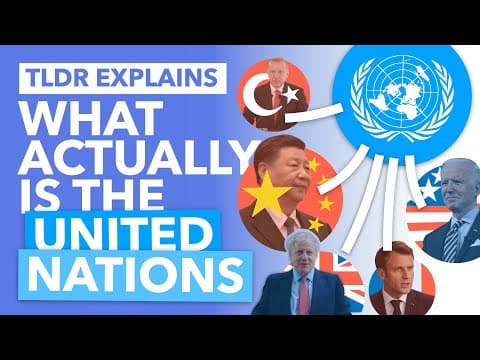
The United Nations Explained: How Does it ACTUALLY Work? - TLDR News
TLDR News Global
9m 59s1,551 words~8 min read
YouTube auto captions
Transcript source
YouTube auto captions
This transcript was extracted from YouTube's auto-generated caption track. The transcript below is server-rendered so it can be read, searched, cited, and shared without opening the original YouTube player.
Pull quotes
[0:11]Everyone's heard of the United Nations, but many don't know how it actually works and facilitates international diplomacy.
[0:11]So, in this video, we'll briefly explain the history of how and why the UN was created, the principal organs that make up the international body, and how they function day-to-day.
[0:11]And if you're interested in more topics about international law and diplomacy, then let us know in the comments down below and be sure to subscribe to the channel so you never miss an upload going forward.
[0:11]So, following World War I, countries wanted to avoid a repeat of the horrific global conflict, and their leaders formed the League of Nations, dedicated to preventing the outbreak of further wars.
Use this transcript
Related transcript hubs
Watch on YouTube
Share
MORE TRANSCRIPTS


