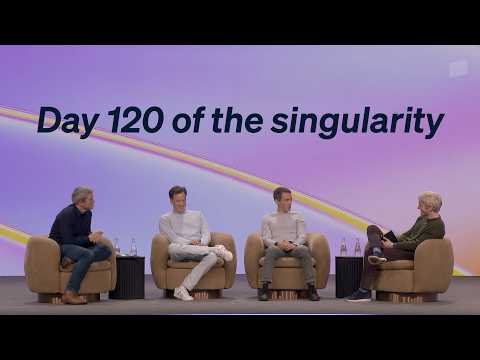
[0:00]So we uh so we opened yesterday uh by proclaiming us acknowledging it to be day 119 of the singularity. So I guess day 120 today. Singly already started on January 1st. Thought? Yeah, I mean, it really does feel that way. Um I think the thing to remember we see AI improving constantly and it's just able to do more and more and there are these sort of I think we've learned a couple of things. First AI works. And second, when a new model comes out, we're quickly dazzled by it and then we become nerd to its new capabilities very, very quickly and we're like, it feels like nothing's happened for a couple months. I's dead. And then there's another step change and it's sort of improves again. I think the um the thing to remember is that this is the slow part. This is the slow part of the singularity right now because the improvement of the model. felt very slow to everyone. Yeah. The improvement of the models um still runs through a lot of human an effort, you know, at at all the labs where models are being developed. Humans have to make decisions, they have to discuss things with each other, they have to run experiments, they you know, they make mistakes along the way, they have meetings, they have to sleep in between although less and less these days. And um all those things slow it down and the like prime project that every AI lab right now is to remove humans from the loop of all the continuous work that has to be done to make the models improve and to get to self-improvement where where where you have AI systems that can you know, start by doing what the people are doing now, the researchers are doing now and um and therefore eliminate all those sleep gaps and and also scale it out to data center scale. And so it feels sometimes fast, sometimes slow right now, but like it's probably as slow as it will ever be when we when we start to automate more and more of that process. And and this is like the story of the economy too. This is not new to AI. It's like always this question of like how do we take a thing that has to be done to provide a product or service and automate it make it more reliable, more efficient. We're always doing this and it's happening in the way we produce AI too. So I feel like we're we are it feels to me like we are in the singularity and we're in the beginning slow part before it involves up with self improvement.
[2:22]It's hard to add on top of that. But um, one of the things I'm responsible for today is computer strategy where Nate and I both work and one of the things we're trying to figure out is obviously the local consequences in terms of how to think about compute and all the things that you know may matter to you know a hyper scaler that also is building some of these models. But the impacts I think of the singularity on the economy I think are also not really well understood nor should they be this as far as we know. I know I know. Well, we'll find out. Um maybe Atlantis will at some point we'll discover you know we'll find in missing CPU cluster in Atlantis and maybe there is a cyclicality to all of this. But um I think there's a there's a lot of, you know, very basic things that I'm trying to figure out. Like for example, is AI uh something that we would expect to be inflationary or disinflationary? Is the singularity and inflationary effect on, you know, money supply or disinflationary. And you know, you wonder around San Francisco and people have usually takes that involve very large numbers. You know, billions of dollars, trillion of dollars. So that would imply kind of inflation review. numbers get very big. I think that is, you know, I'm not an economist but that would be what the economists would say. Um, but then if you kind of think back to, I think the best reference point I have for the singularity is the last time we connected a lower cost super intelligence to the global economy. And I would say that that's roughly when China started modernizing and then joined the world trade organization. Um, and you can kind of think of China as a kind of a super intelligence. It is able to produce goods and services at a lower structural cost than what the West was able to produce. And the you know, the effects of that are actually somewhat disinflationary. Like if you were trying to put on an event like this right now, we see. And and you say it's the last time this happened was when China joined the WTO and not when Ireland joined the EU. Well, Ireland GDP is a very interesting story of um, somewhat of a different trade going on there and that can be discussed a later time maybe with their tax team.
[4:36]But um the um the um the obviously the GDP of China, you know, goes a lot, but goes up a lot, but the actual effects on consumers uh are that you're able to purchase much more with much less. Like if we were trying to provide this experience today, where someone sitting in the under corner of the world can watch this entire show live streaming on their phone for $10 a month data plan and a $200 device. If you're trying to provide that pre China, I I think that would be tens if not hundreds of millions of dollars. And so your your purchasing power of a certain quality of life has collapsed dramatically. And um and so I don't really know. I mean that would be a story of disinflation. So I guess I guess um I I say with a lot of humility. We don't really know what a singularity is. There's a lot of reference point we can try to look at. And we don't even know what the sign bit is going to be on any of the stuff. That's right. We don't even know the direction. But but isn't you know when you talk about inflation versus disinflation, there's so much going on there, everyone's familiar with the famous charts showing when you break out the goods, education and healthcare have seen this rampant cost inflation and then durable goods and your flat screen TV and everything. Uh you know, we talked about in the talk earlier today, tend to go down over time. shouldn't we and again a lot of that was this, you know, the China effect. Like the the mark and recent line uh you know, if uh if you damage your wall in San Francisco it's cheaper to buy a flat screen TV. So cover overish and it is to repair the wall. Yes, it was literally true. And so shouldn't we expect more of that effect with AI where you just guess massive deflation in the things that AI can help you with and then it'll be a boom effect where certain other things, you know, you shouldn't necessarily bet on, you know, um, for your university tuition getting that much cheaper. Maybe I mean part of Bal's cost disease I think was this idea that wages uh in very productive sectors of the economy rise and that forces wages in other parts of the economy even though they may not actually need to rise as well. Um but I think it'd be interesting to see depending on where the cost of software production go over time, how those wages interact with other parts of the economy. And I think there's we stand, you know, before an immense amount of uncertainty in terms of what happens next and I think anyone who has total conviction about this ought to get themselves checked. I'll get you in one second Patrick. Um, but um, but the thing I I
[6:58]I never get the 6% bill. Yeah, we should unpack that later. So the um and you might say it's going to be totally gone because the internet will and you know it turns out that they're here and that industry has in fact grown even though I'm not sure it is rational in a purely utilitarian sort of libertarian paradise sense to have that industry. And I think as we sort of look forward and project, you know, which industries grow and shrink, there's a lot of stuff that's out there like real tors and I'm using that only as an example which is there is valuable to have it's kind of complicated why it's still there? I don't think it's that they regulated themselves in. I mean, we could transact in a house without talking to them. So it's not law. But there's a lot of stuff around the edge and my parallel for that would be in a company like Google, there's a lot of people doing real like stuff, sales, marketing, talking to folks, you know, considered purchases that need handling. Well, can I ask about that because I have a definition questions. So I think it's very sensible to split up what companies do into a few categories. I think engineering is actually untrend to see productivity improvements because engineers have tools. They have for decades and so they're there looking at what the models can do and let's rebuild our workflows and things like this. And so I that think that makes sense with an engineering. I think go to markets like sales, you know, marketing and things like that also works pretty well because uh one fundamentally I think the sales roles are about like you're saying with the real tors. It's about the humanity. You saw a little bit of this with um, you know, COVID people talking about the death of business travel. It turns out if your competitor is going to visit the customer, like you will be going to visit the customer as well and it's that one upmanship. and so go to markets just it feels like it will do great and you know sales rules will do great in age of AI. The question I have is how the diffusion works within you know what we call G&A within companies, sale or sorry legal, finance, compliance, you know, all these kinds of rules. And in particular, there's like how you get all the automation there where we run uh re-forecast process with the strike and we're not feeding it all into a coding agent but maybe we should. But then also the ergonomics are wrong where like your finance data is in a spreadsheet and like the models, you know, make up numbers and maybe you prompt them to not make up numbers and they're a little bit better. And you're not you're not going to be able to verify those outputs. It's not going to be like an RL problem where you're going to run the budget a million times and get the. Right. So how do we get a much more AI native G&A function at stripe? Make no mistakes. It's a good question. I mean, I think this this, you know, I think much has been lamented about AI sort of producing miracle drugs and we'll have to wait and see how that stuff happens. But there is certainly a lot of local at home diagnostics one can do because of LMS, which is I think part because the images can analyze pull telemetry much better, you know, just a bunch of iPhone images probably get you much better information about whatever random, you know, thing you may have than previously, but also because you can buy all this low-end diagnostic equipment to Nat's point and have it just working.
[10:17]Um and I think this if if if we do our job correctly as an industry, this has to be a much larger category than anything we've produced today because the you know, productive mastery of physics and biology to elevate humans is is a much bigger and much more interesting story than, you know, the production of software. And we're in our very early innings now, and I have proof of that in because Nats on eBay, you know, buying some sort of camera to look at his dermatology camera or whatever. Um so if I have to guess, you know, if we meet a year from today, those anecdotes have spread not around the world, and I don't know if they'll make it all the way to the East Coast, but at least amongst the tight, high quality alumnus of the um strip sessions of tents. So John asked his last question. Um, my um, my last question is as we as we proceed into the singularity, what's your each, what is your one sentence of advice for strip?


