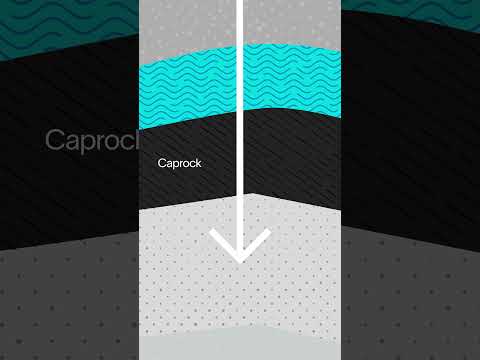
[0:00]Today, carbon dioxide emissions exceed 40 billion tons per year, driving significant changes to our climate. In response, global efforts are underway to reduce emissions and achieve net zero targets by 2050. One key solution to meet this ambitious goal is CCS, carbon capture and storage. But how does carbon storage work? Carbon storage starts with modeling the surface to identify a suitable underground reservoir, typically a saline aquifier or a depleted oil and gas field. with an impermeable rock layer, known as cap rock that can trap and contain carbon dioxide or CO2. Once a site is selected, a well is drilled that is specifically designed and engineered with corrosion resistant materials to inject the CO2. Around the site, monitoring wells are strategically placed to track its movement. Shallow wells are also drilled above the cap rock and in drinking water sources to routinely sample and verify that the carbon dioxide has not migrated. Fiber optic sensors installed along the injection and monitoring wells verify that CO2 is filling the reservoir as expected and that the wells remain intact. In real time, they also detect any irregularities, enabling operators to halt injection if necessary. To complement these underground measures, soil and air sensors at the surface provide an added layer of protection, continuously monitoring to help ensure the safety of both people and the environment. And that is how carbon storage works. Reaching net zero by 2050 requires bold action and trusted solutions. At SLB, we apply a century of engineering expertise to help companies capture and store carbon for a balanced planet.
🌍 How Carbon Storage Works | CCS & CCUS Explained 🌍
SLB
1m 58s264 words~2 min read
Auto-Generated
Watch on YouTube
Share
MORE TRANSCRIPTS