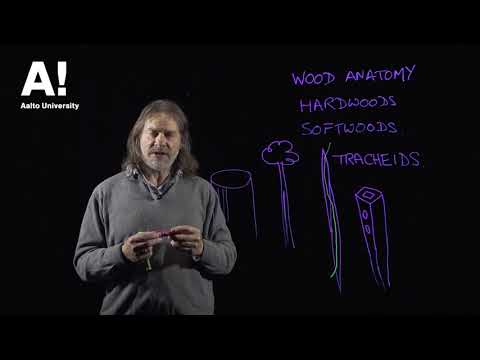
[0:09]So, we're going to talk about wood anatomy now, or rather I'm going to talk about it because I can't hear you. Wood anatomy. Okay, I think that's how you spell it, wood anatomy.
[0:22]Um, yeah, very basic stuff. I'm really just going to talk about the difference between hardwoods and softwoods.
[0:39]And you'll read in any textbook that that's a pretty silly way of describing woods because some hardwoods are soft and some softwoods are hard.
[0:48]Um, but actually most softwoods are relatively soft compared with most hardwoods.
[0:53]But that's the term that's used and we're stuck with it, but we're more concerned with the anatomy of the wood that's described
[1:03]for these different types of woods which are referred to um more correctly as angiosperms and gymnosperms.
[1:08]Softwoods are gymnosperms and hardwoods are angiosperms and angiosperm and gymnosperm refers to how the seed is uh is either encapsulated or not in the tree, but that's biology and I'm not going to do biology with you.
[1:24]So the structure of softwoods first that's the simplest of structures of the two and softwoods are formed of these long thin cells that are referred to as tracheids or tracheids.
[1:41]And these have a dual function of uh mechanical support and also conduction.
[1:47]So if you look at a tracheid close up, we look at a cross section of a tracheid.
[1:52]They're not exactly square, but they have more sort of straight sides than curved sides.
[2:00]They're very long, they're very thin. The length depends upon the type of wood that it's coming from, the species.
[2:07]But they're basically hollow. I talked about the S2 layer. So the S2 layer is the one that I'm showing here.
[2:15]That's that's the thickest layer of the cell wall. Um, and they have pits in them for conduction.
[2:22]Uh so that a tracheid next to another tracheid is able to pass water from one to the other.
[2:29]So these pits are conduction pathways so water will come in through a pit, travel through a tracheid and then up and then out again through pits.
[2:40]So without these pits you wouldn't be able to conduct water from the bottom of a tree to the top of a tree.
[2:46]So the tracheids run up and down the axis of the tree.
[2:50]So this is what a tree looks like, I'm sure you're all aware.
[2:55]And there's the trunk. So the tracheids run up and down in this direction, the longitudinal axis of the tree, the vertical axis, the growing direction.
[3:03]And apart from conducting water, they're also there to act as a structural support for the tree.
[3:10]But we also have another type of cell and that type of cell runs across.
[3:15]So if we were to look at the trunk of a tree, we have the tracheids going up and down in this direction.
[3:22]But we have another type of cell that are referred to as perma cells and they run out from the center to the outside.
[3:31]So if you look at them, they look a little bit like rays, um, so they're referred to as ray cells, but the scientific word for them is parenchyma, parenchyma.
[3:51]So you can have a conduction pathway in this direction as well.
[3:55]Uh and in softwoods there is very often another type of cell as well and these are what are called resin ducts.
[4:02]I'm running out of room here. Resin ducts, uh, and these are rather more complicated.
[4:10]They're usually formed of groups of cells and they also run up and down in the vertical direction.
[4:17]And they're there in case the wood or the tree gets harmed, the resin ducts will then produce lots of resin for which of course many softwoods like pines are famous for.
[4:29]And it's basically a wounding response. It's a way to protect the tree from becoming infected.


