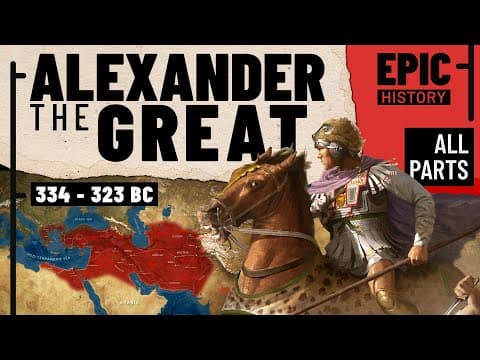
[0:01]In 334 BC, Alexander, King of Macedonia, began one of the greatest military campaigns in history.
[0:09]Against the superpower of the age, the Persian Empire.
[0:18]Just 20 years old, his brilliant and fearless leadership won him battle after battle. And in an astonishing 10-year campaign that took him to the edge of the known world, he carved out one of the largest empires ever known. Few men have had such a massive impact on the course of history. To the Persians, he was Alexander the Accursed. But to the West, he was immortalized as Alexander the Great.
[1:02]Ancient Greece.
[1:06]From around 500 BC, this rugged land was the scene of remarkable developments in art, philosophy, and warfare. Its two greatest city-states were Athens, a naval power where democracy, art, drama, and philosophy flourished. And Sparta, an austere militaristic society, famed for its formidable army. In 480 BC, these two city-states had joined forces to fight an invasion by the mighty Persian Empire. At the narrow pass of Thermopylae, a small Greek force, led by 300 Spartans, held up the enormous Persian army for 3 days before they were finally encircled and killed.
[2:08]Then, in the straits of Salamis, the Greek fleet defeated the Persian Navy.
[2:18]But they couldn't prevent the Persians burning the sacred temples of the Athenian Acropolis. The next year, at Plataea, the Greeks won a decisive land battle against the Persians and forced them to abandon their invasion.
[2:40]The next 50 years were the Golden Age of Classical Greece. But rising tension between Athens and Sparta and their allies eventually led to war, dragging the Greek world into decades of destructive fighting. Wars between the Greek city-states continued for almost a century, leaving them exhausted and vulnerable to a new rising power to the north. For centuries, sophisticated Greeks had viewed the mountainous kingdom of Macedonia as a backwater, Hicksville, barely Greek at all. But under King Philip II, Macedonia emerged as a formidable military force. His most famous reform, the introduction of the Sarissa, an 18-foot pike, twice the length of a normal Greek spear, and wielded by trained infantry fighting in close formation, known as a Phalanx.
[3:51]In 338 BC, at the Battle of Chaeronea, Philip's army crushed the joint forces of Thebes and Athens.
[4:03]Through alliance and conquest, Philip had already gained control over most of his neighbors. Now, following this victory, he united all Greece in an alliance known as the Hellenic League, or League of Corinth, with Philip as Hegemon, or Supreme Commander. Only Sparta stood aside. Philip began to plan a great campaign, a pan-Hellenic or all Greek war against the Persian Empire. Their old foe was now an ailing superpower, its great riches ripe for the taking. But on the eve of launching his war, Philip was assassinated by his own bodyguard, victim of Macedonia's brutal court rivalries. He was succeeded by his 20-year-old son, Alexander, brilliant, restless, tutored by the great philosopher Aristotle, and already an experienced military commander. Alexander inherited his father's grand plan to invade Persia, but first he had to secure his own position as king. At home he had potential rivals executed, then crushed rebellions in Illyria, Thessaly, and Central Greece. He made a special example of Thebes, completely destroying the ancient city and selling its people into slavery. In the spring of 334 BC, now ready to launch his war against the Persian Empire, Alexander led his army across the Hellespont into Asia Minor.
[5:58]It was the start of one of the greatest military campaigns in history.
[6:10]Alexander's army was about 40,000 strong, drawn from all parts of Greece. The infantry were commanded by the veteran Macedonian general Parmenion. In the front rank, 9,000 Macedonian phalangites armed with the 18-foot sarissa. These were professional soldiers, well-trained and drilled, who formed up for battle in the phalanx 16 ranks deep. This packed formation presented a solid wall of iron spear tips and was virtually unstoppable. But it was also difficult to maneuver and highly vulnerable to attacks on its flanks or rear. So, 3,000 elite infantry, the hypaspists, or shield-bearers, armed with shorter spears, guarded its flanks. They were commanded by Parmenion's son, Nicanor. The second line of Alexander's army was made up of 7,000 Greek allies and 5,000 mercenaries, armed as hoplites. They took their name from the hoplon, their large round shield, and carried shorter 8-foot spears. A hoplite phalanx was not as effective as the Macedonian phalangites, but still well-armed and heavily armored for the time.
[7:46]The Agrianes were the army's elite skirmishers, expert javelin throwers from what's now Southern Bulgaria. Other skirmishers from Thrace and Illyria were armed with javelins, slings and bows.
[8:04]The shock troops of Alexander's army were the Companion Cavalry, 1,800 elite horsemen armed with spear and sword, commanded by Philotas, another son of Parmenion.
[8:19]Alexander led the Royal Squadron in person.
[8:25]There were also 1,800 cavalry from Thessaly, commanded by Callas, 600 from other parts of Greece, led by Erigyius, and 900 mounted scouts from Thrace and Paeonia, under Cassander.
[8:57]The great Persian Empire was divided into provinces, called satrapies. Each satrapy was ruled by a governor, or satrap.
[9:09]Those in Asia Minor, now threatened by Alexander's invasion, met to discuss strategy. Memnon of Rhodes, a skilled Greek general in Persian service, urged them to avoid battle with Alexander. Instead, he advised them to use a scorched earth strategy, to burn villages and crops and withdraw to the interior. Alexander's army, he promised, would quickly starve. It was good advice, but the satraps were unwilling to lay waste to their own provinces without a fight.
[9:50]So, they decided to face Alexander's army at the river Granicus.
[10:00]The Persian army formed up behind the river, which was shallow but 60 feet wide with steep banks. Their front line was a wall of cavalry, about 10,000 horsemen from across the empire. Medes and Hyrcanians from modern Iran, Bactrians from Afghanistan, and Paphlagonians from Turkey's Black Sea coast. Behind, in reserve, were the infantry, several thousand Greek mercenaries, a common sight in Persian armies at this time. These men fought for Persian gold and were armed with the round shield and short spear of hoplites. The Persians may have been unsure if they could trust these men in combat against fellow Greeks, and so placed them at the rear. Alexander, determined to attack and destroy this Persian force before it could retreat, raced to the Granicus with his best troops. On his left wing he posted Thessalian, Greek and Thracian cavalry under Parmenion's command. In the center were the massed spears of the phalanx, its six divisions commanded by Perdiccas, Coenus, Amyntas, Philip, Meleager, and Craterus.
[11:30]On the right, Alexander himself with the Companion Cavalry under Philotas, as well as the elite hypaspists, the Agrianes javelin-throwers, and the archers. Alexander with 13,000 infantry and 5,000 cavalry in all, was probably slightly outnumbered. But ignoring advice to wait until dawn to cross the river, he ordered an immediate assault. He sent a squadron of Companion Cavalry to ford the river, followed by a regiment of hypaspists and the Paeonian light cavalry. Alexander, calling on his men to show their courage, then led his right wing across the river. As they reached the middle of the river, the Greeks came under a hail of javelins, darts and arrows from the Persian line. Those that made it to the far bank were immediately charged by the Persian cavalry.
[12:44]Alexander was in the thick of the fighting.
[12:51]He attacked where the whole mass of their cavalry and leaders were stationed. Around him a desperate conflict raged. Horses were jammed against horses, and men against men. The Macedonians striving to drive the Persians away from the river bank, the Persians determined to prevent them crossing and to push them back into the river.
[13:24]Alexander's attack seemed reckless. But he was buying time for the rest of his army to cross the river, including the irresistible Macedonian phalanx.
[13:39]Then, suddenly, Alexander was fighting for his life, charged by two Persian nobles. Rhoesaces rode up to Alexander and struck him on the head with his sword, breaking off a piece of his helmet. But the helmet broke the force of the blow, and Alexander struck him down with his lance. Then, from behind, Spithridates raised his sword against the king, but Black Cleitus, son of Dropeus, anticipated his blow, struck his arm, and cut it off, sword and all.
[14:20]Now, the Greek army was across the river.
[14:25]And the Persian cavalry faced a wall of Macedonian spears. Most turned and fled.
[14:40]The speed and shock of Alexander's attack meant Persia's Greek mercenaries hadn't even had time to join the battle. Alexander, in a blood rage, or possibly regarding these Greeks as traitors, ignored their appeals for mercy. The mercenaries were surrounded on all sides and massacred.
[15:10]Alexander had won a great victory. Asia Minor now lay at his mercy. But the Persian Empire was still a land of immense wealth and power. Already, it was mobilizing its vast resources to face him. If Alexander was to conquer this empire and take his place in history, he'd next have to face Darius, King of Kings himself.


