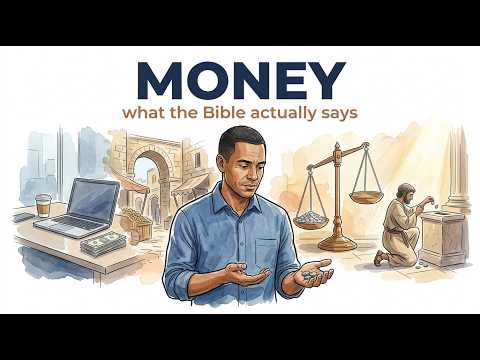
[0:00]There is a Hebrew word that shows up over a hundred times in the Old Testament, and most English Bibles translate it as money. But the word is not money. The word is kesef, and kesef means silver. That distinction matters more than you might think, because for much of the early biblical period, coins were not yet in use. No bills, no bank accounts. When Abraham purchased a burial plot for Sarah in Genesis 23, he did not hand over a check. He weighed out 400 shekels of silver on a scale, piece by piece, in front of witnesses. The Hebrew word shekel comes from the verb shaqal, which means to weigh. Money in the Bible was not an abstraction. It was a physical substance you could hold in your hand, and its value was determined by putting it on a scale. That changes how you read almost every passage about wealth in scripture. Because when the Bible talks about money, it is not talking about numbers on a screen. It is talking about something tangible, something with weight. And the question scripture keeps bringing into focus, from Genesis to Revelation, is not whether money is good or bad. The question is simpler and harder. Who does it belong to? The answer shows up early. In Deuteronomy chapter 8, Moses is giving his final address to Israel before they crossed the Jordan into the land God promised them. He has been with them for 40 years in the wilderness. He has watched them eat mana every morning and drink water from a rock. And now they are about to enter a land flowing with milk and honey, a land with houses they did not build, wells they did not dig, vineyards they did not plant. Everything is about to change. And Moses knows the danger. He has seen what happens when people get comfortable. So he gives them a warning. Beware lest you say in your heart, 'My power and the might of my hand have gotten me this wealth.' But you shall remember the Lord your God, for it is He who gives you power to get wealth, that He may establish His covenant which He swore to your fathers. The Hebrew word translated wealth here is hayil. And hayil is broader than the English word suggests. It can mean wealth, yes, but it also means strength, ability, influence, even military force. The same word describes the virtuous woman of Proverbs 31. The same word describes the valor of a soldier. So when Moses says God gives you the power to make hayil, he is not just talking about bank accounts. He is talking about every form of capacity you possess. Your ability to think, to work, to create, to build, to influence. All of it comes from somewhere. And Moses says the somewhere is God. But notice the purpose clause. God gives you the power to create wealth that he may establish His covenant, His binding promise to His people. The wealth is not the point. The covenant is the point. The wealth is the vehicle. God entrusts resources to people so that his purposes move forward in the world. The moment you flip that, the moment the resources become the destination instead of the vehicle, you have made money into something it was never designed to be. The prophet Haggai, writing centuries later to a discouraged group of exiles trying to rebuild the temple, puts it even more directly. God says through him, The silver is Mine, and the gold is Mine. That is not a request. That is a statement of ownership. Every piece of silver and gold on the planet belongs to God, which means every dollar, every paycheck, every inheritance, you do not own it, you manage it. And the Bible has a specific word for someone who manages what belongs to someone else. The Greek word is oikonomos. It is a compound of oikos, meaning house, and nomos, meaning law or management. An oikonomos was a household manager. In the Roman world, wealthy land owners often left their estates in the care of a trusted servant who would oversee the finances, manage the workers, distribute resources, and keep the household running. The oikonomos had enormous authority, but none of the property was his. He managed it on behalf of the owner. Our English word economy comes directly from this Greek word. And Jesus built some of his most pointed teaching around this concept. In the parable of the talents in Matthew 25, a master entrusts his property to three servants before leaving on a journey. One receives five talents, another two, another one. A single talent was worth roughly 20 years of a day labor's wages. So even the servant who received one talent was holding a staggering sum. These were not pocket change, they were fortunes. Two of the servants invested what they had been given and doubled it. The third buried his in the ground. When the master returned, he said the same thing to each of the first two. Well done, good and faithful servant. You have been faithful over a little, I will set you over much. Enter into the joy of your master. Matthew 25, 21, 23. Notice the identical praise. The first servant earned five more talents. The second earned two more. The return was different. The commendation was the same. Because the master was not measuring output, he was measuring faithfulness. The third servant handed back exactly what he had received. Nothing gained, nothing lost. And the master called him wicked and lazy. Not because he lost money, because he did nothing with what had been entrusted to him. He treated his master's property as something to protect rather than something to deploy. That parable reframes how you think about every resource you have. If money belongs to God and you are the oikonomos, then the question is not how much do I have? The question is, what am I doing with what has been placed in my hands? And the answer God is looking for is not perfection, it is faithfulness. Because the Bible does not stop at ownership, it goes further. It asks what happens inside a person when money moves from being a tool to being a master. And the language it uses to describe that shift is startlingly precise. Quick word before we continue. If this channel has helped you see scripture more clearly, consider becoming a member. Your support is what makes this work possible. To those of you who already support us, thank you. You are part of every script we write. So here is where we are. Let's pause and pull this together. The Bible starts its teaching on money with a claim of ownership, everything belongs to God. Then it gives you a role, you are the oikonomos, the manager. And the measure of your management is not the size of the return, it is the faithfulness of the steward. Two anchors, God owns everything and we manage what he entrusts. Everything else the Bible says about money is built on top of them. Now the question shifts. If money is a tool entrusted to you by God, what happens when the tool starts to change you? In Matthew 6:24, Jesus says something that has been quoted for 2000 years, but is rarely examined closely. No one can serve two masters. For either he will hate the one and love the other, or else he will be loyal to the one and and despise the other. You cannot serve God and mammon. The word mammon is not Greek. It is not standard biblical Hebrew either. It comes from Aramaic and is often understood as wealth or possessions with roots that may be connected to the idea of trust or reliance. But the root idea is not simply money. It is closer to, the thing you lean on. The thing you depend on for security, identity and future. Jesus does not say money is evil, he says you cannot serve it. There is a difference. A tool is something you use, a master is something that uses you. And Jesus says the shift between those two is binary. You are serving one or the other. There is no neutral ground. Paul picks up this thread in his first letter to Timothy with a phrase that has been misquoted so often that the misquotation has almost replaced the original. People say, money is the root of all evil. But that is not what Paul wrote. He wrote, The love of money is a root of all kinds of evil. First Timothy 6:10. The Greek phrase is filarguria, and it is a compound of phileo, meaning affection or fondness, and arguros, meaning silver. It is a love of silver, a craving for it, an emotional attachment to it. And Paul says some who have reached for it have wandered away from the faith and pierced themselves with many griefs. That word pierced in Greek is peripeiro, and it carries the image of impaling yourself on something from multiple sides. It is not a scratch. It is a wound that comes from all directions. Paul is describing what happens when money moves from tool to master. It does not just redirect your priorities, it wounds you. And the wounds come from places you did not expect. The verse right before that one often gets overlooked, and it is just as revealing. Those who desire to be rich fall into temptation and a snare, and into many foolish and harmful lusts which drown men in destruction and perdition. Timothy 6, 9. The word drown is buthizo, the same word used for a ship sinking. Paul is saying the desire to be rich is not a harmless ambition. It is a current that pulls you under. Not because wealth itself is toxic, but because the craving for it rewires what you depend on. And what you depend on determines what you worship. There is a moment in the Gospels that puts all of this into a single scene. Mark 10 records the story of a man who came running to Jesus and knelt before him. He was young, he was wealthy, and he was sincere. He asked, good teacher, what shall I do to inherit eternal life? Mark 10, 17. Jesus listed several of the commandments. The man said he had kept them all since his youth. And then Mark records a detail that only appears in his gospel. Mark 10, 21 says, Then Jesus, looking at him, loved him. The Greek word is agapao. It is the word for deep, deliberate, selfless love. Jesus looked at this man and loved him. And then, out of that love, he said the hardest thing the man had ever heard. One thing you lack: Go your way, sell whatever you have and give to the poor, and you will have treasure in heaven; and come, take up the cross, and follow Me. The man's face fell. Mark says he went away sorrowful, for he had great possessions. Mark 10, 22. And the Greek phrasing there is worth noting. It does not say he had many possessions. It says his possessions were great, Ktemata Polla. The word Ktemata refers to acquired property, things you have obtained and hold. The possessions had weight, and they held him. Jesus did not tell this man that wealth was sinful. He told him that his wealth had become the thing sitting on the throne of his life. It was the master, not the tool. And Jesus loved him enough to name it. What followed is one of the most honest moments in the Gospels. Jesus turned to his disciples and said, How hard it is for those who have riches to enter the kingdom of God. The disciples were astonished. In their world, wealth was seen as a sign of God's blessing. If the rich could not enter the kingdom, who could? And Jesus answered, With men it is impossible, but not with God; for with God all things are possible. Mark 10, 27. That gets to the heart of it. No human being, rich or poor, can rearrange their own heart. The grip of money, or the grip of anything that sits where God should sit, does not release because you try harder. It releases because God intervenes. Salvation is not a financial transaction. It is a rescue. But the Bible does not only warn about the dangers of money. It also gives a picture of what it looks like when money is held rightly. And the clearest picture comes from the earliest church. Acts 4 describes the community of believers after Pentecost. Luke writes that the multitude of those who believed were of one heart and one soul. Neither did anyone say that any of the things he possessed was his own, but they had all things in common. The apostles continued teaching about the resurrection with great power. And then this. Nor was there anyone among them who lacked. For all who were possessors of lands or houses sold them, and brought the proceeds of the things that were sold and laid them at the apostles' feet. And they distributed to each as anyone had need. Acts 4, 32-35. Notice two things. First, this was voluntary. Nobody was forced to sell anything. The sharing came from the overflow of transformed hearts, not from an external mandate. Second, the purpose was that no one lacked. The generosity was not performative, it was functional. It met real needs in real time. And notice the phrase, neither did anyone say that any of the things he possessed was his own. That language echoes Deuteronomy 8 and Haggai 2. These early believers had absorbed the foundational idea. It all belongs to God. We are managers, and managers distribute according to the owner's priorities, not their own. Paul would later formalize this principle in Second Corinthians 8 and 9, where he describes the Macedonian churches giving generously out of their own poverty to help believers in Jerusalem. He frames their giving not as obligation, but as grace. For you know the grace of our Lord Jesus Christ, that though He was rich, yet for your sakes He became poor, that you through His poverty might become rich. Second Corinthians 8, 9. That verse reframes everything. It takes the entire conversation about money and anchors it in the gospel. Jesus had everything. He gave it up. Not to make us financially wealthy, to make us spiritually whole. And the pattern of his life, rich becoming poor, so that others might be enriched, becomes the model for how believers handle every resource they have. If anyone in the ancient world was qualified to speak about what money can and cannot do, it was the writer of Ecclesiastes. Traditionally associated with Solomon, this author had more wealth than nearly anyone in history. And from that vantage point, he wrote one of the most sober assessments of money ever composed. He who loves silver will not be satisfied with silver; nor he who loves abundance, with increase. This also is vanity. Ecclesiastes 5:10. The Hebrew word for satisfied is saba, and it means to be full, to have enough, to be content. The preacher is saying that money has a built-in design flaw when it comes to the human heart. It cannot produce satisfaction. It can produce comfort, options, security, and pleasure, but it cannot produce the thing the heart is actually looking for. The more you get, the more you need. The appetite grows faster than the supply. He continues, When goods increase, they increase who eat them; so what profit have the owners except to see them with their eyes? Ecclesiastes 5:11. More wealth means more people depending on it, more expenses, more complexity. The net effect on your actual experience of life can be surprisingly small. And then he says something that stings. The sleep of a laboring man is sweet, whether he eats little or much; but the abundance of the rich will not permit him to sleep. Ecclesiastes 5:12. The person with less sleeps better. The person with more lies awake managing it. This is not anti-wealth rhetoric. This is observation. The preacher is not saying money is worthless. He is saying money is a terrible God. It promises what it cannot deliver. And when you build your life around it, it keeps you awake at night without ever giving you the rest your soul is looking for. But the Bible does not leave you with only warnings. It also brings the conversation down to everyday life. And that is where Proverbs lives. The relationship between money and justice shows up in Proverbs again and again. He who oppresses the poor reproaches his Maker, but he who honors Him has mercy on the needy. Proverbs 14:31. That verse connects how you treat the poor to how you treat God. Oppress someone in need, and you are insulting the one who made them. Show mercy to the vulnerable, and you are honoring the creator. Money in the Proverbs is never just a private matter. It has a social dimension. It touches other people. And how it touches them says something about your relationship with God. He who has pity on the poor lends to the Lord, and He will pay back what he has given. Proverbs 19:17. That is an extraordinary statement. When you give to someone who cannot pay you back, God considers it a loan to himself. He takes the debt personally. The most powerful being in the universe says, I owe you one. Not because he needed your money, because he values what it cost you to give it. Proverbs also contains some of the most direct warnings in scripture against gaining wealth dishonestly. Bread gained by deceit is sweet to a man, but afterward his mouth will be filled with gravel. Proverbs 20:17. There is a short-term pleasure in cutting corners, but it turns to grit between your teeth. Wealth gained by dishonesty will be diminished, but he who gathers by labor will increase. Proverbs 13:11. The Hebrew word for by labor carries the idea of hand by hand, piece by piece, through steady, honest effort. The Bible is not opposed to building wealth. It is opposed to building it on the backs of other people. And then there is one of the most overlooked financial instructions in the entire Old Testament. Honor the Lord with your possessions, and with the firstfruits of all your increase; so your barns will be filled with plenty, and your vats will overflow with new wine. Proverbs 3, 9, 10. The word firstfruits matters. It does not say leftovers. It does not say whatever is convenient. It says the first portion. The part that comes off the top before you calculate your expenses. That is not a formula for getting rich. It is a practice that retrains your heart to remember who the owner is before you start making decisions about what to do with his resources. There is one more story that shows what happens when money loses its grip on a human heart. And it is one of the shortest transformation scenes in the Gospels. In Luke 19, Jesus enters Jericho and encounters a man named Zaccheus. He is a chief tax collector. In first century Judea, tax collectors worked for the Roman occupation. They extracted taxes from their own people, and were permitted to add whatever surcharge they wanted on top. It was a system built for exploitation, and Zaccheus had made himself very wealthy from it. Luke 19:2 says plainly, he was rich. He was also short. And when Jesus passed through, Zaccheus climbed a sycamore tree to see him.
[20:46]Jesus looked up and said, Zaccheus, make haste and come down, for today I must stay at your house. Luke 19:5. The crowd grubled. They saw a corrupt man getting an undeserved invitation. But something happened inside that house that Luke records in a single verse. Zaccheus stood up and said, Look, Lord, I give half of my goods to the poor; and if I have taken anything from anyone by false accusation, I restore fourfold. Luke 19:8. No one told him to do that. Jesus did not lecture him about finances. There was no guilt trip. What happened was simpler and more powerful than any of that. Zaccheus met the person who was worth more than what he had been holding on to, and the grip released. Not through willpower, through encounter. Jesus responded, Today salvation has come to this house. Luke 19:9. Notice that Jesus did not say, Today you have been saved because you gave away your money. He said salvation came. It arrived. It walked through the door. And when salvation enters a house, money finds its proper place. Not on the throne, in the hands. Open, available, flowing toward the people who need it. That is the Bible's answer to the love of money. It is not a rule, it is a person. When Jesus becomes the center, money becomes a tool again. So where does all of this leave you? The Bible's teaching on money is not a list of rules. It is a reorientation. It starts with ownership. Everything belongs to God. It moves to identity. You are a steward, not an owner. It warns about the heart. Money can shift from tool to master without you noticing. It shows the danger. The love of money pierces from every direction. And it points to the remedy. The generosity of Christ, who gave everything so that you could receive what money can never buy. Proverbs 30, 8-9 contains a prayer that ties it all together. Agger, the author of the section, asks God for something unusual. Give me neither poverty nor riches. Feed me with the food allotted to me, lest I be full and deny you and say, who is the Lord? Or lest I be poor and steal, and profane the name of my God. That prayer is not about a number. It is about a posture. Agger understood that both wealth and poverty carry spiritual risks. Too much, and you forget where it came from. Too little, and you are tempted to take what is not yours. The sweet spot is not an income bracket. It is a heart that remembers who the owner is. Paul found the same ground from a different angle. I have learned in whatever state I am, to be content. I know how to be abased, and I know how to abound. Everywhere and in all things, I have learned both to be full and to be hungry, both to abound and to suffer need. I can do all things through Christ who strengthens me. Philippians chapter 4 verses 11 to 13. That last verse is one of the most misapplied in the Bible. People quote it as motivation for athletic achievement or career goals. But Paul is talking about money. He is saying that contentment in any financial situation, abundance or scarcity, is possible only because Christ is the one supplying the strength. The secret to handling money well is not a better budget. It is a settled trust in a provider who does not change. There is a detail about currency in the ancient world that puts all of this into perspective. Roman coins carried the image of Caesar. Every denarius stamped with his face was a reminder of who claimed authority over the empire. When the Pharisees tried to trap Jesus with a question about paying taxes, he asked to see a coin. Whose image and inscription is this, he asked? Caesar's, they said, and he answered, Render to Caesar the things that are Caesar's, and to God the things that are God's. Mark chapter 12 verses 16 to 17. On the surface, that sounds like a clever dodge. But underneath it, Jesus was asking a deeper question. The coin bears Caesar's image. Give it to Caesar. But you bear God's image. You are stamped with the likeness of the creator. So give yourself to God. The coin is metal. You are a life. And if the coin belongs to the one whose image it carries, then you belong to the one whose image you bear. The question about money was never really about money. It was always about worship. Here is where it gets personal. If you opened your bank account right now and mentally said, this is mine, the Bible would gently correct you. It is not yours. It is entrusted to you. And that is not a demotion. It is a promotion. Because a steward who is faithful over a little gets set over much. The question is not how much is in the account. The question is whether the one who owns it would be pleased with how it is being used. And the Bible never asks you to figure that out in the abstract. It gives you a direction. Care for the poor, support the work of God's kingdom, provide for your family, be generous, be honest, do not hoard, do not exploit. And above all, do not let the tool become the master. The moment you notice that your peace depends on your balance rather than your God, something has shifted and it is worth naming. Jesus sat across from the temple treasury one day and watched people dropping their offerings into the collection box. Rich people threw in large amounts, and then a widow came and dropped in two small copper coins. Jesus called his disciples over and said, this poor widow has put in more than all those who have given to the treasury. For they all put in out of their abundance, but she out of her poverty put in all that she had, her whole livelihood. Mark chapter 12 verses 43 to 44. She gave everything. And Jesus called it more. Not because the amount was impressive, because the trust was. She held nothing back from the one she believed would take care of her. Her two coins weighed almost nothing on a scale. But in the economy of the kingdom, they outweighed every fortune in the room. That is how God measures money, not by the weight on the scale, by the weight on the heart. And the lighter money sits on your heart, the closer you are to how God intended you to live. The question is not how much you have. It is whether what you have has you. Look at how you spend. Look at what you avoid giving. That is where your trust is showing up. If this helped you see something in scripture you had not seen before, subscribe and leave a comment, even one word. Share this with someone who is wrestling with what the Bible actually says about money. Pray for us as we keep digging into these texts. And may the God who owns the silver and the gold give you the wisdom to hold it all with open hands. God bless you.