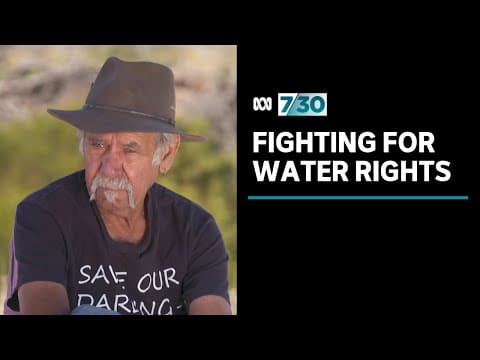
[0:05]For the first time in five years, water is flowing into Lake Menindee as flood waters snake their way down the Darling River. It's a welcome site after one of the worst droughts in living memory, but for some the celebration is bitter sweet. Okay, we got water now, but how long are we going to keep the water for? Barkindji elder William Badger Bates, the recent flows aren't enough to undo years of what he calls water mismanagement. Two years ago, this river system looked very different. A once thriving river now seems more like a stinking swamp. When millions of fish washed up dead in the Darling River, or the Barka, as it's known to local Aboriginal people, the Barkindji felt it deeper than most. It was sorry, it just made us sorry, we cried.
[1:03]A report found the fish kills were a result of high temperatures and prolonged drought, exacerbated by water extraction upstream. For the Barkindji, it was yet another instance where they were forced to watch from the sideline as their country suffered. We take our name Barkinji from the Darling River and we love the Barka, the Darling Barka, and it's our job is to protect it. In 2015, the Barkindji won the largest native title claim in New South Wales, including a 400 km stretch of the Darling Barka. The wind gave the group the right to use water for cultural purposes, but not for economic gain. And it didn't give them the key thing they were fighting for, a meaningful voice in how the river system is managed. 19 years we fought for the country to get our native title. And if it takes us another 19 years, I won't be around, but my people will fight for our rights and fight for our Barka. A spokesperson for the New South Wales Environment Department said it was working on an agreement with the Barkandji to address their access to water. Aboriginal people on this dry continent have a strong connection to water. But on our own country, you know, we should be seen as the original owners, the original custodians, and have a say in how water is managed on our country, but at the moment we don't.
[3:16]Under colonial law, water rights were granted to whoever owned the land. In the '80s and '90s, some land was returned to Indigenous people, but in most cases, without lucrative water entitlements attached. Around the same time, native title gave First Nations groups rights to use water for cultural purposes, but not for economic gain. A decade later, land and water was decoupled in national policy, and water became a commodity to be bought and sold. We find ourselves in the position where we don't have water, we got to go to the market and buy it, land is separated, so all our value sets and all our knowledge is is clashes with the way water is managed on this continent. Today the basin's water markets are worth around $16 billion. Indigenous groups own less than 1% of that water. Part of the plan is also to ensure that those indigenous Australians up and down the basin will share in the opportunities. In 2018, as part of a deal to keep the basin plan intact, the Federal Government pledged to set up a $40 million fund for indigenous groups to buy water in the basin. Three years on, the communities haven't seen a cent. Keith Pitt has since taken over the water portfolio. He declined to be interviewed but said the government was working with indigenous groups to agree on a model to deliver the funds as soon as possible. Lawyer Emma Carmody provides legal advice to First Nations communities in the basin. She says the funding is only part of the solution. If the government is serious about reversing Aboriginal water dispossession in the Murray Darling basin, it has to first of all, reimagine water laws so that they privilege Aboriginal rights and interests and ensure that those rights are enforceable, but it also has to put money on the table, and $40 million just doesn't come close enough. We're talking at a minimum, hundreds of millions of dollars.
[5:24]There are rare cases where Aboriginal groups own and manage water in the basin, and the results speak for themselves. Our dream time stories tell us that we've been here forever, for a very long time. Our supermarkets where the flood plains and our wetlands sitting here beside us, it's where our mob fed, um, sustained themselves. 20 years ago, this property outside Hay in Western New South Wales was a dust bowl. Two decades after the Nari Nari people took ownership, the land is coming back to life. I'm big believer that if the country's talking, you know, you're doing something right.
[6:05]The Nari Nari Tribal Council acquired the property as part of a government scheme to return lands to Indigenous groups. It was one of the few parcels of land that came with the rights and infrastructure to pump thousands of megaliters of water from the Murrumbidgee River. The owners lease that water to irrigate to fund their conservation work. In addition, they apply for a cultural access license each year to pump water for their wetlands. Water is a way out of welfare, you know, we can be farmers, you know, and we can be great business people and we prove that.
[6:46]The property has employed 40 indigenous people over the years. Mark Brettschneider started working at Toogimbie when he was 16. You can see that the flora and fauna and stuff in the area sort of appreciate what you do. And you know, it's it's a great feeling.
[7:04]He says the transformation at Toogimbie shows what's possible when Indigenous people have a voice in water management. If we got country and we got land for people to go to, I'll guarantee you that there's going to be less drug use, less domestic violence, less alcohol abuse, all that sort of stuff in communities if they got places to go and learn from.
[7:33]The potential is the gap will close. So, potentially, we'll have healthier rivers, we'll have healthier country, we'll have healthier culture, we'll have healthier people.
[7:49]Hi, I'm Lee Sales. Thanks for watching this story. If you'd like to watch more of 730 stories, they are on the left of your screen. And tap on the button below to subscribe and get the latest from ABC News.