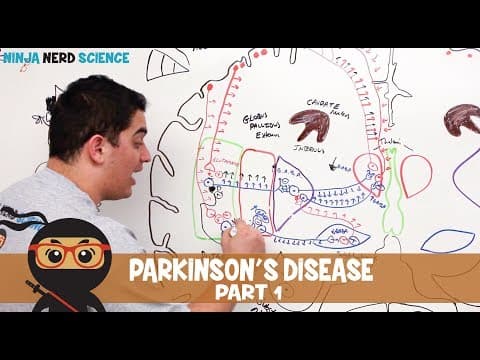
[0:07]All right, Ninja Nerd, so what we're going to do in this video is we're going to talk about Parkinson's disease. But first off, just wanted to let you guys see the new shirt. And we're going to have other types of styles eventually.
[0:16]But, if you guys are interested in any of our types of apparel that we'll be making eventually and having more different types of merchandise, just leave a comment down below in the comment section. Give us any type of advice of maybe the style t-shirt that you want,
[0:28]uh, maybe if you're interested and we'll go ahead and try to get those out soon and available to you guys. All right, so let's go ahead and dive right in first.
[0:34]So Parkinson's disease, what is Parkinson's disease? We're going to get into a lot of detail on it but let's just try to get an overall just definition. So if someone asked you what is Parkinson's disease,
[0:45]you would tell them that Parkinson's disease is the progressive degeneration of the dopaminergic neurons within the substantia nigra and when over those dopaminergic neurons are actually decreasing, it can lead to altered motor movement and we'll define specifically what those motor movements are that are affected.
[1:05]So again, one more time, if someone just came up to you the street and they said, what is Parkinson's disease? What would you say? You would say, it's the progressive degeneration of the dopaminergic neurons that are present within the substantia nigra that can lead to altered motor movements.
[1:22]So let's go ahead and get into that. So whenever you're looking at Parkinson's disease, what would be some of the signs that you would be able to identify with Parkinson's disease?
[1:28]So the mnemonic out there to be able to remember for signs and symptoms. Now there is many, many different types of signs and symptoms.
[1:34]These are kind of like the big ones that you'd want to be able to notice in an individual who has Parkinson's disease. So T, what is T stand for? T stands for the tremors, right? So they'll have tremors and usually these are resting tremors, right?
[1:51]So they're going to have these resting tremors. Now, before I even do that, what kind of tremors are they? So we have this little guy here, right? The one of the tremors is what's called a pill rolling tremor and we'll explain what's actually happening and why tremors are occurring.
[1:58]But it looks like their hands are like shaking, right? And it looks like they're rolling pills within their fingers, right? So that's a pill rolling tremor. So that's one of the specific ones, right?
[2:10]So again, tremors is one symptom. What's another symptom? Another symptom is rigidity. So rigidity. And if you think about it, there's two different types of rigidity. There's actually another one, but we're going to mention the two big ones.
[2:24]So there's two different types of rigidity that we're going to talk about. One of the rigidi we're going to apply to the upper limbs. And what it means is it's like a cogwheel rigidity. So a cogwheel rigidity, what do I mean by that?
[2:34]If I'm trying to be able to, let's say I'm trying to pull someone's arm down, it'll go down and click, click, click, click. So that's a cogwheel rigidity, right? All right, so this can also happen within the lower limbs and what do they call that within the lower limbs? It's a rigidity, but it's called lead pipe rigidity, so they won't, it won't even want to move at all. All right?
[2:52]So that's going to be that type of rigidity that you'll see. You'll see two types of rigidity again. What is one type of rigidity? Cogwheel rigidity and lead pipe rigidity. Lead pipe rigidity is more common within the lower limbs, whereas cogwell rigidity is more common within the upper limbs. All right.
[3:05]Next one, A. A stands for akinesia. Akinesia. And there is another one here. They call it, I say akinesia or bradykinesia. So it means that there's a struggle being either there is little to no movement, right? And then bradykinesia is very little or hard to be able to initiate the motor movement. Okay?
[3:47]And then P. P stands for postural instability. So P stands for postural instability.
[3:59]So if you'll notice, within these individuals, they're always going to have this hunched over posture. They're going to have this hunched over posture too. All right? And then one other thing, with akinesia or bradykinesia, because of the struggled motor movements, their face is actually expressionless.
[4:15]So they have what's called an expressionless face or sometimes they even call it a mask face. Okay? So if you look here, what would we notice then if we were to kind of look at this individual? We would notice a mask face, an expressionless face, right?
[4:37]What else would we notice? We'd notice the tremors, the resting tremors, right? What else would we be able to notice? We'd also notice postural instability, hunched over posture. Okay? Now,
[4:53]here's where we're going to start getting into a lot of depth. So Parkinson's disease. We're going to have to look at a lot of different nuclei. So in the actual central nervous system, we define nuclei.
[5:05]Nuclei is defined as a group of cell bodies that are present within the central nervous system, and then a ganglia is actually called a group of cell bodies that are present within the peripheral nervous system.
[5:18]But they call a lot of these structures we're going to talk about, the basal ganglia, but really they should be called the basal nuclei because they're groups of cell bodies here. Gray matter that are present within the central nervous system.
[5:31]Okay? But they do, they do refer to them as basal ganglia, but they should be referred to as basal nuclei. So what are some of those structures? So if you look here, this green one right here,
[5:39]this is actually called the putamen. Okay? So this green one right here is actually called the putamen.
[5:46]So we call this one the putamen. This red one right here is actually called globus pallidus externus. So globus pallidus externus.
[6:05]And then this one over here, this purple one is internus. So what this one be, this would be internus.
[6:12]So this would be globus palidus externus and this is globus palidus internus. This right here is your caudate nucleus. It's also an important component of the actual basal nuclei. So caudate nucleus.
[6:23]So caudate nucleus. And then right here, this is just going to be your third ventricle, and you'd also have your hypothalamus around here. These are your thalamus, so you're actually going to be your thalamus right here. We'll put thalamus.
[6:38]Over here you're going to be your subthalamus. So we're going to have your subthalamus right here.
[6:44]And here's the big, big most important one, and this is going to be the substantia nigra. Okay?
[6:57]So we have again, what do we have? We got the putamen, the globus pallidus externus, the globus pallidus internus, the caudate nucleus, the thalamus. This would be the third ventricle. Subthalamus and substantia nigra, right?
[7:37]And again, this whole thing here is the lentiform nucleus. And we do have the striatum. And then we'll have a cortico-striatal pathway, nigrostriatal pathway. And then we even have what's called the the striatal-pallidal pathway. But we'll get into all that stuff. So first off,
[8:44]the problem with Parkinson's disease is abnormal motor movement, right? So if they have abnormal motor movement, sometimes what we need to understand is what is the actual normal activity of the central nervous system and how it coordinates these motor movements.
[8:57]So let's go ahead and do that first. But before we even get into how Parkinson's disease is occurring, let's get into the normal physiological activity here that is affecting this muscle over here. So let's go ahead and do that.
[9:09]So, whenever you're thinking about performing a movement, let's say I want to be able to flex my bicep, all right?
[9:14]If I want to be able to flex my bicep, that thought for me to be able to flex my bicep had to originate usually within the prefrontal cortex, and then it actually could stimulate the premotor cortex. It could have even stimulated the primary motor cortex, and even the primary somatosensory cortex.
[9:33]So a lot of this stuff is coming from the cortex, right? A lot of the gray matter from the cortex. So again, the thought that arises, the desire, so that thought to be able to move the muscle, arises within the prefrontal cortex.
[9:43]The planned and repetitive motor movements that you have in there is going to be the premotor cortex, and then you can also have information sent to the primary motor cortex, and then the primary somatosensory cortex can also have fibers that come down.
[10:11]All right, So now, what happens is, in order for us to be able to coordinate this movement, the cortex before it sends it down and out to the muscle, it has to send this message down in to the putamen.
[10:23]All right, so it sends this actual neurons, these neurons that extend all the way from the cortex down into the putamen. So again, we call this pathway the cortical striatal pathway, right?
[10:35]Because we call this putamen part here, we call the striatum. All right? So now, cortical striatal fibers come down from the cortex to the putamen. These neurons right here are releasing a specific type of neurotransmitter that's usually a stimulatory neurotransmitter. This neurotransmitter is called glutamate.
[11:00]Okay? So glutamate is actually and generally an excitatory neurotransmitter. So what it does is it releases that glutamate onto these neurons that are present within the putamen.
[11:10]Okay? So it releases these actual this glutamate, sorry, this glutamate onto these receptors that are present on these actual neurons here. And when it does that, it stimulates this neuron.
[11:21]And this neuron extends all the way over here until it gets to this portion right here in the globus pallidus internus. So it extends from the putamen all the way to the globus pallidus internus here. And this neuron releases a specific chemical.
[11:35]And this chemical is naturally almost always inhibitory, and this chemical is called gamma, so G, amino, A, B, which is butric, and A, which is acid. We just call it GABA. Okay?
[11:51]GABA stands for gamma amino butric acid. So GABA actually binds onto these neurons that are present here within the globus pallidus internus.
[12:04]And when it does that, what did we say GABA is? GABA is an inhibitory neurotransmitter, where glutamate was a stimulatory neurotransmitter. So glutamate likes to initiate what's called EPSPs, excitatory postsynaptic potentials. So cation influx.
[12:20]So it loves to load cations into the cell body through NMDA receptors and it causes calcium to flush in, right? And causes action potentials. But GABA, GABA works through causing potassium ions to leave the cell or chloride ions to come into the cell.
[12:35]So by doing that, what happens? If chloride ions are coming into the cell, there's more negative ions coming in, it's undergoing IPSPs or inhibitory postsynaptic potentials. So then what's going to happen?
[12:49]So if we were to look at like this, let's come over here real quick, look at the graph. Let's say here is my resting membrane potential.
[12:57]So every cell should have a resting membrane potential, right? Negative 70 millivolts, let's say. And then it has a threshold that it has to reach, in this case for a neuron to generate an action potential.
[13:11]If we use red to denote the glutamatergic neurons, what they're doing is they're bringing the resting membrane potential up to approach threshold. That's called an EPSP, right? So it's trying to approach threshold.
[13:25]But then we use the blue to denote the GABA, it's actually bringing the resting membrane potential. It's actually bringing it away from threshold. So then what would that generate? It would want to generate a IPSP.
[13:38]So if you think about it, there's this mixture, right? So you can have EPSPs, which are trying to stimulate it, reach threshold and cause an action potential. And then there's these IPSPs, which are trying to bring it away from threshold and inhibit it from having an action potential.
[13:50]So glutamate is trying to stimulate action potentials, and GABA is trying to inhibit the formation of action potentials. So this wants to cause depolarization, this one wants to cause hyperpolarization.
[14:00]We just need to make sure we get that general anatomy down first on physiology, sorry. So again,
[14:05]glutamate's release, stimulates this neuron. Then what will happen? Action potentials will proceed down this axon here. It'll release a lot of GABA.
[14:13]But GABA or gamma aminobutyric acid is an inhibitory neurotransmitter, where glutamate was a stimulatory neurotransmitter. So if you're releasing a lot of it onto this neuron, what are you going to do to this neuron? You're going to inhibit this neuron.
[14:24]And this neuron actually extends all the way from the globus pallidus internus to the thalamus. So they call this the pallidothalamic fibers. Okay?
[14:35]In the thalamus, there's another group of cell bodies here. And these group of cell bodies like to extend all the way back up here to some of these cell bodies within the cortex. But first before we do that, let's look at this.
[14:50]This guy was inhibited, right? So if you think about it, you can draw down, down arrow to denote very little action potentials, whereas this one, when he was stimulated, he's having a lot of action potentials, right?
[15:06]So a lot of action potentials because he was stimulated by glutamate, he inhibits him. So there's very little action potentials. So what will happen then?
[15:12]He'll release very little GABA. So it's not going to release as much GABA there. And if there's less GABA, then you're going to have less IPSPs. And if you have less inhibitory postsynaptic potentials, it allows for this cell body to start slowly approaching threshold.
[15:33]So in other words, they say it's releasing it from inhibition. So if you're releasing this neuron from inhibition, he will then technically be stimulated. And then we'll show stimulation by upward arrows.
[15:47]So now, if you have stimulation here, then the primary motor cortex is going to be stimulated. Why would I want to do that?
[16:05]Because dopaminergic effect desires to be able to increase or enhance the motor movement. That's our desire to enhance the motor movement.
[16:24]So you want more stimulatory input to come in, less inhibitory input. Because this inhibitory input could also be going to the biceps muscles.
[16:34]So the inhibitory input could be coming to the triceps muscles, and the inhibitory input could be going to the biceps muscles. But we want as much stimulatory input possible going to the biceps muscles. That's what the purpose of this dopaminergic effect was, right?
[16:51]Before, the direct pathway was actually having a stimulatory effect, and the indirect pathway was having an inhibitory effect. So the biceps muscles might not have contracted as powerfully as before. Then what does dopamine do? Dopamine comes in there and says, all right,
[17:15]let's enhance the direct pathway, and let's even kind of kick up and increase the indirect pathway. So now what's happening to the biceps muscle? It's having more powerful contractions, right? So it's going to have better contractions here, less inhibitory input, that is a good thing.
[17:28]Now, one more thing and then we're going to go into the disease now. There's other neurons which are present right here. And this neuron actually can do the exact opposite effect of dopamine. So these are cholinergic neurons.
[17:40]These cholinergic neurons, if dopamine is inhibiting this neuron, guess what the cholinergic neurons will be doing over here? They'll be attempting to stimulate that neuron.


