[0:00]Thank you to my Patreon members who helped make this video possible.
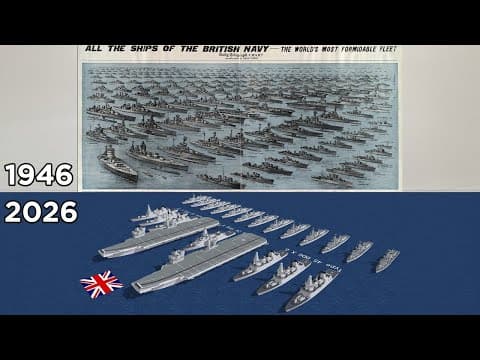
[0:07]In 1944, the Royal Navy sent 1,200 warships to the beaches of Normandy. Battleships, cruisers, destroyers, landing craft stretching to the horizon. It was the single greatest naval operation in human history, and Britain led it. 82 years later, in 2026, the Royal Navy couldn't scrape together enough frigates for a NATO patrol, so it borrowed one, from Germany. This is the story of how the most powerful navy the world has ever seen, a force that ruled the oceans for 300 years, that defeated Napoleon, that held the line against Hitler, shrank to 63 ships. Fewer ships than it lost in destroyers alone during the Second World War, and the decline isn't over. To understand how far the Royal Navy has fallen, you need to understand how high it once stood. In September 1939, when Britain declared war on Germany, the Royal Navy was the largest and most powerful fleet on the face of the Earth. 15 battleships, seven aircraft carriers, 66 cruisers, 184 destroyers, 60 submarines, over 1,400 vessels in total, crewed by 200,000 men, operating from naval bases on every inhabited continent. And that was just the starting point. Over the next six years, Britain transformed itself into a naval war machine on a scale that's almost impossible to comprehend today. By 1945, the fleet had swelled to nearly 900 major combat ships, 52 aircraft carriers, 257 destroyers, 131 submarines. The personnel rolls had exploded from 200,000 to 861,000 sailors, marines, and airmen. The Royal Navy didn't just participate in the Second World War, it fought across every ocean on Earth simultaneously. In the Atlantic, it waged the longest continuous campaign of the entire conflict. Six brutal years of convoy battles against German U-boats, protecting the supply lines that kept Britain alive. 3,500 merchant ships were lost. Thousands of sailors drowned in freezing water, but the convoys kept coming, and Britain didn't starve.
[2:37]In the Mediterranean, it fought the Italian and German navies for control of the sea lanes to North Africa. It launched the strike at Taranto, carrier-borne aircraft crippling the Italian fleet in harbor. An operation the Japanese would study carefully before a place called Pearl Harbor. In the Arctic, it ran convoys to the Soviet Union through some of the most lethal waters on the planet, under constant attack from aircraft, U-boats, and surface raiders operating out of Norway. And when D-Day came, the 6th of June 1944, it was the Royal Navy that provided the backbone of the invasion fleet. 1,200 warships, thousands of landing craft, the largest amphibious operation ever attempted, and Britain put more ships in the water that day, than the entire Royal Navy possesses in 2026, by a factor of 20. By the end of the war, Britain had spent over 50% of its entire national wealth on the fight, and the Royal Navy had paid a staggering price. 278 major warships sunk, over 1,000 smaller vessels lost, 50,000 sailors killed. The Navy lost more destroyers during the war, over 130 than it has total ships today, but it won, and in 1945, the White Ensen flew over the most battle-hardened, globally deployed, technologically advancing navy in history. So, what happened? What happened was that Britain won the war, but lost everything else. The country was bankrupt. The empire that had justified a global navy was dissolving. One by one, the colonies and bases that had given the Royal Navy its worldwide reach simply disappeared. But the cuts didn't come all at once. They came in waves, each one deeper than the last, each one sold as a sensible adjustment to new realities. The first real blow landed in 1966, when the government canceled the CVA01 program, Britain's next generation of aircraft carriers. The decision was dressed up in strategic language, but the message was blunt. Britain would no longer maintain the capability to project naval power independently. From now on, the Navy would shelter under the American umbrella. Then came the 1967 defense white paper and the withdrawal from East of Suez. The bases in Aden, Singapore, the Persian Gulf, all gone. The Royal Navy, which had once policed the world's oceans from Gibraltar to Hong Kong, was retreating to the North Atlantic.
[5:22]Before we continue, I want to tell you about something I finally finished working on. Bismarck, From Glory to the Abyss. It's the complete story of the most powerful warship Germany ever built. From the secret keel laying in Hamburg in 1936, to the discovery of her wreck three miles beneath the Atlantic in 1989. She packed more history into eight days than most ships see in a lifetime, and I want to tell that story the right way. If you want to grab it, scan the QR code onscreen right now with your phone. It'll take you straight to the book. You can also find the link in the description and pinned comment. Now, let's get back to where we were. By 1975, the fleet had shrunk to 166 ships. Still a serious navy, still capable, but already a shadow of what it had been 30 years earlier. Then the Cold War ended, and the politicians saw their chance. The peace dividend of the 1990s gutted what remained. Why maintain expensive warships when there was no Soviet fleet to fight? The cuts were savage. Entire classes of ships were scrapped or sold. Shipyards closed. The skilled workforce that had built the wartime fleet, the welders, the fitters, the designers, dispersed and never came back.
[6:52]There was one brief shining moment when the old spirit flared up. In 1982, Argentina invaded the Falkland Islands, and the Royal Navy sailed 8,000 miles to take them back. It was a remarkable achievement. Carrier-launched airstrikes, amphibious landings, destroyer duels with Exocet missiles, but it was also a warning. The Navy lost six ships and had another ten badly damaged. If the Argentinian bombs had been properly fused, the losses would have been catastrophic. The Falklands should have been a wake-up call. Instead, it became a farewell tour. The last time the Royal Navy would fight a war on its own. After that, every defense review brought more cuts. The frigate and destroyer fleet that had numbered over 50 in the early '80s fell to 40, then 30, then 20. The government kept ordering reviews, and the reviews kept recommending fewer ships, because that was what the budget allowed. Nobody ever asked whether the budget matched the threats. And then, in the 2000s, the decision was made to build two enormous aircraft carriers, HMS Queen Elizabeth and HMS Prince of Wales. 65,000 tons each, the biggest warships Britain had ever built. They were supposed to be the centerpiece of a revitalized fleet. Instead, they became monuments to a Navy that couldn't afford to use them properly, which brings us to today, April 2026, and the numbers are devastating. The Royal Navy has 63 commissioned ships, 63. To put that in perspective, in 1945, the Royal Navy had 52 aircraft carriers alone. Today, the entire fleet, carriers, destroyers, frigates, submarines, patrol boats, everything is 63. Let's go through it ship by ship, because the overall number is bad enough, but the details are worse. Start with those two grand carriers. HMS Queen Elizabeth is sitting in a Scottish drydock, months behind schedule on maintenance. Nobody can say when she'll sail again. HMS Prince of Wales is technically available. She was put on five days' notice in March when the Middle East crisis flared up, but she spent only 21% of her commissioned life actually at sea. A warship that spends four-fifths of its existence tied to a wall. The destroyer force. Six Type 45s, supposed to be the most advanced air defense ships in the world, and in many ways, they are. The Sea Viper missile system is genuinely formidable, but right now, only HMS Dragon is actually deployed, out in the Eastern Mediterranean. The rest are either in maintenance, getting their engines ripped out and replaced because of a design flaw that's plagued the class since they were built, or sitting alongside waiting their turn. The frigates. Seven Type 23s, most of them over 25 years old, and not all operational. The Royal Navy entered 2026 with fewer frigates than it's had in centuries, and the replacements, the Type 26 and Type 31 programs are running years behind schedule. The first Type 26 was supposed to commission in 2026. Now it'll be 2028 at the earliest. There's a growing gap where old ships are retiring and new ships haven't arrived. But the submarine situation is where it gets truly alarming. The Royal Navy has six Astute-class nuclear attack submarines. Six, and as of early 2026, only one, just one, is at high readiness. Four others are at low or very low readiness, stuck in maintenance and refit cycles. And the sixth, she's in Australia, part of the AUKUS program, helping the Australians learn to operate nuclear submarines. Meanwhile, the sailors who make all of this work are leaving. Total trained strength has dropped from 39,400 in 2022 to 37,800 in 2026. The Ministry of Defense has increased recruitment spending by 20%, and for the first time in years, more people are joining than leaving. But new recruits take years to train, the experienced sailors, the ones who actually know how to fight a ship, are walking out the door faster than they can be replaced. And then there's the Royal Fleet Auxiliary, the unglamorous but absolutely essential support ships that carry fuel, ammunition, and food for the fleet. Without the RFA, the carriers can't deploy, and the RFA is on strike. Their pay has fallen 30% in real terms over the past decade. The Ministry of Defense offered 4 and a half percent and couldn't even prove it was paying minimum wage. So the sailors walked out. The First Sea Lord, the head of the Royal Navy, stood up at a conference in February 2026 and said plainly that the Navy is not as ready as it should be. He estimated that full war readiness might not come until the 2030s. The 2030s, and this is where it stops being about numbers and starts being about something deeper. The Royal Navy isn't just a military force, it is woven into the identity of Britain itself. This is a nation that exists because of its Navy. An island that survived Napoleon, because Nelson destroyed the combined fleets of France and Spain at Trafalgar. A country that endured the darkest days of 1940 and 41, because the convoys kept getting through. The Navy didn't just defend Britain, it built Britain. It connected the empire, it carried the trade, it enforced the peace. Every schoolchild used to know the names: Trafalgar, Jutland, the River Plate, the Bismarck. They weren't just battles, they were proof that when everything else failed, Britain could still command the sea. Now the Navy has more admirals than it has ships, and the hardest part isn't the statistics, it's the contrast. Knowing that the same nation which built 52 aircraft carriers in six years of total war, now takes a decade to build a single frigate. Knowing that a Navy which once deployed 1,200 warships on a single day, now struggles to send one destroyer to the Mediterranean. Knowing that the shipyards that armed the most powerful fleet in history, now employ a fraction of their wartime workforce. There are plans. The strategic defense review talks about a hybrid Navy, drones, autonomous systems, AI. The Type 26 and Type 31 frigates are being built. The Dreadnought submarines will carry the nuclear deterrent into the 2060s. But plans don't float, and there's a dangerous gap between the fleet the Navy has today and the fleet it's been promised for tomorrow. The Royal Navy once ruled the waves. That phrase wasn't propaganda. It was a statement of fact backed by 1,000 ships and half a million sailors. Today it's a memory. The question is whether it stays that way.


