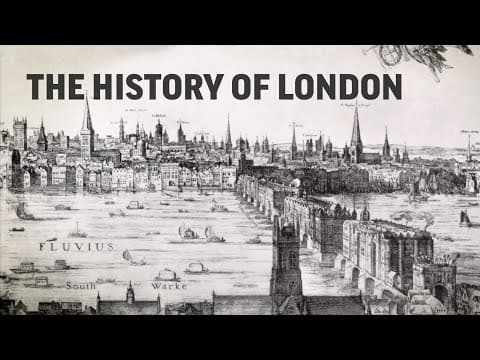
[0:13]The history of London started 2000 years ago when the Romans settled here on the north bank of the Thames in the area we'd now know as the City of London. And they chose this site because the river was narrow enough to build a bridge across to the South Bank and connect with the roads to Cirencester to Dover and to Canterbury. They protected the city with walls that stretched from the Fleet River in the west to Tower Hill in the east and it remained the center of administration for the Romans until they departed at the beginning of the 5th century.
[0:54]Over the next millennium, the area grew into a major trading city. Its commercial wealth attracting the establishment of the Palace of Westminster to the west, thus setting up the polarity between state and commerce that exists to this day.
[1:19]The medieval City of London was contained within the ancient Roman walls. It was densely packed with narrow streets and timber houses. The disastrous Great Fire in 1666 destroyed some 80% of the city. And although King Charles II and others like the architect Sir Christopher Wren wanted to rebuild with a Renaissance plan of wide streets and vistas, the merchants wanted to get back to business as soon as possible. So the city was rebuilt on the old plan. The fire also led to the setting up of the London Building Act which decreed that all new housing should be built of brick and to a standard design which formed the basis of London streets for the next 200 years. Georgian London spread westwards as developers and estates built planned streets and squares in places like St. James and Mayfair. In the 19th century, London's population grew to 4 million people. The greatest city in the world and the center of the British Empire. It was a city of fine public buildings, grand houses, as well as horrific slums where existing suburban settlements grew until they formed a large and untidy metropolis.
[2:52]In the 20th century, London grew by spreading outwards with the growth of the suburbs. By the beginning of World War II, the population totaled 8.6 million people.
[3:16]The Abercrombie plan for post-war blitz damaged London in town decanting citizens to new towns in the home counties. Thus the population fell and continued to do so until 1988, when the capital began to grow as a global financial center and there was an increase in immigration. Today, London's population is about 8.6 million people, about the same number it was in 1939. But by 2036, we expect that number to have grown to closer to 11 million people.


