[0:00]The US and China have been locked in a battle for influence around the world, and at the moment, the US is losing. We're here today to talk about one element that is a gap in our strategy for pushing back against China at the edge, and that is a lack of good data. We don't understand what local populations need, what they think and what they expect out of partnerships with global superpowers. First of all, let me take a moment to thank Van of our labs for sponsoring this event and another series of events on competing with China at the edge. So let's take a step back and set the scene. Domestically and globally, Beijing has become more authoritarian. This is evident in their repression of the Weers, their dismantling of democratic freedoms in Hong Kong. Its support of Russia's invasion of Ukraine and the global export of censorship and surveillance technology. Despite these things that Emily mentioned, global perceptions of the United States are falling, whereas perceptions of China are rising. We can look at Canada as a really good example of this. In 2025 adults in Canada viewed China and the United States similarly favorably at 34%. However, in comparison to the previous year, the perceptions of the United States fell 20 points, whereas China gained 13. For decades, China has consistently engaged with countries all over the world to build credibility and influence. China has adopted a local level strategy. It puts effort into working with local communities, adapting to local cultures and building influence not only in national capitals, but also in regional capitals and rural areas. On the other hand, Washington has not really built the similar public diplomacy strategy to counteract that Chinese messaging. One reason for this is that the US doesn't have the data that it needs to effectively respond to breaking events. Understanding the people, their needs and their goals will help us push back against Chinese influence. But at the moment, policy makers are largely forced to rely on assumptions rather than actual evidence. Let's dive deep on one example of this tension between the US and China in a critical part of the world, Cambodia. So Cambodia is frequently cited as the most pro-China country in Southeast Asia. China is Cambodia's largest investor as well as its largest trading partner. In 2025, China was responsible for 25% of the total foreign direct investment in Cambodia, which totaled a staggering 3.76 billion. On the other hand, Washington is not even in the top five. The sheer scale of Chinese investment in Cambodia is having both positive and negative impacts on local perceptions of China. This, combined with other complicated narratives, such as the fallout of the COVID pandemic and educational exchanges are impacting local populations' perceptions. We're going to focus now on one specific investment that China's made in Cambodia, which is down here in the Southwest corner known as the Sihanoukville Special Economic Zone. This area in the southwest as I mentioned, is located about 12 kilometers from the Sihanoukville port, which is the country's only deep water port and is also quite close to the beach town of Sihanoukville. The Sihanoukville Special Economic Zone is a partnership between Cambodia and China that began in 2006. By 2009, we can see that development is already taking place within the southern part of the Special Economic Zone down here. Today, in 2026, we can see how much this area has grown. It's really quite astonishing. I mean, I think the previous slide was down here, is that about right? And all of this has grown since then, and then what's this area up here? So this area is still under development. Currently, the Special Economic Zone is about 8 km squared, but it's proposed to grow even to 11. That's astonishing. And then if we look at the next slide, you can actually see the growth for the people and also the number of enterprises. And I have to say, I find this piece of this astonishing. Yeah. So in by 2017 when the Special Economic zone started in 2006, we saw that 109 enterprises had been built, but 94 of those were Chinese and only three were local Cambodian. Created 16,000 jobs. Now we'll fast forward to 2025. We see 217 enterprises today and about 35,000 jobs have been created in this area. And I don't think we have updated data for how what percentage of those businesses are actually Chinese or actually Cambodian. But we can certainly see that with the growth of that zone, it's been largely China and not a lot of local support. Correct. And that's one of the biggest criticisms of the special economic zone is that there are few opportunities for local Cambodians to move themselves up. So a lot of these enterprises seem to prefer to hire Chinese nationals at the middle and upper management area, which hasn't really created this many employment opportunities for local Cambodians. Other criticisms of the Special Economic Zone have to do with Sihanoukville itself, the city. This area used to be quite a sleepy beachfront town, but Chinese investment has transformed it into what once was a booming resort town. When China invested in the Special Economic Zone as well as other Belt and Road Belt and Road initiatives like the Phnom Penh, Sihanoukville Expressway. It signaled to private Chinese investment investors that this was a lucrative area and they could potentially make money investing here. So a lot of private Chinese investors built casinos and hotels in Sihanoukville. And what I understand was the COVID-19 pandemic was a huge change here. Correct. So when COVID-19 halted international travel to Sihanoukville into the world, Chinese investment in the area stuttered. And that left thousands of buildings vacant, and it also created a vacuum that transnational organized criminal organizations have stepped in to fill. So now Sihanoukville is known for having these large industrial scale scam centers where basically people are trafficked to the area from all over the world, forced to commit scams and defraud people globally, which raises billions of dollars for these transnational organized crime groups. So we see these two sort of areas working together in a way. We've got the beach town that is now a home to some scam centers, and we've got the economic zone, which is growing rapidly with a huge Chinese presence. So they're not officially connected, but we do see at least a geographic proximity. Correct. Yeah. So obviously all of this Chinese investment as well as the increase in crime that we've seen are shaping Cambodia's perception of China. We're seeing that today 75% of Cambodians think that Chinese growing influence in the region is positive or more positive than negative, with only 25% saying it's negative or more negative than positive. But what's really interesting about this specific data is that 75% of the people who responded identified crime and security concerns as a reason for their negative perceptions of China. However, we know that, but this data is only taken on 11 provinces of Cambodia plus the capital region out of an entire 24 in the country. So it's not fully representative of what's going on in the country as a whole, but it's also not quite specific enough for us to identify what exactly China's done or the US has done that's impacting this data. So from this level, it's hard to know whether this is perceptions of crime in general or crime specifically in the special economic zone or even around these particular Chinese investments. We just know that there's overall a very positive view of China with the caveat. Correct. And we can see similar problems in other data taken from this region. So this is showing the way the country that Cambodians would prefer their country aligned with between US and China. So in 2020, we see 42% choose the US, whereas 57, 58% choose China. But what's really interesting about this data is if you look at the jump between 2022 and 2023, we have 18.5% choosing the US this year and 81.5% choosing China. But then it essentially flips the next year, but we don't really have the data to understand why that happened. Is that a result of something positive that the US did in 2022 that then changed perceptions? Is it a result of something negative that China did that made people turn away from China? And until we can understand the why behind this data, we're not going to be able to make targeted policy decisions that are going to both benefit local Cambodians and then also increase US soft power. I mean that swing is immense, going from 42 to 53 to 18 to 73. I really want to know what happened in this space to cause that shift and we just don't have that kind of data right now. Yeah. So policy makers clearly need to understand more about what is happening at the local level, far beyond these broad national trends. That means more in-person engagement, but also smarter ways to collect large data sets, using AI to analyze them so we actually understand what's behind the data and then thinking through and experimenting with what kinds of messaging might really work in these kinds of situations. Using natural language processing to analyze, for example, camera language, social media, local community platforms in particular regions. For example, a spike in words and phrases like debt or eviction might suggest that it's a time to engage with a new US strategy, that there is in fact a declining perception of what China's doing right now. That could allow the US to pivot its aid toward local business grants or other kinds of incentive structures. As we see here, China is the number one investor, but we really don't understand what percentage of that investment stays in Cambodia and helps local Cambodians. For example, if a $100 million factory is approved, but 90 million of steel, machinery, other supplies are imported from China, the value add to Cambodia is minimal. This isn't a problem or a strategy that's unique to Southeast Asia. Chinese investment and engagement is global, and US policy makers need the right data to successfully engage. Some questions they should consider asking. Where are the steel, machinery, other supplies actually coming from? Who is transporting the supplies? Who is employed in these Chinese businesses? How are locals talking about the project and talking about their perception of this outside investment? If the US is going to compete successfully at the edge of influence, it will need real-time data to be able to respond to events as they happen. It will need the AI tools to process that data and it will need the intelligence to respond and respond usefully for the people on the ground. Thank you so much.
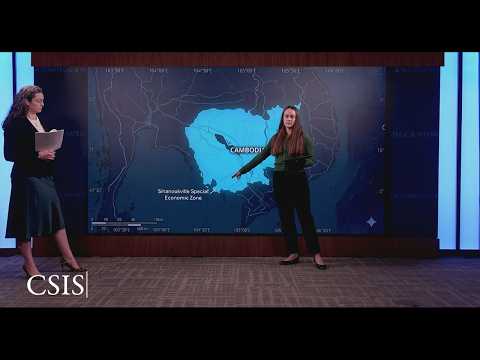
Using Data to Win in the Era of Strategic Competition: Lessons from Cambodia
Center for Strategic & International Studies
10m 48s1,831 words~10 min read
YouTube auto captions
Transcript source
YouTube auto captions
This transcript was extracted from YouTube's auto-generated caption track. The transcript below is server-rendered so it can be read, searched, cited, and shared without opening the original YouTube player.
Pull quotes
[0:00]The US and China have been locked in a battle for influence around the world, and at the moment, the US is losing.
[0:00]We're here today to talk about one element that is a gap in our strategy for pushing back against China at the edge, and that is a lack of good data.
[0:00]We don't understand what local populations need, what they think and what they expect out of partnerships with global superpowers.
[0:00]First of all, let me take a moment to thank Van of our labs for sponsoring this event and another series of events on competing with China at the edge.
Use this transcript
Related transcript hubs
Watch on YouTube
Share
MORE TRANSCRIPTS


