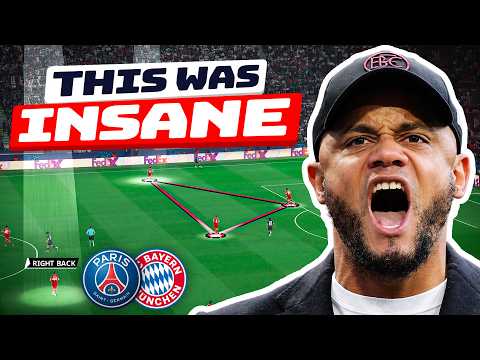
[0:00]The most vulnerable stages for both teams in football is the state between the different moments of the game, and that was on full display in the encounter between PSG and Bayern Munich. And the match also showed how some of the things we've praised Bayern and PSG for over the past few months could be the reason that they lift the trophy or that they crash out next week. So let's take a look at the tactics, beginning with PSG in possession. And Bayern were extremely aggressive in their press, and they have been one of the biggest proponents of man-to-man marking. And we saw it again in this match, as if PSG were building with a more traditional back four, either like this or with Vitinho or Nevez dropping in, Bayern's shape would instantly shift. With Musiala and Kane leading the charge through the center and the wingers covering the wide regions, backed up by Kimmich and Pavlović on the two deepest midfielders. The issue presenting itself, of course, is a midfielder moving into the front line, means that they're depleted here, and could potentially be overloaded. But the man-to-man was so aggressive that ideally, rather than having a center back step in and potentially create more structural vulnerability here, company preferred his right back to tuck into the midfield and often pick up Zaya Emery.
[1:10]When we think of Bayern and fluidity, we're usually talking about their attacking shape, but this encounter was a perfect example of how great they are at adapting their man-to-man system on the fly when defending. As in that first half, PSG often built in a back three with Mendes talking in, which meant that Bayern could maintain a roughly similar pressing shape.
[1:34]But rotations are a massive part of how PSG keep possession, so often they had a midfielder drop in, drawing in Kimmich or Pavlovic even higher. So it would be up to Alise to tuck in to prevent that overload instead. Failing that, the center backs were also great at identifying the last ditch scenarios where it was up to them to step up for the press.
[2:01]Different solutions for different scenarios. And the result of this, well, it worked. And this high pressure, combined with PSG's midfield often maintaining large spaces between each other, meant that if the highly technical PSG players occasionally got caught on the ball, Bayern could win it, leading to instant counterattacks, which happened on a few occasions. But remember how we just said that this defensive system worked for Bayern? Well, it worked sometimes, because when it failed, it failed catastrophically. Because PSG could use some of the most common ways of breaking a man-to-man press effectively. Physicality, which is usually pace, running power or strength, technicality, which is usually dribbling, associative play, which is combination play, or taking advantage of temporary communication errors. Man-to-man marking requires exceptional coordination with defenders either knowing to stick to their man across the pitch or when to pass them on to a teammate. One error means there's usually an unmarked man, leading to easy progression like we see here.
[3:13]Or much worse, like we see here.
[3:25]Man-to-man also creates built-in 1v1s, which is fine against most teams with one or two danger men. But PSG have three genuine dribblers up top, and two fullbacks who are quick, as well as midfield technicians. This, of course, means there's a decent chance of a man being beaten and completely opening up the game.
[3:51]And all of this was particularly devastating as the rotations and combinations between PSG's men would exaggerate these scenarios. Higher up on the pitch, we often saw them move into rough 3-2-5 shapes, with the front line looking to push the defense deep. Particularly, if Bayern's pressing pack were drawn high up the pitch, it now created a chasm for PSG men to drop into, and the man-to-man pressing would create natural gaps in the back line, which PSG were more than technical enough to take advantage of.
[4:30]The disadvantages, of course, for PSG were also present because of how they attacked, as these heavy rotations would mean that if they did lose the ball, if Bayern countered quickly, there were plenty of men out of position. That could be paired with the fact that they often still had plenty of numbers high up from the pressing phase, meaning that Bayern could look lethal on the counterattack, particularly down the PSG ride where Hakimi was much more aggressive than Mendes, especially in that first half.
[5:02]But it wasn't just the counter where Bayern looked dangerous. What did they do when they were in possession? And just before we take a look at what Bayern did in possession and the risks they were willing to take when they had the ball, if you are a true tactical nerd and want to take your understanding even deeper, sign up for football fundamentals through the link down in the description below. And football fundamentals is my free program designed to teach you the basics and the fundamentals of tactical analysis over the course of 30 days. And like I said, it's completely free. PSG did often look to press high, but weren't quite as front-foot as Bayern. But still, that initial pressure meant that Bayern weren't building in a slow control pace, meaning we saw less of the forwards dropping super deep in the first phase to pick the ball up off the center backs or the goalkeeper. But still, even when they did get higher up the pitch, Kane and Musiala were operating almost as dual tens as we've seen throughout the season. Looking to drop deep and draw defenders to potentially create room in behind for the wingers, or at least isolations.
[6:10]And interestingly, especially early on, PSG's pressing shape was highly aggressive, and we saw Hakimi push high down the right onto Alfonso Davies. Meaning that Marquinhos would move into a temporary right back position, and Neves had to take up the role of following the dropping forward. And while PSG may not have been made to pay for this shape directly, it was high risk, and they did look vulnerable at times.
[7:34]Throughout the season, we've seen that Bayern are all in on company style of play. That means when they attack, if they lose the ball, they look to instantly make the pitch as small as possible and then counterpress. This means that naturally, they leave a lot of potential for isolations and space for the transition, and they looked extremely porous on the break, and PSG with their attackers were sure to make them pay. A classic first leg encounter means the second leg is perfectly set up, with only one goal in it. But I want to know two things from you down in the comments below. What do you think both managers could have done better tactically in this match? Who do you see going through to the final after the second leg? Of course, in a match as hectic as this, it's impossible to cover everything that happened, so drop anything else down in the comments below. And if you're curious about why Company and Enrique's styles of play have been so effective this season, check out this video on screen now. But first, don't forget to check out football fundamentals through the link down below.