[0:28]The score is 28 to 9. People like to talk about 28 to 3, but no. Sorry, I'm gonna have to be a snob about this. Many people won't taste the difference, but if you want the best of the best, reach for the vintage and go for 28 to 9. I think you'll enjoy it.
[0:46]It's the highest anyone's ever been with a minute and a half left in the third quarter of Super Bowl 51. Largely because of what immediately proceeds it. The New England Patriots have finally scored a touchdown. Down 25 points, they needed it quickly. What they produced instead was this arduous lurching drive full of runs and short passes that ran more than six of the remaining 23 minutes off the clock. Minutes they just do not have to spare. When Tom Brady finally drops one into James White from five yards out, well, sure, it's the very least they can do. So, they set up for the extra point and trot out Stephen Gostkowski, one of the most automatic kickers of all time, to complete the paperwork. Yeah, NFL rules now set the distance for the extra point a few yards back from where it used to be, but paperwork is still always seen as. When he clangs it off the right upright, it makes the sound you hear when you're attempting to close the program without saving your work. You can literally hear them losing. After all that, the Patriots still can't bring it to double digits. It just is not their night. On the next play, the Patriots further debase themselves by lining up for the onside kick. One of the most graceless and stupid looking things in the world of sports. If the extra point is paperwork, the onside kick is, I don't know, check fraud. Your job is to kick it to yourself, but the rules say you have to kick it at least 10 yards, so you have to make it bounce as awkwardly as possible before you pick it up. What we're about to see is a level of desperation rarely seen in football. A team in such dire straits that they felt compelled to kick onside before the game has even reached the fourth quarter. It's something that, if you're lucky, carried about a 20% success rate back then. While the Pats don't initially telegraph their intentions with personnel, they do show a look that they typically don't on kickoffs, with four Patriots bunched tightly on either side of kicker Stephen Gostkowski. That should be an obvious sign of what's about to happen, yet the Falcons are lined up like it's a regular old kickoff. When the Pats stay in this look, even as Gostkowski approaches the ball, it removes any ambiguity. But somehow the Falcons initially retreat, even after Gostkowski strikes the ball. It's like the mere idea of an onside kick has never even crossed Atlanta's mind. And it just doesn't matter. Everything's been coming up Falcons, and everything's continuing to come up Falcons. They recover the kick, still stumbling into doing the one final thing they needed to do to extinguish the one remaining molecule of doubt. This is now a formality. All they have to do is dot some eyes and cross some Ts on the last page of paperwork to acquire their very own shiny new Vince Lombardi trophy.
[3:38]After living in New York for a little over two years, I just knew I had to be back home in Atlanta to watch the Falcons try to pull off the unthinkable. I had to be surrounded by my people to fully appreciate what I was watching. I mean, as a Falcon's fan, this is a moment that rarely happens. The last time my team made the Super Bowl, I was a snot-nosed six-year-old, barely comprehending the full importance of the big game. Fast forward almost 20 years later, there was no chance I would pass on the opportunity to watch the team that I grew up with, go for it all, and the city that I love. And what I was watching was pure domination. Not only were the Falcons crushing on all levels, but they were doing it against the goddamn Patriots. Seeing the smug look wiped off Tom Brady's face was pure bliss. For a moment, it seems as if my friends and I were the happiest we had been in our entire lives. There was talks of which one of the finest, let's just say clubs that Atlanta has to offer, that we would go to celebrate that. This was a moment that a city and a franchise had been waiting on for years, and it was finally happening. Now Atlanta takes over, already on the fringe of field goal range, thanks to their onside kick recovery. If the Patriots want to even fantasize about winning this ball game, okay, here's what it'll take. First, it will require holding the Falcons offense, a unit whose 540 points constituted one of the NFL's 10 greatest ever scoring seasons, without points for at least three, possibly four, consecutive possessions, barring future onside kick recoveries. Well, not including those that were terminated due to the end of a half, the 2016 Falcons had 160 drives. They scored on 92 of them, over 57%, while rarely going more than even two consecutive possessions without putting points on the board. Oh, and New England's got to combine that herculean defensive effort with squeezing in at a minimum two touchdowns, two two-point conversions, and a field goal of their own just to force overtime. The Atlanta Falcons have finally done it. Comfortably in Patriots territory, the brilliant Matt Ryan immediately finds tight end Austin Hooper for a nine-yard gain. Maybe they'll end this drive with a touchdown, or maybe they'll settle for a field goal. A field goal might be more tasteful. Either way, it's time to stamp this envelope and ship it. This isn't just any Super Bowl, because this isn't just any point in history. What happens on this field tonight is inseparable from the political climate of this time. There are millions of people who, still reeling from a crushing material defeat, are clean to these Atlanta Falcons for at least some purely symbolic victory, however small. These people have been big Falcons fans for precisely two weeks. Some are fans of other teams who have hopped on the bandwagon. Some couldn't even tell you the rules of American football. Millions more have been diehard Falcons loyalists for decades, through every euphoric rise, nauseating collapse, weirdo head coach, electrifying athlete, and bewildering turn of events. This moment, though, is a first. Nearing the fourth quarter, the Falcons are up huge. It's a victory procession very few players or fans ever get to experience. After spending their entire 51-year existence, often a distant world, completely isolated from real consequence, the Atlanta Falcons have spent the last two months destroying all comers, and playing their way directly into the center of the universe. Few teams have ever played on a stage this large, and few teams have ever looked so invincible. This is an exhilarating, perfect moment. So let's just take a minute to enjoy it. Let's stay a little while.
[8:13]Something happens when you draw a line through North Georgia that runs exactly north-south. It doesn't even need to be more than a few hundred yards wide. Up in Cherokee County, there's a town named Ball Ground. So named because the Cherokee people played games of anetsa in this area. Anetsa is a Cherokee variant of stickball, and its meaning, little brother of war, is appropriate. It was sometimes thought of as a stand-in for war, a substitute that would actually resolve disputes over things like property or perhaps even land, without resorting to actual conflict. It was an elegant solution that seems eons ahead of its time. There's a report of one particular match held in 1834, making it perhaps one of the last great Anetsa games before the Cherokee were forced out of their homeland by the United States government. It sounds so much like the football that would follow a century and a half later. The object of the game was to send the ball through the goalposts. It was played by 18 on each side, typically on Saturday afternoons in the fall, on a field that stretched a little longer than 100 yards. Everyone turned out to watch. $1,000 bets were placed on the game. Before and during the match, cultural traditions dominated the proceedings. Supporters cast spells on their opponents, not unlike today's fans who spend all week talking trash at their rival. It's easy to look at sports today and think of them as a corporate invention, but they're no more of an invention than singing, dancing, acting, or any of the other things that make us human. These are things that have always been part of us and always will. In the ensuing decades, the oppressors who stole all this land fought over it and ultimately destroyed it. Almost exactly due south of this spot, nearly 100 years later, we see another collection of athletes harnessing sports as an alternative to warfare. The Great War is destroying Europe as humans have invented horrifying new ways to maim and kill each other. America is being dragged in, and the future of the entire world is uncertain. And all the while, one man is unbothered. John Heisman is in the lab. Georgia Tech's head coach has spent the war years building one of the first great American sports dynasties.
[10:19]Much more importantly, he spent his time in Atlanta evolving the sport of football into the game that we recognize today. He's perfected the forward pass, a rule he spent years tirelessly advocating for. He's insisting on four quarters instead of two halves. He's telling his quarterbacks to yell hike before they take the snap. He's telling his centers to actually snap the ball to the quarterback instead of rolling it to him on the ground. It was as though there was no war in Europe, or any Europe at all. Instead, Heisman was obsessed with the beauty of football, a thing that's kind of like stabilized war in a controlled non-lethal state. He gave every violent thing inside of people a place to go. In these two moments, sports served as a sort of refuge, an alternative to conflict, mostly untouched by the realities of the time and place. And it's appropriate that along this thin little ray of time, we see it happen a third time, half a century later. You know all about it. In the 1960s, the war in Vietnam is scaling up. Americans are perpetually worried that they're on the brink of nuclear annihilation. At home, art and culture are being turned upside down. Politics are beginning to fracture in a way that will later prove permanent. Women are fighting for equal rights. The South and Atlanta in particular is a focal point of the Civil Rights movement, and sweeping directly into the middle of all of it, like a lost bird into Kmart, are these Atlanta Falcons.
[11:45]This logo will eventually be redesigned into something sleeker and more aggressive, but for now it's perfect. The beady-eyed face, the dopey, somewhat mortified facial expression, it looks like it walked into their wrong restroom. Regardless, the city of Atlanta rallied around this big fella. And in a city as diverse as Atlanta, a lot of the fans don't have much in common, but looking forward to Sundays. From the wealthy suburbs of North Atlanta to the forgotten streets of East Atlanta, people with vastly different upbringings and values, whether racially or economically, tossed that to the side in the name of the Falcons. I mean, I personally know you and what you stand for, but for four quarters, if you're rocking black and red, we're family. Falcons fans are like the parents of a disappointing child. The team may fall flat on their face over and over, but we'll always begrudgingly be there to show support and love. We can talk shit about our team because that's our child, but don't you dare speak ill of them if you're not part of the family, because one day we hope they'll finally get it right. And when they do, we'll be there. It was only a matter of time. For decades, the AFL and the NFL had avoided the South, which was considered to be college football territory. Major pro football mostly kept to the Northeast and Midwest, with a couple of ventures into California. It wasn't until 1960 that they finally put teams in Texas. Take away the map and it's not even clear that the South exists. But in terms of economy and population, the region was getting too big to ignore. When the Falcons moved in with their baseball counterparts, the Braves, both became the teams of the South. There just wasn't anyone else around. To this day, step into a hole in the wall bar or diner in Alabama or Tennessee or the Carolinas, and you still might see ancient Falcons and Braves stuff on the wall. It was all theirs, land nobody else wanted. It was brought there by insurance exec and Atlanta native Rankin Smith after he put up eight and a half million bucks. Which at the time was the highest price ever paid for an American sports franchise. One of his first moves was such an ambitious one that 50 years later, it sounds like a joke. He was going to hire the most famous coach on earth, Vince Lombardi's Green Bay Packers had won two NFL championships, and they were on their way to a third when Smith called him up to hire him away. He just went for it. Most amazingly, it almost worked. According to Smith, they shook hands on bringing Lombardi to the Falcons, and the media reported that it was just about a done deal. Of course, Lombardi reconsidered, stayed with the Packers, won the NFL championship that season, then won Super Bowl 1, then won Super Bowl 2. But before he did, Lombardi recommended his assistant coach for the job. Smith listened, figuring that if he couldn't have Vince Lombardi as the Falcons' first head coach, he'd get the next best thing. His name was Norb. When Hecker was fired three games into the 1968 season, he was so damn happy.
[17:01]He was finally free after a head coaching tenure that had resulted in four wins and 26 losses. This wasn't totally a referendum on Hecker's coaching ability. He'd later join the 49ers coaching staff and win multiple Super Bowls there. It's just that brand new teams lose a lot. Regardless, though, no coach with this long a leash had ever done this much losing. When the 504 coaches who have ever coached an NFL game are plotted by their wins and losses, Norb Hecker's 4 and 26 record is all by itself. A big driver of those first few dark seasons, as you might expect, was poor quarterback play. The first QB in franchise history was Randy Johnson, who the Falcons bookended with Nobis to close out the 1966 NFL Draft's first round. He was arguably the worst quarterback each of his first two seasons, posting identical passer ratings of 47.8 in each. Then an injury-plagued third season in 1968 opened the door for backup Bob Berry's first career extended playing time, and he also underwhelmed. But he was better than Johnson and was named the starter for the 1969 season. Berry and then Johnson would each get hurt and replace one another, but they played surprisingly well when healthy. As a result, the Falcons, outscored by over 200 points in each of their previous three seasons, actually outscored their opposition in year four. They sort of just treaded water over the next three years with Berry under center before trading him to Minnesota in a deal to acquire quarterback Bob Lee in 1973. Lee lost out on the starting gig to Dick Shiner to open the season, but after dropping three of their first four games, Lee replaced Shiner and the Falcons immediately went on a lengthy winning streak.
[18:50]Lee's hold on the job would be short-lived, though. In 1974, he was benched multiple times for Pat Sullivan, but Sullivan struggled mightily as well and also got yanked late in the season. Enter their formerly third string rookie out of Lehigh, Kim McQuilken.
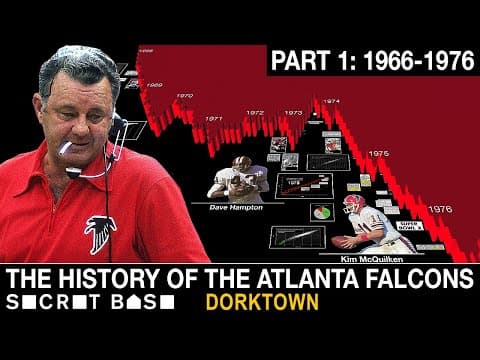
[19:12]This is where we talk about the Atlanta Falcons passing attack in the mid-70s, which was bad in ways that are impossible to imagine today. I mean, if you made current Falcons quarterback Matt Ryan throw into a 35-man defense, he'd probably still come up with better stats than what we're about to see. I'm serious. At this early point in the story, I'd like to urge you to cherish this. Though it might seem like it now, this is not the story of a team that's perpetually hapless and awful. In the future, the Atlanta Falcons are going to do a whole lot of winning and a whole lot of contending. This is the one and only time we're gonna go long on a Falcons team that deeply, genuinely sucks ass. There's a strange sort of beauty in that. Enjoy it while it lasts. McQuilken closed out a Week 12 loss to the Rams and threw three interceptions in the second half, bringing his career total to four on just 34 attempts. But Lee and Sullivan had been so disastrous all year that the Falcons figured they had nothing to lose and kept McQuilken in the lineup for the final two games to see what he could do. First, the good news: They were in the midst of a seven-game losing streak when he took over, and they split his two starts. Now, the bad news: another five of his passes were intercepted. That brought his rookie season to a close with his 79 passes generating just 373 yards, with nine of them being picked off while still searching for his first career touchdown pass. Combined with miserable play out of Lee and Sullivan, who together threw 22 picks against four touchdowns, the 1974 Falcons passing offense was dreadful. Like really dreadful. The NFL's 32 teams have combined to play 1509 seasons since the AFL-NFL merged in 1970. Here's the passing proficiency of each and everyone based on passer rating and adjusted net yards per attempt. Over 99% came in with a passer rating above 40, and most that didn't were at least close and at least had an adjusted net yards per attempt above one. And then we have the 1974 Atlanta Falcons with a passer rating under 28 and a negative adjusted yards per attempt. Yeah, there's one squad, the 1977 Tampa Bay Buccaneers, that was even worse than they were. But as for the other 1507, the 74 Falcons are complete outcasts from them, with their thorough inability to get anything going through the air. Atlanta had to turn to the draft to try and find some sort of answer at quarterback. And there was really only one strong option to pursue. The University of California's Steve Bartkowski. Sitting with the third overall selection in the 1975 NFL Draft, and unable to afford missing out on the top prospect, to guarantee their ability to draft him, the Falcons had to ship one of the league's top offensive linemen, George Kunz, along with the number three pick to the Colts to land the first overall pick. Seeking a new franchise quarterback after a season like Atlanta had in 1974 is understandable, as they were beyond atrocious through the year. But if they just been regular bad instead of that bad, they wouldn't have felt so much pressure to get a QB. Perhaps they could have instead kept their standout tackle, kept their third overall pick, and taken, say, a dazzling running back prospect out of Jackson State by the name of Walter Payton. Anyway, midway through Bartkowski's rookie season, he dislocated his elbow, creating another chance for McQuilken to play. Although he did throw his first career touchdown in relief against Cincy, it was overshadowed by three picks, and a listless first half the next week in New Orleans got him benched at halftime. With Bartkowski still shelved for another couple of weeks, and a trip to Minnesota on deck, McQuilken was reinserted into the starting lineup. Entering that game, he'd thrown 13 career interceptions against just one touchdown, but we hadn't seen anything yet. Things may have been wobbly before, but here's where the wheels completely fall off. McQuilken attempted 26 passes, completing five to each team, for 43 yards with no touchdowns. Those five interceptions ensured him a passer rating on the day of 0.0. However, he was playing against the defending conference champion Vikings and their terrifying Purple People Eaters on defense. Like Hall of Fame defensive end Carl Eller makes quarterbacks' lives miserable enough as a pass rusher, it's really not fair for him to also snag the only pick of his career right here by throwing a big paw up there on this screen pass and coming back down with it. This was a really brutal game, so let's show some mercy and pretend that didn't happen. Okay, so he threw four picks. Oh, still zero. Maybe a receiver ran a bad route or deflected a well-thrown ball. That happens. Okay, then, let's take a second interception off the board. Oh, oh.
[24:18]In a somber postgame scene, McQuilken had no words. Even reporters were speechless.
[24:32]McQuilken returned the next year, and a month into the 76th season, Bartkowski suffered a season-ending knee injury. More McQuilken. He played a lot like the previous two years and was eventually yanked from the lineup in a season that marked the final extensive playing time of his career.
[24:55]By passer rating and adjusted net yards per attempt, McQuilken's first three seasons likely constituted three of the four worst by any quarterback to throw at least 60 passes in a campaign since the merger.
[25:09]Despite his level of play, McQuilken wasn't one of the worst players or even quarterbacks in NFL history. For one, he managed to hang around the NFL for seven years before voluntarily retiring, when most players are lucky to have a career half that long. Additionally, as underscored by the pitiful 1974 Falcons passing game, whose ineptitude Bob Lee and Pat Sullivan were more responsible for than McQuilken, he was embedded within a terrible offensive infrastructure, in which all other men brave enough to try and play quarterback for the Falcons during the mid-70s also struggled immensely. His protection wasn't up to snuff, and he had zero coaching staff stability. What's ironic is that, despite his noteworthy struggles during his time in the NFL, in the big picture, very few people have been as successful at as wide a variety of endeavors as Kim McQuilken has. The man excelled in everything he tried his hand at after his playing days came to a close. First as a football analyst, then in becoming an executive with Cartoon Network, then in starting his own toy company that licensed merchandise for movies, then in presiding over a supply chain consulting business. And whereas plenty of non-stars don't stand out in any way and have boring, forgettable careers, McQuilken's career lent itself to the creation of some fascinating charts for a documentary made about his Falcons nearly 50 years after he played for them. God, I love Kim McQuilken. I do too. This is our official editorial position.
[26:45]Kim McQuilken rules. Now, all this decidedly sub-par quarterbacking cuts even deeper once we consider who is actually presiding over most of it. Between 68 and 74, their head coach was not that far removed from a Hall of Fame career as a quarterback, and in fact, many of the time considered him to be the best quarterback ever. Even before being subjected to all this horrendous passing happening right in front of him, this man was already established as one of the crankiest individuals ever to walk the earth. A big old crusty Dutchman who'd cuss you out as soon as look at you. Take just a minute to imagine what such a man might look like. How'd you do? Across all sports, the 1970s were a golden age for crabby, red-faced coaches and Norm Van Brocklin might have been the best of the best.
[27:33]He smoked like a chimney on the sideline. Who's gonna tell him no? This man was a former two-time NFL champion quarterback, spending most of his playing days in Los Angeles, a place he hated because hippies confounded him. In fact, Norm hated everything that was less than 9,000 years old. He hated when quarterbacks scrambled instead of standing in the pocket. When Lions kicker and Cypriot native Garo Yepremian used a newly introduced soccer-style kick to beat him, he wanted the government to take a hard line against the Cypriots. From the NFL's merged with the AFL, his read on the situation was that the NFL was stupid, and also that the AFL was stupid. It couldn't have been easy for a guy who did so much winning as a player to do so much losing as a coach. His first stop was with the Minnesota Vikings, and seeing as they were a brand new franchise, Van Brocklin was able to draft players from other teams. They were a bunch of stiffs, he said about the players he himself selected. After a few years of losing, he quit, then came back the next day and said he was a fighter, not a quitter, and then he lost some more, and then he quit. Strangely, during his time in Atlanta, the press actually seemed to kind of like the guy, despite calling them whores and sons of bitches, and on one reported occasion, grabbing them by the necktie. As an editor, he could stop on a dime and fly off the handle without warning. One of his post-game locker room speeches started with I'm proud of you boys, and then immediately veered into a rant about how the Atlanta media apparatus was conspiring against them. That involved multiple invocations of the Sherman Anti-Trust Act of 1890. He concluded with a declaration that sounded like something straight out of the Nixon White House tapes. Van Brocklin loved Richard Nixon. He also hated Richard Nixon. What's interesting, though, is that the media didn't simply write him off as an asshole. They described him as a complete enigma, a man they just could not figure out. I think they knew that he was always kind of halfway serious. That he realized he'd never escape criticism no matter what he did, so there was no harm in upping the volume.
[29:21]Nobody's ever any one person. Although it didn't seem like it, the Falcons in the mid-1970s were right on the precipice of two things.
[29:45]First, they were about to invent new and more devastating ways to beat the Saints. And second, they were about to enter an era that most fans today have completely forgotten.
[45:06]These Atlanta Falcons didn't want to make the decades-long slog toward respectability that most new teams settle for. They wanted to win a Super Bowl, now. This was the first of 103 body blows, and counting, that the Falcons and Saints will deal each other. It was excruciating for Falcons fans to see their team build a 21 to 3 lead, only to lose in the end.


