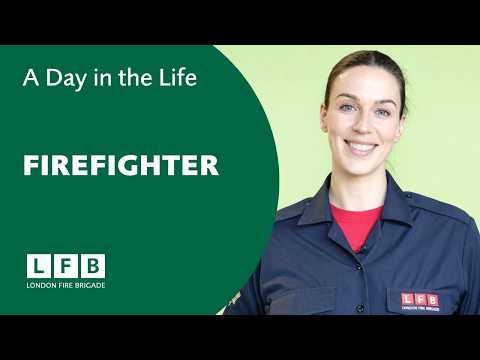
[0:28]Hello, I'm Shivan and I'm a firefighter for the London Fire Brigade. Spend the day with me and I'll show you the ins and outs of a day in the life of a firefighter.
[1:05]It's 8:45 and I've just arrived to get ready for the working day, which starts at 9:30. It leaves me enough time to get my workwear and PPE ready before the start of shift.
[1:25]Just going to my dorm and I'm starting by ironing my shirt and polishing my boots. As a uniform service, it's important for us to look professional and presentable.
[1:44]My shirt's ironed and my boots are polished, so let's head downstairs, check our PPE and ancillaries.
[1:58]I'm just going through my PPE and checking everything's clean and my ancillaries are all in good working order.
[2:10]I'm checking the condition of my BA mask, making sure there's no scratches or defects. Hi, good morning. Uh my name's Ben. I'm the station officer here at Lambeth. Just up in the office now checking what we've got on for the day. We're going to head down onto roll call, so I can detail uh all the watch so they know what they're doing for the day. I'm checking the diary and I'm going to head down there. So if you want to come down with me, we can go to the roll call.
[2:59]Straight after roll call, we test our breathing apparatus. This is one of the most valuable pieces of equipment we've got because it allows us to breathe when we're inside of fires. We test it at the start of every single shift.
[3:25]So now we're doing the inventories and this is something that we do before every shift to check that all the equipment is present and ready to use for when we need it.
[3:54]As part of our daily routines, we check and test various pieces of equipment.
[4:09]Grubs up. Another delicious meal served in the mess. Grubs up. It's time for some lunch.
[4:22]Here we are for our first meal of the day. It's always a good chance to sit down and eat together. We normally eat twice on days. We're still operational so we could get called out at any stage. Normally if we've been uh working hard like a Christmas meal or something like that, we'll get called out halfway through it, but it's all part and parcel of our working day.
[4:41]Mess time is always good. It's a good time for us to sit around the table together. Um it's social but we also talk about work. It depends what we've had throughout the day. Um sometimes if we've had an incident, we'll sort of digest that, we'll look back at that. Um we do a proper debrief after incidents, but mess is more of an informal time. Um they always say no ranking mess, so we'll just talk, socialize. Um and it's just a good chance for colleagues to bond.
[5:07]So yeah, and this is our first meal of the day. Hopefully we won't get called out, but we could get called out. Who knows? So that's just the the nature of our of our work.
[5:51]Right, we've got a high rise AFA, start on the first floor outlets to all floors. So we're currently responding to an automatic fire alarm, which is a fairly common incident for us to attend. This is an incident that's slightly out of our ground that we cover. Um, but we're arriving as part of a predetermined attendance. Even though we attend a lot of these incidents, we still treat them as though they are something um and take each one very seriously.
[6:30]Right, so we've uh just had a call out onto a neighboring station's ground, onto Brixton's ground. There was a 14 story high rise building, with a high rise you'd get a a larger attendance. Uh in this instance, it was uh there was no uh incident at the location. Uh so Brixton have got us away, so we are going to get back to station and wait for the next call.
[7:00]Everyone feeling well? Excellent, wonderful. Uh, pumps crew out on a shout, so we're just going to start the training without them. Uh as I said earlier, uh, fire fight priest has just passed her driving. Congratulations. So over the next couple of weeks, I want to make sure that we're doing regular pumps and pumping. We'll go, we'll go for a refresher, we'll all get involved in that.
[7:29]Flushing hydrant. Hydrant flushed. Four to six bar pressure.
[7:38]Okay, work on get it in the window. Uh, that's good. Keep rotating as well on the jet. Good work. I'm telling you you're doing well. Excellent. Branch techniques. Good switch round. I thought the control was good, good bit of pulsing. Hoes reel's on a high pressure with the jet we'll go into low. Going to low pressure. Excellent.
[8:03]All right, knock off my car. Knock off my car. All right, knock off my car.
[8:25]Thank you for your hard work and efforts as always, excellent work. Uh, let's go and warm up quickly and then we'll go out. We have got quite a lot to do today. We'll crack on. Thank you very much. Oh, was that all right? Yeah, great. Thanks, guys. Nice, well done. Top effort as always. Good to see good knowledge. Everything was good on the branch. Like I say, we'll do this, we'll do this regularly for us especially until you we get you on your EFAD. Lambeth is the site of the old Brigade Headquarters. We are really busy like other Central London stations. We've got so many major risks on our ground, we cover a lot of the city. We always getting call outs to places like Houses of Parliament, Buckingham Palace. On our ground, we've got the Waterloo Mainland Station, we've got the London Eye, loads of tourism features. But we also attend a wide range of residential going the other side away from the city. We've got the river boat directly opposite us. And we're the only station in the fire brigade that actually tips out directly onto the water. And it's it's beautiful every time we go out the doors. And actually, we're about to go out, so if you want to come with us, we're going to do a home fire safety visit, uh to give some safety advice to a local resident and stick some smoke alarms up. So come with us. And there it is, another call out for us. So I'm gonna have to go.
[9:54]Smoke detector activating.
[9:58]So on the way to an incident that is a smoke detector activating. This is on Brixton's ground, adjacent to our ground. This could be anything from burnt cooking to a serious fire. Okay. So we're going to wait for Brixton to give us the all clear. They're checking out the property at the moment and we're just waiting for us to weigh on the bri. Yeah.
[10:40]So we're just about to do a home fire safety visit where we offer home fire safety advice and look out for any hazards. So we've just finished the home fire safety visit and we offered a bit of advice on overloading electrical sockets. So hopefully they're going to be safe for the future. Always good to give a service like this to the members of the public and the community we serve. Yeah, he'd be loving it when he do you blue light training as well. I tell you what that course is fantastic.
[11:16]We're just about to conduct a 72D visit on this building. That is to allow us to familiarize ourselves with the layout, any installations or any hazards that might present in the event of a fire. Okay. You happy where you going? Yeah. Yeah. Um I'm going to make sure we'll we'll keep you driving, um to for everything apart from uh incidents and blue light calls. Okay. So straight over when we get over there. Yeah, yeah, we'll go straight over and then we'll go down there because otherwise a lot of traffic that way. Okay. Happy?
[11:41]So we just finished a home fire safety visit and we installed two smoke alarms for an elderly lady um and offered her some fire safety advice on a heat issue she was using and her plug sockets. Right. We are done with our visits for the day. We've put smoke alarms up. Uh we've gone out to do a 72D visit where we uh check out uh risks on our grounds. Uh and now we're done with the work. We're going to go and do the workout. So we're going to go back, do an hour in the gym before we have our dinner. Uh and then we'll go home I guess.
[12:48]Okay. So we've just been called out to a non-emergency uh shut in lift. Non-emergency is normally when the occupant of the lift um is isn't suffering, panicking or or claustrophobic. Um and that they're okay to be rescued without speed. Um obviously, we'll get into the lift as soon as we can. Um so what we're doing now, I've just sent a crew above because we're on the ground floor. I've sent a crew above to knock the power off. We won't we won't let we won't let the occupant of the lift out unless the power is off and safety do so. Sometimes you might open the door and on the ground floor, but we normally knock it off of the um the lift motor rooms to make sure that we're safe to do so. And now what we're going to do, we're going to get access to the lift. And depending on on where the lift is and we might have to move the lift because sometimes where the lift is, it changes whether we can open the doors or not.
[13:52]And now the lift is out of our order, so we'll shut the door, we'll close it and then we'll send a stop code and we're out. You're all right, you're all right. You're all right, you're all right. Okay, excellent. Otherwise, excellent.
[14:18]Matt, can you send me code 7, please?
[14:44]So we're back at station and now we get allocated one hour on day shift to use the gym. This is to maintain our fitness and promote mental well-being. But we still are on the run, so we could get mobilized at any point.
[17:35]Kitchen fire.
[17:41]So we just got back from a kitchen fire. And in this case, luckily it was nothing serious. This happens a lot in built up areas such as London, and it's generally a case of unattended cooking or a toaster that sets off a smoke alarm. Burnt cooking might not seem like a big deal, but it's one of the most common causes of house fires, especially if you're using high heat or oil. Always stay with your cooking. Never leave it unattended. So it's 8:00 and the shifts just finished. I'm going to get my PPE off the fire engine, put it in the gear room and then I'm good to go.
[18:32]So that's it. I hope you've enjoyed following along and got a good insight to see what it's like to be a London firefighter.
[18:50]If you like this video, subscribe here. If you'd like to see more videos like this, click below.


