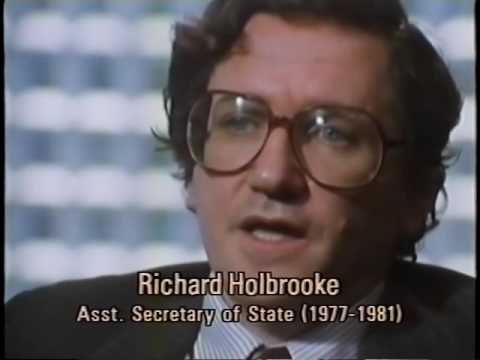
[0:01]I think Vietnam was the probably the greatest single error that America has made in its national history. Uh, Vietnam, I think, has at least for a period, diverted our attention from this central issue of how the world is to organize itself to prevent World War III. Vietnam is still with us. It has divided the consensus that carried American foreign policy through a generation. It created the doubts about American judgment, about American credibility, and American power. But for me, the greatest legacy of the war in Vietnam is that I will never believe my government again.
[1:12]30 years after the first American died in Vietnam, the last Americans were leaving, waiting on the US Embassy roof to be flown to safety.
[1:27]The long war was ending in the defeat of the South Vietnamese state that America had supported for two decades. What kind of peace finally was at hand? What would be the meaning of peace? To many South Vietnamese, peace meant the end of their way of life. The Americans helped 65,000 to escape in the last weeks of war. Thousands more, families of officials, businessmen, and others with close links to the Americans, fled in terror. I was 14 years old when I left Saigon in '75. At 6 o'clock, we heard on the radio that the soldiers have to give up, so the communists will come in for peace. My father didn't believe that, so he decided to go no matter what.
[2:25]It was like a movie to me because we didn't know what's going on, and I was so afraid. The communist stopped us and asked where we would be going, but my father had to bribe them by giving a diamond watch. I saw my father slip his watch to the comrade's hand, so the guy was smiling and he was satisfied, so he let us go.
[2:54]To the North Vietnamese soldiers who took Saigon, peace meant the end of the anti-colonial war that had started 30 years before. When we arrived at the palace, I walked up to the second floor, where members of the puppet administration had gathered.
[3:17]Duong Van Minh then stepped out of the crowd and said, "I've been waiting for you since early this morning in order to turn over the government to you." The generals replied at once, "There is no need to talk of turning over the government to us. Your entire administration has collapsed. People cannot turn over what they do not have in their own hands. Your only choice is to surrender." To many Saigonese, peace brought a glimmer of hope. The South Vietnamese government was really not good, not good for us before. And maybe now it's a change, and at least we can see our country now with the full length from north to south, and no more war, no more hostility. Therefore, we came out the street to see what uh, communists look like. And we saw uh the communist army, they, they're really nice, and they smile with us. We saw a forest of flags and slogan and the picture of Ho Chi Minh.
[4:45]The communist use a lot of beautiful work, for example, nothing is precious than freedom and independence. Now we are free and independence. And uh we can visit Hanoi, maybe we can know the whole country. Then after that, day by day, we really realize a lot of terrible things. 130,000 refugees from Indochina made their way to Guam and onto America by the end of 1975. By 1976, the flow of refugees had slowed and the war had faded into a kind of limbo. America saluted the country's 200th birthday in a joyful outpouring of patriotic celebration. Sailing ships from around the world assembled in the Hudson River to do honor to the nation on the 4th of July. The confusion and discord among Americans that had marked the Vietnam era were nowhere in evidence. But the Bicentennial was also a presidential election year, as the major parties positioned themselves. They offered conflicting judgments on the meaning of Vietnam.
[6:11]The Democratic Party's platform plank on Asia stated, the Vietnam war has taught us the folly of becoming militarily involved where our vital interests were not at stake.
[6:47]I gave in September of 1974 an opportunity for all draft evaders, all deserters to come in voluntarily, clear their records by earning an opportunity to restore their good citizenship. I don't think we should go any further. I don't advocate amnesty, I advocate pardon, there's a difference in my opinion and in accordance with the ruling of the Supreme Court and accordance to the definition in the dictionary. Amnesty means that that you, uh, what you did was right. Pardon means that what you did, whether it's right or wrong, you're forgiven for it. More than 200,000 men were accused of draft evasion during the Vietnam era. President Carter gave them a blanket pardon on his first day in office. Among the first to come home from Canada was Anthony Rodriguez. I see the, the whole Vietnam issue as a very divisive issue in the country. And maybe this is really the first step towards reconciling some of the different ideas. Mr. Carter should have waited a bit more than uh one day to do this, if he was going to do it at all. There are other priorities he should have set to to heal the wounds of war if that's what he really wanted to do. There are 1300 families or more who don't know where their sons are.
[8:16]Uh, I'm talking specifically about the missing in action. Also there are there are Vietnam veterans who are unemployed, uh, and, and who did serve this country honorably and who are wounded, uh, who are not receiving their rights and, and things of this nature. And I feel that the first priority should have been given to these people, to these men, and then maybe we could talk about the others. Carter himself deeply wanted to have some major symbolic actions of reconciliation. He had pledged during the campaign to the league of MIA families that he would send a delegation to Hanoi to pursue the search for the counting of MIA families. In March of '77, he sent this team to Vietnam, headed by Leonard Woodcock and Mike Mansfield. I think it was at best a very difficult road to create a reconciliation between the United States and Vietnam after the horrendous lacerating events of the previous decade. In the course of these meetings, the Vietnamese have informed us that they're giving us the remains of 12 American servicemen. They will be flown out of Vietnam with the commission. We welcome this positive step by the Vietnamese government. We have also established a mechanism for the provision of additional information on our missing men. The League of MIA Families had a powerful emotional issue, which grabbed the souls of many Americans beyond the immediate families. We want accounting, we want them to stop dribbling out remains 11 at a time anytime it's politically expedient to suddenly find some to deliver to a congressional delegation. We want them to put some priority on getting the accounting and doing it now. There were 2,500 of the Americans who died in Vietnam who remained unaccounted for at the end of the war. Now that's 4% of the Americans who died in Vietnam. Compared to the 22% of Americans who died in Korea and 22% of the Americans who died in World War II, whose bodies never recovered, that's a remarkable percentage and a tribute to the determination and skill of the United States military in recovering the bodies of their dead.
[10:44]However, pilots went down in the north and other people were lost in the south, whose bodies were never recovered. If the Vietnamese are so anxious to get normalized relations in trade, then let them do what President Carter supposedly has this big human rights thing going on. If they're so concerned about human rights, why don't they get the Vietnamese to cooperate on the humanitarian issue of the accounting? In April 1977, Vietnamese Premier Pham Van Dong arrived in Paris, where Vietnam and America had agreed to talk about establishing diplomatic relations, separate from the MIA issue. His arrival fired political passions among the refugees.
[11:28]At a press conference, Dong expressed hope for better relations with America. I am, I was, and I will be always optimistic.
[11:44]The premier's optimism may have been linked to a letter from an American president. The Vietnamese took a position in 1977, an idiotic position in my view, a self-defeating position, which the American public understandably and instantaneously rejected, that the United States had to pay up the money promised to the Vietnamese by Nixon in a letter he had sent them on February 1st, 1973 for $4.75 billion of credits and grants. Now, that letter was secret at the time. Nixon had subsequently disavowed in effect by saying that it was linked to actions of the Vietnamese which never took place. And in any case, there was no, no possible, uh, of no possibility that the American public, the Congress were going to give money to the Vietnamese.
[12:48]It just was not in the cards. We have always for the last 25 years opposed Vietnam's entry into the United Nations. This year we did not oppose it, and now Vietnam will be a member of the world community in the United Nations. I don't have any apology to make about that action. I am not in favor of the United States paying any money or reparations to Vietnam, however. America was not in a mood to help an undefeated and unrepentant enemy. In the fall of 1978, I continued under presidential instructions my talks in New York with Nguyen Co Thach. We met several times and in the second of our meetings here in New York, Thach dropped the demand the Vietnamese had maintained for the previous three years that the United States pay war reparations or aid to Vietnam as the price of recognition. When he dropped that demand, he thought that the way was now clear for immediate progress. But the boat people were pouring out in Southeast Asian waters into the South China Sea, and there was a worldwide uproar. And on November 2nd, while we were in the process of reviewing what we should do, the Vietnamese and the Russians signed a treaty of peace and friendship with considerable ceremony in Moscow between Brezhnev and Pham Van Dong. This series of events made us decide that we ought to ought to go slow. The United States of America and the People's Republic of China have agreed to recognize each other and to establish diplomatic relations as of January the 1st, 1979. The normalization of relations between the United States and China has no other purpose than this. The advancement of peace. We, when we went into office, very deliberately sat down and defined for ourselves about 10 objectives for the four years. And I remember quite vividly that the fifth objective was that we would normalize relations with China during the first term, and we even set for ourselves the objective of normalizing relations by 1979. When we began to cope with American Chinese relationship, which required a great deal of domestic effort, we were conscious of the fact that China and Vietnam were at loggerheads. They were in a condition of severe hostility with some limited fighting. Not of the kind of fighting that developed later in February, March of 1979, but still, in effect, shooting. And thus, it was out of the question to try to normalize relations with both of them at the same time. It would also diminish the importance of the new American Chinese relationship. And therefore I made certain that we moved in a deliberate fashion, purposeful fashion, in normalizing relations with China, but that we would put aside, while doing that, any improvement of relations with Vietnam. Feud from Hanoi, America's reversal seemed ironic. America had gone to war in Vietnam to contain Chinese Communist expansion. Now, to please China, it was refusing to make peace with Vietnam. Vietnam needed all the aid it could get. The war may have caused as many as 2 million Vietnamese dead, and 4 and a half million wounded, North and South. 1/10th of the country's entire population. Vast areas had been battlefields, devastated by three times the total tonnage of bombs dropped in all of World War II. The Vietnamese peasantry had endured 30 years of increasingly sophisticated warfare, supplied by the big powers on both sides.
[17:51]Since the end of the war, though all those bombs dropping down on us, we have lost much of our former fervor. We are facing housing shortages and food shortages.
[18:11]You never heard anyone complaining about anything at all. Peace had brought a new name to Saigon, Ho Chi Minh City. It was plagued by uncounted numbers of prostitutes and drug addicts, 2 million refugees from the countryside and 700,000 unemployed. Tough northern officials, determined to build a communist society, took over from their former Viet Cong comrades. Southerners quickly lost their illusions. Some months later, we soon realized that really the Communist Party, they try to make the people become robot to serve for any interest of the Communist Party. When the communist took over South Vietnam, I didn't go to teach anymore because I can see that they have a lot of discrimination policy.
[19:10]So, uh, I stay home and try to plan with my family to escape because the situation in, in South Vietnam is worse and worse.
[19:26]The bloodbath predicted by many, mass executions of political opponents, did not take place in Vietnam. But 1 and a half million southerners were forced to resettle in new economic zones. The zones were remote and the land was often poor. Many found the work too hard and the distractions too few. Some drifted back into Saigon, increasing the numbers of those who felt they had no future in Vietnam. The new government oppressed the Chinese business community for both racial and economic reasons, and they interned more than 200,000 political suspects in so-called re-education camps in the first 12 months of peace.
[20:10]Right up to April 1975, I was called and reported to the communist post, and they sent me to the re-education camp. Like all the camp, uh, they have a 10, 10 lessons. That's mean, you know, they introduce themselves what is the communist doing for our country, and who is the US. And the last lesson, I think, was, uh, uh, Communist Russia is a great country, is our, uh, like, uh, heaven. The first, we trust them and, and we thought that, you know, maybe, you know, after, you know, a few lesson, we can come back, you know, to our family and live with a normal life, right? So all of us, you know, we tried to study and, and try to trust them. The physical condition is survive, day by day, and, uh, many people was killed by disease. Because the condition is, you know, there was no way you can describe here, because the people that starving. One time, I, uh, I, uh, I start to catch, uh, you know, one frog for eating, and, you know, one of the, you know, um, police, you know, communist police, he saw that, and they push me in the very small room.
[21:40]And they made, um, they made something like a locker by one piece of wood with a five hole, one hole for the neck, two hole for hands, and two hole for feet. And they push all of my body in there, and they lock it up, and they left me like that for one week. After that, right, for two days, I couldn't stand up because all of my body, you know, just like, uh, rolled, you know, something like that for one week. At the moment that I escape from the, uh, re-education camp, I, I made my mind that I have to escape from the country at all price. But the managed to do that is, uh, the matter of money and, um, and a chance. Life in post-war Vietnam was grim. It was worse in neighboring Cambodia. Thousands of Cambodian refugees were escaping with stories of almost unbelievable horrors. In Cambodia, peace meant death. Now I talk about, uh, the, the killing in my hometown is, uh, they killed all the soldier, even you are private soldier, the teachers, And all the educate peoples, uh, nurses, uh, all every everywhere, even their own people, their own cadre, their comrade, when they think they are not good, they arrested. Nobody know what's going on, they just arrest him, beat them along the road and disappear. The Cambodian communists, the Khmer Rouge, had seized power in a shattered society in 1975. Led by Pol Pot, they drove the population into vast agricultural collectives. Cambodia drew closer to China, and increasingly hostile to Vietnam. Fearing Communist China, Communist Vietnam invaded Communist Cambodia. Nationalism was stronger than ideology. The Vietnamese intervened to unseat Pol Pot, they also put an end to the Holocaust. My first trip inside Cambodia occurred while I was working on Cambodian refugee and famine relief programs. I made a second trip to Cambodia to photograph the evidence that remained of what had happened under the Khmer Rouge. At the Choeung Ek mass grave site, victims' skulls were still blindfolded and their arms still bound. Later, the remains were collected in memorial sheds where Buddhist ceremonies were held. At Tonle Bati, a former school served as the execution center. Another district level execution center was established at Tom Onn. There was essentially a three-tiered structure of murdered by government in Cambodia under the Khmer Rouge. At the top of the pyramid, so to speak, was a prison execution extermination system where people who were presumed to be opponents, enemies of the regime, traitors to the revolution, were individually executed.
[25:25]When the Vietnamese invaded, they did so quickly that, uh, essentially the Khmer Rouge jailers and prison officials ran off, uh, fled for their lives and left behind scores of thousands of pages of documentation that had been utilized at this prison execution, uh, center. And it's very surprising that you would have in a illiterate peasant country, a bureaucracy of death that was that efficient and that developed, uh, literally an Asian Auschwitz, as it were.
[26:07]And you have photographs of individuals taken after they were dead or nearly dead, that could also be sent on to party higher-ups to show that these traitors to the revolution had been killed and they were not being harbored. As the revolution failed to work, they kept looking about for who was sabotaging it now, because they had figured that they had eliminated the enemies to the revolution, but still things weren't working. So they sought scapegoats.
[26:39]You have essentially in three and a half years of Khmer Rouge rule, somewhere between 1 and a half and 2 and a half million out of 7 million people dying, uh, through a combination of execution, uh, induced starvation, exhaustion, and disease.
[45:57]The Reagan administration saw Soviet-inspired threats to the nation security in Central America, and stepped up support to friendly governments in the region. In the ensuing debate, the Vietnam analogy was asserted and denied, again and again. To tell us that this will not lead us into a mass intervention, like it did in Vietnam, is simply, uh, to repeat the naive tay with which we bought the idea that advisors would not get us into trouble in Vietnam. Let me say to those who invoke the memory of Vietnam, there is no thought of sending American combat troops to Central America. They are not needed.
[47:17]And as I say, they are not needed and indeed they have not been requested there. All our neighbors ask of us is assistance in training and arms to protect themselves, while they build a better future for your life. To begin with, we believe the administration fundamentally misunderstands the causes of conflict in Central America. We cannot afford to found so important a policy on ignorance. And the painful truth is that many of our highest officials seem to know as little about Central America in 1983 as we knew about Indochina in 1963.
[55:00]What happened in the course of that week in Washington D.C. was extraordinary.
[55:07]The renewed sense of a brotherhood, just rekindled, if you wish. The understanding and the awareness and the need to carry on in our work in getting us together. In that, with that understanding, hopefully, prevent another Vietnam or anything like it from happening again. The chief legacy of the Vietnam War is an open question, and it's in our country's hands right now.