[0:00]This is a mechanism of disease map for diabetic ketoacidosis, also called DKA for short. I'll be talking about the etiology of DKA, some of the diabetes pathophysiology that's common to both uncomplicated diabetes and DKA, and some of the DKA specific manifestations. And in general, those three categories will flow from left to right across this flow chart. As with all of these mechanism of disease maps, the core concepts are color coded according to this legend up here. So each of the boxes will correspond to at least one of these core concepts. Let's get started. First, we have the central mechanism of diabetic ketoacidosis, and that is that insulin is low and you have relative to insulin, an excess of glucagon. We'll next talk about the ideologies. They can be grouped into these two big categories. The first is that you have insulin insufficiency, and the second is that you have an increased demand for insulin and the body is not able to meet that demand. Within insufficient insulin, there are a few other factors that can contribute to this. You can have undiagnosed, untreated diabetes, and the rest of these are kind of social determinant of health and pharmacology causes. The insulin pump can fail, the patient can forget their injection, the patient can have poor adherence to their medications, and the patient might not be able to afford their insulin. Some examples of increased insulin demand are drugs, for instance, cocaine, alcohol, and steroids like corticosteroids, all increase your insulin demand. And if those are taken without proper precautions or without increasing the amount of insulin that you have in you, that can precipitate diabetic ketoacidosis. In addition, stress like trauma, surgery, infections can all increase your insulin demand and cause DKA. Specifically infections like pneumonia and UTIs. Myocardial infarctions or heart attacks can also increase your insulin demand, burns, and heat stroke do the same thing. So this is a short list of pretty well-established ideologies for diabetic ketoacidosis. It's either insufficient insulin, like the patient is failing to take their insulin for a variety of reasons, or increased insulin demand, like drugs or stress on the body. Now let's get into the pathophysiology and the manifestations. When you have low insulin and high glucagon, you're going to start breaking down your adipose tissue and your muscle tissue. When you break down your adipose tissue, you're doing lipolysis, and the body's going to release glycerol and fatty acids. When you do muscle catabolism, you're going to break down your proteins and release amino acids. Both of these release amino acids and glycerol carbons that are then used for gluconeogenesis. So the body's going to be able to make glucose based on the breakdown of the muscles and the adipose tissue. This leads to some of the classic symptoms of diabetes, which is also sometimes present in DKA. That's weight loss and it's polyphagia, which makes sense if you're breaking down your body's tissues, you're going to lose weight. You're also going to be hungry because you're breaking down your body's tissue. Your body's essentially starving. In addition, adipose catabolism also releases ketone bodies and protons. And there's also a direct effect on the ketone body production as well from hepatic fatty acid oxidation as well. This results in ketosis, which is increased presence of ketones in urine and serum, and that's what causes the high anion gap ketoacidosis. You have all of these ketones floating around in your blood and that increases the anion gap in your blood. So you'll see both of these things on blood tests or urine tests in the case of urine ketones. In addition, when you produce excess protons, your body's going to become acidic, your blood is acidic, and you're going to deplete your plasma bicarbonate. This also contributes to the increased anion gap ketoacidosis. This increased ketone body production also causes the fruity odor that's characteristic of DKA and that's from acetone, which is a ketone itself on the breath. So you'll actually be breathing out acetone and exhaling it and the patient might have a fruity odor when they're undergoing DKA. This anion gap ketoacidosis also results in a shift in potassium from the intracellular space to the extracellular space. And this is also a direct result of having high glucagon relative to insulin. When you shift your potassium from inside your cells to outside the cells, this can result in hyperkalemia, which is also seen on the labs of patients with ketoacidosis. And this potassium is actually quite important. It's used to track the progression of DKA in these patients as well. So this is an important one to know. In addition, when you have a high anion gap ketoacidosis, the body's blood is very acidic, and it's a metabolic ketoacidosis. In response to a metabolic ketoacidosis, the body's going to do some respiratory compensation in an attempt to produce more bicarbonate and to try to equalize the acid in the blood. This respiratory compensation results in hyperpnea, or long, deep breaths. You're going to be breathing more than a usual person would. And this is also called Kussmaul respirations when you have these long deep breaths. And again, it's an attempt from the patient's body to try to compensate for the acidic blood with the respiratory system. In addition, this acidic, high anion gap ketoacidosis state can also cause abdominal pain, nausea, and or vomiting. And there are a few proposed mechanisms. So it could be any combinations of these. That's ileus, gastric stasis, electrolyte imbalance, peritoneal irritation, and or gastric mucosal damage. Lastly, this high anion gap ketoacidosis also alters your neural function. And that's one of the contributors to altered mental status in patients with DKA. This high, this high glucagon low insulin state also increases your hepatic glucose output. And it decreases the peripheral glucose tissue uptake. This in combination with the new glucose being made from the breakdown of adipose tissue and muscle tissue, all lead to hyperglycemia. Now, typically in DKA, you'll have moderate hyperglycemia, around 250, maybe up to 500 milligrams per deciliter. That's in contrast to some other diabetic emergencies where it'll be much higher like an HHS. In any case, this level hyperglycemia can also contribute to the symptoms. This can also contribute to the abdominal pain, nausea, and or vomiting through some of the mechanisms listed here. In addition, when you have hyperglycemia, that's high glucose in the blood, it makes sense that you'll have more glucose going to the kidneys for filtering at the nephrons. This is okay up to a certain point. There's only a certain limit for the amount of glucose that the kidneys can reabsorb from the urine. When your hyperglycemia gets so high and you surpass this limit, you'll have glycosuria, or the presence of high glucose in the urine. When you have high glucose in the urine, water tends to follow that glucose, and that can result in an osmotic diuresis, where you're peeing in excess because you're peeing out your glucose, and water follows that glucose. That can result in polyuria, or peeing a lot, which is another classic symptoms of diabetes, which might also be present in diabetic ketoacidosis. When you pee a lot, your body will be dehydrated and you'll be volume depleted. But this is kind of tricky because in the beginning you'll be peeing a lot, and then when you're really dehydrated, you can actually become anuric or oliguric. You can be peeing very little or not peeing at all. So all of these states are possible in diabetic ketoacidosis. You can be peeing a lot from the osmotic diuresis, or once you've peed off much of your fluid and you're very dehydrated, you can slow down the peeing or even not pee at all. This volume depletion dehydration is also something that contributes to the weight loss in patients with diabetes. And um they'll they'll have weight loss not only from the muscle tissue and from the fat tissue breakdown but also from peeing out a lot of their excess fluids. And in general, there's a bit of a vicious cycle that happens here. When you have hyperglycemia that leads to osmotic diuresis that leads to dehydration, you'll then have decreased circulating blood volume, which means decreased renal blood flow and decreased glucose to the nephron. So you're essentially concentrating the the glucose that's in your blood and you're kind of exacerbating this hyperglycemia and the cycle kind of continues. This dehydration also leads patients to be very thirsty and have polydipsia. And the mechanism for that is kind of shown here. You'll have hyperosmolarity because you're dehydrated and volume depleted and that stimulates osmoreceptors in the hypothalamus, which contributes to polydipsia. In addition, the dehydration also results in cerebral hypoperfusion, which also contributes to the altered mental status in DKA. And lastly, this dehydration, volume depletion also causes osmotic shifts in the brain, which can result in cerebral ischemia and blood brain barrier destruction. This inflammatory cell damage process is of course another thing that can cause the altered mental status in DKA through cerebral edema. So that's all we had for this mechanism of disease map for diabetic ketoacidosis. It's quite complicated and there's a lot of things that contribute to the main symptoms that you have here. Um the slow, long, deep breaths, the abdominal pain, the nausea, the vomiting, and the altered mental status, as well as all of these classic symptoms of diabetes, like polyphagia, weight loss, polyuria, polydipsia. I hope this mechanism of disease map was helpful, and thank you for listening.
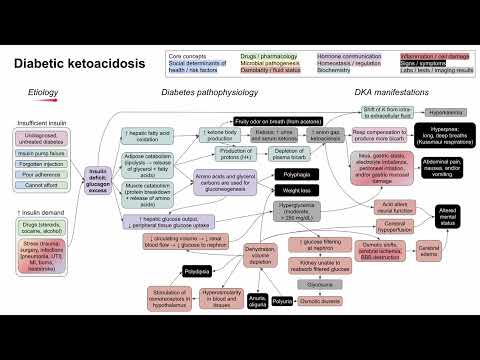
Diabetic ketoacidosis (mechanism of disease)
MedLecturesMadeEasy
10m 19s1,615 words~9 min read
Auto-Generated
Watch on YouTube
Share
MORE TRANSCRIPTS