[0:00]A production of WGBH Boston in association with Harvard University. Funding for this program is provided by. Additional funding provided by William D. Budinger, Gerry Cardinale, Ann B. and Thomas L. Friedman, Kenneth M. Hirsh, The Margot and Thomas Pritzker Family Foundation, and by Paul and Mary Anderson, Bruce G. Bodaken, Christman-Horvath Foundation, The Goldman Sachs Foundation, The Hermine and David Heller Foundation, Gerald D. Hosier, Joy Foundation, Laura and Gary Lauder, Markle Foundation, William E. Mayer, Dov Seidman.
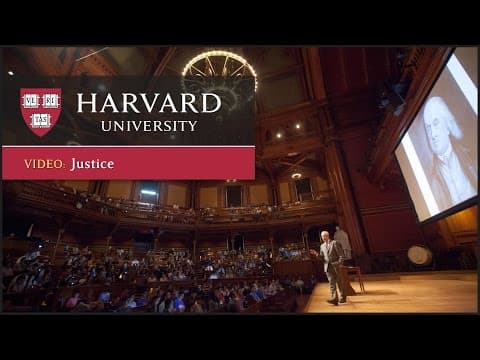
[0:32]Today we turn to John Locke.
[0:39]On the face of it, Locke is a powerful ally of the libertarian. First, he believes as libertarians today maintain that there are certain fundamental individual rights that are so important that no government, even a representative government, even a democratically elected government can override them. Not only that, he believes that those fundamental rights include a natural right to life, liberty and property.
[1:29]And furthermore he argues that the right to property is not just the creation of government or of law. The right to property is a natural right in the sense that it is pre-political. It is a right that attaches to individuals as human beings, even before government comes on the scene, even before parliaments and legislatures enact laws to define rights and to enforce them. Locke says in order to think about what it means to have a natural right, we have to imagine the way things are before government, before law. And that's what Locke means by the state of nature. He says, the state of nature is a state of liberty.
[2:39]Human beings are free and equal beings. There is no natural hierarchy. It's not the case that some people are born to be kings and others are born to be serfs. We are free and equal in the state of nature, and yet he makes the point that there's a difference between a state of liberty and a state of license. And the reason is that even in the state of nature, there is a kind of law, it's not the kind of law that legislatures enact, it's a law of nature. And this law of nature constrains what we can do, even though we're free, even though we're in the state of nature. Well what are the constraints? The only constraint given by the law of nature is that the rights we have, the natural rights we have, we can't give up. Nor can we take them from somebody else under the law of nature. I'm not free to take somebody else's life or liberty or property.
[4:05]Nor am I free to take my own life or liberty or property. Even though I'm free, I'm not free to violate the law of nature. I'm not free to take my own life or to sell myself into slavery. Or to give to somebody else arbitrary, absolute power over me. So where does this constraint, you may think it's a fairly minimal constraint, but where does it come from? Well, Locke tells us where it comes from, and he gives two answers. Here's the first answer. For men, being all the workmanship of one omnipotent, and infinitely wise maker, they are his property, whose workmanship they are, made to last during his, not one another's, pleasure. So one answer to the question is why can't I give up my natural rights to life, liberty and property is, well, they're not strictly speaking yours. After all, you are the creature of God. God has a bigger property right in us, a prior property right. Now you might say that's an unsatisfying, unconvincing answer, at least for those who don't believe in God. What did Locke have to say to them? Well, here's where Locke appeals to the idea of reason. And this is the idea that if we properly reflect on what it means to be free, we will be led to the conclusion that freedom can't just be a matter of doing whatever we want. I think this is what Locke means when he says, the state of nature has a law of nature to govern it which obliges everyone: and reason, which is that law, teaches all mankind, who will but consult it, that being all equal and independent, no one ought to harm another in his life, health, liberty or possessions. This leads to a puzzling paradoxical feature of Locke's account of rights, familiar in one sense but strange in another. It's the idea that our natural rights are unalienable. What does unalienable mean? It's not for us to alienate them, or to give them up, to give them away, to sell them. Consider an airline ticket. Airline tickets are non-transferable. Or tickets to the Patriots or to the Red Sox, non-transferable tickets. Are unalienable. I own them in the limited sense that I can use them for myself, but I can't trade them away. So in one sense an unalienable right, a non-transferable right makes something I own less fully mine.
[7:26]But in another sense of unalienable rights, especially where we're thinking about life, liberty and property, for our right to be unalienable makes it more deeply, more profoundly mine. And that's Locke's sense of unalienable. We see it in the American Declaration of Independence. Thomas Jefferson drew on this idea of Locke.
[7:56]Unalienable rights to life, liberty and as Jefferson amended Locke, to the pursuit of happiness. Unalienable rights. Rights that are so essentially mine that even I can't trade them away or give them up.
[8:18]So these are the rights we have in the state of nature before there is any government. In the case of life and liberty, I can't take my own life, I can't sell myself into slavery, any more than I can take somebody else's life or take someone else as slave by force.
[8:37]But how does that work in the case of property? Because it's essential to Locke's case that private property can arise even before there is any government. How can there be a right to private property, even before there is any government? Locke's famous answer comes in section 27. Every man has a property in his own person. This nobody has any right to but himself. The labor of his body, and the work of his hands, we may say, are properly his. So he moves as the libertarians later would move, from the idea that we own ourselves, that we have property in our persons, to the closely connected idea that we own our own labor. And from that, to the further claim that whatever we mix our labor with, that is unowned, becomes our property. Whatsoever then he removes out of the state that nature has provided, and left it in, he has mixed his labor with, and joined to it something that is his own, and thereby makes it his property. Why?
[10:06]Because the labor is the unquestionable property of the laborer. No man but he can have a right to what that is once joined to, his labor.
[10:21]And then he adds this important provision, at least where there is enough, and as good left in common for others. But we not only acquire a property in the fruits of the Earth in the deer that we hunt, in the fish that we catch, but also if we till and plow and enclose the land and grow potatoes, we own not only the potatoes but the land, the Earth. As much land as a man tills, plants, improves, cultivates and can use the product of, so much is his property. He by his labor does, as it were, enclose it from the common.
[11:10]So the idea that rights are unalienable seems to distance Locke from the libertarian. The libertarian wants to say we have an absolute property right in ourselves, and therefore we can do with ourselves whatever we want. Locke is not a sturdy ally for that view. In fact, he says if you take natural rights seriously, you'll be led to the idea that there are certain constraints on what we can do with our natural rights, constraints given either by God or by reason, reflecting on what it means really to be free. And really to be free means recognizing that our rights are unalienable. So here's a difference between Locke and the libertarians. But when it comes to Locke's account of private property, he begins to look again like a pretty good ally, because his argument for private property begins with the idea that we are the proprietors of our own person, and therefore of our labor, and therefore of the fruits of our labor, including not only the things we gather and hunt in the state of nature, but also we acquire a property right in the land that we enclose and cultivate and improve.
[18:24]I feel like there's a general distinction to be made between the right to life that individuals possess and the and the fact that a government cannot take away a single individual's right to life.
[18:41]And there are also the unalienable rights, which are the rights to liberty, and also the rights to property. And my question is how does Locke defend those natural rights?