[0:00]On August 11, 2016, researchers working with paralyzed people announced a surprising outcome. The patients were getting better. The team, led by Duke University neuroscientist Miguel Nicolelis, discovered that his patients regained partial sensation and muscle control in their lower limbs by training with brain controlled robotics. This is an example of one of our patients that was trained to use a non-invasive technique EEG to imagine walking. And this signals basically translated into digital commands that go to a robotic exoskeleton that he's wearing. And not only he can walk with this device, but we have sensors all over the exoskeleton that when pressure sensors, when he touches the ground, there is a pressure wave that is generated and delivered to a vibrating element on his arm. We found a way to give them the feeling that is not the EO that is carrying them, but is them walking with the exo and it was very realistic. We have been working with all these eight patients for 24 months now. And the most beautiful part is now we know because we have done neurological examination these guys and they have been chronic spinal cord lesions. They have been in the wheelchair for a decade. Two years later, seven of these patients have recovered a sensitivity below the level of the injury and motor control, voluntary motor control of some muscles below the level of the lesion. So, I think plasticity was triggered by this exercise of imagining your walking and getting this feedback that is very realistic. So this conjunction of the output to control a device and the feedback that feels like my body is moving may have triggered actions that were left. Nerves that survived the original lesion to to start working again. Our expectation is that we are going to reduce the time that it takes for a paraplegic patient to regain the concept of having legs and being able to control them mentally. So they can move to the exoskeleton faster. I I think that's brilliant. I think that's wonderful. Not only because it's great science, but because it also reflects one of the slogans of the disability community. It says nothing about us without us. I think that's a great, you know, merge of of of what we need as individuals, as human beings, our differences, our personalities, our disabilities, plus how to bring the science together. That's a great synthesis. Yeah, what they like, they tell us is that most of physical rehabilitation, the classical one is passive. You are there in a physical therapist is trying to move your leg and you're just there receiving that. In this kind of thing, you're a protagonist.
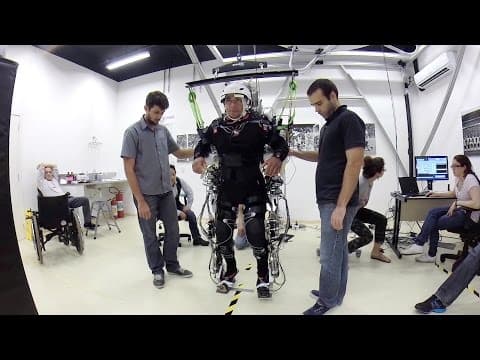
Miguel Nicolelis Helps Paralyzed Patients Learn to Move Again
World Science Festival
2m 50s452 words~3 min read
Auto-Generated
Watch on YouTube
Share
MORE TRANSCRIPTS