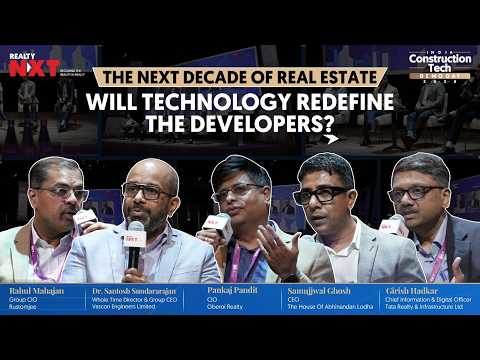
[0:00]We have been listening to this fact since morning that real estate traditionally is built on three pillars, which is essentially land, capital and the execution capabilities. While we hear that the things are really changing today and there is a fourth dimension that is getting added to it, which is data and technology. It has not only started influencing the decisions, but it has also started influencing the way we started doing our businesses. I'm lucky to have such a elite panel and why I say elite is not just because the designations these people carry, but essentially they represent both spectrums of the business. I have two CEOs on the panel. Dr. Santosh from Vascon and Samujwal from the House of Abhinandan Lodha. And I have two CIO CDO's on the panel, Pankaj from Oberoi Realty and Girish from Tata Realty & Infrastructure Ltd. So with this panel, I think the good part is that they will bring on both sides of the spectrum to the discussion. And what we will try and answer over the next 30 minutes is as a sector, are we only simply adopting technology or are we making any efforts or strategizing to be a digital developer going forward? You know, are we imbibing technology as a part of doing business going forward? So let's explore this during our chat in the next 30 odd minutes. Traditionally, we have been speaking about, you know, ERP, CRM and all those technologies that the world uses. While real estate has been a little laggard in adopting this. We have caught up big way on this and say ever since morning, we have seen very brilliant presentations representing Gen AI and Agent AI and stuff like that. I want to start with Samujjwal, you and I want to just understand from you what is that one shift that you have seen that has fundamentally changed the approach the way you do business. It could be a technology, non technology, you know, shift but one shift that you think that has fundamentally changed the business. Good afternoon ladies and gentlemen. Thank you Rahul. Thank you other esteemed panelists. I think over the past 20, 25 years as far as real estate as a category and industry is concerned, the transition from a capital intensive industry going on to morph into a more brand and sales centric industry. That's one large shift that has happened. Over the years we have seen real estate being a sellers business, but with a flux of time there has been an increasing focus on customer centricity, product centricity and centricity on innovation. More in the recent times, Technology, as we have been talking about it through the course of the day and is the predominant theme for the day. Technology also has become increasingly core to the business model of real estate where largely we are seeing the advent and the adoption of technology for the sake of growth, simplicity and furthering efficiencies. That's in a natural is a significant shift as far as I am concerned and I believe a lot of us in this room will concur. Great. Girish, I would want to have your perspective from a digital lens on this. You have been in the sector for very long. I know, before TRIL, Mahindra Life spaces and, you know, and Piramal as well. So what's your take on this, you know, on Samujjwal said, you know, how have you seen the shift? Yeah, I think the most important thing is, it's great to be in tech today. Everybody is pursuing tech and everybody's looking at at tech for answers, which was not the case maybe in 2010. So I think that's a huge shift. And traditional businesses were mainly you create a website, you do SMS blast and that's what technology was all about. And and now today, if you see in real estate business, uh, I mean marketing, sales, CRM has been completely dominated by the tech environment. But in construction also, 3D models are a way of working. I mean everybody is 3D, most of us are on 4D and 5D is not very long away. So I think huge, huge improvements and and we are building digital twins. So that's the next wave and obviously everybody's looking at AI. I think a brilliant time to be in tech. Absolutely, Rahul, I think both of you touched upon the role technology is playing today in driving the business outcomes. Right. Great. That I think I would like to come to Dr. Santosh and let's move from theory to reality. I Dr. Santosh, I would want to ask you for Vascon on the ground, you know, where has the technology made a measurable difference? You know, whether it is in terms of cost reduction, improving quality, bringing up on speed in execution, whatever. But where is that measurable difference you think technology has made? So I mean, for us as real estate players, you know, at the end of the day it all boils down to cost to your profit and loss. And I think the final answer is that it has to reflect in the costs. But it's a journey. I think uh it starts from your corporate culture. What suits you? So we we see so many startups today presenting their case, but when they come and then, you know, can they customize to our needs? It starts with a corporate culture of trying to ensure that we are ahead of the curve in adopting technology. This this then translates to us as top management having control over our firm's operations. I mean we are building projects. Vascon is not only a real estate player, we are also a contractor across the country. So for me, you know, I'm having 40 live projects at various corners within India. We are not operating outside India, but we are all across India. So to get live data on our projects at various locations, to give us a semblance of control, you know, we talk of MIS and dashboard, but I think not only dashboards, technology at various, various data points within the company that we are able to. So we have a policy of trying to take at least three new jumps to go with marrying technology every year, whether it is in HR, whether it is in procurement, whether it is in design, you know, across the functions that real estate and contracting have us do. And eventually, of course, to answer your question, long story short, eventually this control and this usage of technology has to translate to the bottom line. Absolutely. Pankaj, do you see the same impact technology doing in Oberoi Realty as well? Yeah, absolutely. I mean, one of the core impact of the technology around in my opinion is to bring in transparency. And as developers, we really need this badly. So a lot of, you know, aspects of operations for example, internally I'm saying, how we execute our sites, are our designs getting properly built on our sites with the right quality, with the right efficiency and all that. The management is looking at technology to give answers to these solutions and to try and achieve efficiency, reduce the turnaround time of the projects. I mean, these are very long-term projects. Like if you're doing it for say, the lifespan of the project, let's say five years, even if you bring it down by six months, it translates into huge impact on the bottom line. So net net, this is, I mean, the impact in terms of top and bottom lines are quite substantial if the technology gets rightly deployed. Yeah, I mean, while transparency is one side of it, the accountability is also other side of it and why we bring transparency through technology, it also creates that accountability and drives better results is something that I can always vouch for. Girish, I would want to understand from you. We've been talking about technology. We have been talking about new age technologies and the adoption of that. But what is the real bottleneck do you think today is? Is technology itself a bottleneck? Is integration of the newer technologies with the age old systems like ERP, CRM is a bottleneck or is adoption about bottleneck?
[9:01]Yeah, I think in the question itself evaluated to the answer. And throughout the day we have been speaking and hearing different people saying saying this. So we have included. So what we did is we went about implementing best of the breed solutions across the value chain. We saw Salesforce as the best as in the CRM, SAP as the best, ERP Autodesk as the best design to delete platform. But it's not integrated data, it's okay, but if if that data is not meaningfully connected to each other, it does not solve a lot of problem. And I think that's one area where everyone of us uh we are working. We had a lot of discussions among ourselves also. We're trying to solve that problem. So, so that's obviously, and the adoption part, like you said, uh today there was always some amount of fear of technology adoption amongst individuals. And with AI coming in, now there is clearly two distinctions. One is, one there is one set of people who are having the FOMO, fear of missing out, they want to do everything in the AI and then there is another set of people who are having fear of attrition. They are saying AI is going to throw me out. So how do you balance that? I think that that also has become a very critical aspect today. And going forward, I think it's it's only going to increase. So I think creating awareness, training and training, it's not going to be any more generalized training. It has to be training created for a particular JD. I think that's that's the route that we have taken. Identify a JD, identify what areas of that particular JD can be catered through technology and what will definitely need genuine human intervention. So I think that's exercise that we need to do for each JD and then take it forward. I think that that's that's the way I feel. will help us sustain. Yeah, you touched upon the buzzword these days, AI, right? I mean, if you just stand on the road and say who knows AI, I'm I'm sure 100% of people will raise their hand and say I know AI. I mean that's the popularity it has right or wrong only the time will tell. A lot of organizations have now started adding AI to their name, just to to say that they are now AI enabled. Yes, yes, yes. Pankaj, let me come back to you from your technology lens, right? When we speak about AI, you will find a lot of use cases in the pre sales surveys, post sales areas in our industry. While we have been seeing some of the startups, you know, presenting since morning on the AI use cases on the construction take side. I want to understand your experience in terms of actually seeing data and AI influencing decisions if at all you have, you know, kind of implemented that at your workplace. Yeah, it's a great question. Of course, we are implementing AI in its all the flavors, agentic, analytic and Gen AI and all that stuff. So what we have seen is, as you very rightly said, it is very different when it comes to enterprise setup and try to extract, you know, value from AI. It is okay to use chat, GPT and then use LLMs and all that and create stuff. But when you are asking an agent to function within the existing enterprise setup and deliver something, there is simple process of automating bill payment, which we have been trying. So on one hand, it can handle 80% of your, you know, scenarios. 20% it will fail. The business is much more complex and there are various scenarios. So one is this, that it will succeed in 80%. It will, it may fail in 10. The accuracy again is a question mark and we need to add human in the loop. So while you're working with data and AI, these are certain elements those have to be looked into when we look at the end result of an AI agent. The data quality, of course, matters. Then you use, I mean, we used a technology like OCR to scan the bill, let us say, or supporting documents to a bill to figure out whether the bill is, is as is okay as per supporting documents, is it okay as per the contract? AI can do this, yes, it does. Is it 100% successful? No. There has to be somebody who needs to look at what has gone wrong, handle exceptions and all that. So net net, right now, if if I can tell you Rahul, we are working with multiple AI agents, especially we are trying to hit the processes, those don't need too much of a human judgment with certain amount of success. Over a period of time, I am very sure that it will deliver the results. Absolutely. I mean, you said you're working with multiple AI use cases, but typically the way adoption goes, and this is on behalf of the tech guys that I'm saying this, typically we will always do pilots first and then roll it out or scale it up to other business units or other sites or other areas within the business, right? Let's be honest, pilots are always great, but when it comes to scaling up, we have our own challenges, right? I don't understand, Girish, from you, your perspective on before even you get onto a pilot, and this is important for the startups present in the room to understand. How do you even decide any technology or any startup that you would want to you know, pilot with or subsequently scale up with? So I uh I think for us it is very clear that it's it has to be associated with the business outcome. I mean what is the business come, what is the benefit that's going to come out to the business? And usually what happens with the pilot, it's it's not about implementing a technology. I mean when you do a POC, proof of a concept, or you do pilot on a small scale, it's basically testing out the technology. But what it needs to do is solve the problem at all the three levels. It is process people and technology. I mean what's in it for me for the person at the site who is going to use that technology? I think that becomes a very critical part. Uska kaam asaan ho raha hai ya aap uska kaam bada rahe ho? If if that's going to be the case, then that pilot does not scale up because people say theek hai, ye chal raha hai, but I will not use it. So it fails to scale up. And I think there was one question about adapting processes to a universal standard. Now that becomes a huge ask because unlike a manufacturing company, every real estate project is different and expecting everything an affordable housing project to have the same set of processes as an ultra premium luxury, I am not really sure. I mean it's it's a great concept as of now, maybe it's possible. And that's why the the solution needs to be configurable to bring those project space accommodate those project specific variances. And I think that's that's a point which is missing and one of the person just came and said, okay, I mean we want to be lean and we want to be able to replicate the same thing everywhere. I'm not really sure if that's what we are looking for. Yeah, I mean, absolutely. You know, business outcomes is something that that drives the business and that's where, you know, the pilots are, you know, essentially aimed at and then subsequently scaled up. Samujjwal, I would want to come back to you here again and you have a rich experience in the real estate industry. So if you are to advise to the startups in the room, what is that one, fundamentally one thing about the industry that they should know? But one thing about the industry that the startup should know that they should address in the solutioning that they do is something that I would like to understand from you and and help the startups understand that as well. See, the response would actually encompass the entire value chain of real estate, which is extremely complex and hence very interesting. So as far as any kind of advisory from a business perspective that I could give on the technology front, especially to the startups and companies who have been presenting till now, I think the biggest favor that any startup could do, any tech initiative could can do both at a pilot level or a prototype level to a scalable level is to bring intense focus on consumer and consumer data. I guess the richer we are about our understanding of the consumer, the better we are poised in the new world because data is going to have immense bearing on how businesses shape up in the future. That's point number one. I think the second part that that tech companies can do inside a real estate organization, which is slightly alien to the latest developments in the technology world is to how to drive the culture of adoption within real estate. Because we are very happy to deal with legacy systems and can run BAU, but that is not going to be the order of the day. So with the youngsters in of tech companies that I deal with, especially the Gen Z, you it's extremely important that they are able to drive that culture. The last and probably the most important part is that we are slightly a little ahead of the curve when it comes to tech adoption in the M&S side of things. However, on the construction part of the business, which is such an integral part of the value chain because I would believe that each real estate organization believes that that inherently they are a product company and that's what stays, that's what get tested over a period of time. So how does technology help us to on the construction side of things is going to be of immense value.
[19:29]I still believe that the days are far when tech will have a role to play in a far more pronounced manner in BD and approvals, but to begin with in a natural consumer centricity would be one critical area and greater adoption of tech in the construction and design side of things. Absolutely. I think very well articulated and very well said consumer data as it is. We always say data is oil. Today oil is $110, but consumer data is probably five times of that. And you know, if you can get hold of that and translate it into insights, obviously this is going to be a game changer in the business. Rahul, just one sentence from my side and it's an input to all the startups who are here, based on my experience of working with startups. While you're building the functionalities and focusing on it, please do give some weightage to the data privacy angle because we are talking about the data mainly within the enterprise. Who sees what data and who has access to what data is a crucial parameter where the software gets evaluated for enterprise deployment. And in the light of DPDPA being effective from 17th May 2027, which is just about 14 months away, this is a very important point for the startups to note. I said this because I have seen that this aspect of the software gets a little bit in the shadow. It doesn't get that much. Absolutely. I think great insights. I would want to come to you, Dr. Santosh. You know, you said you operate out of 40 odd sites and generally when it comes to pilots and then scaling up, something falls apart when we start scaling it up. In your opinion, what is it that typically falls apart? And as startups, you know, I'm trying to drive the discussion more towards helping them. As startups, what should they do so that a pilot to a scaling up is essentially as successful as the pilots are? Yes, this is, I think one of the biggest roadblocks we face and all the more, given that we are from the civil industry and while, you know, the top management does always recognize that we have to get into technology and we have to force ourselves, but it's not so easy to then translate that same vision and mission all the way down to a site in Bihar, where the, you know, the civil engineer there or the supervisors there working at site need to essentially also understand the urgency or the the vision of the company and then cooperate. So it doesn't happen. So those are the weaknesses from our side as a developer, which we have to constantly work on our corporate culture and you know, keep pushing, so that technology does get scaled up within the company. But the other thing, you know, all of us are taking funds on AI, I'm a civil engineer, but I think we are all experts in AI, we all accepted that. So I think whatever we have all visualized and speculated that AI can do or not do and change the world. One thing that is coming out is that coding is something that AI is able to do much faster with much less errors than humans were doing over this period. And if that is true and that seems to be recognized by, I think the startup firms would know better. But if that is true, then I see that this this 20% gap that Pankaj talked about where generic startup solutions, which are generic in nature. But, you know, all of us are individual real estate companies with a good ego. We are different. I am different to him, he's different to me. So we are not generic at the last 20%, we are not generic. And that is where, you know, our systems within our company, uh, are are special. You know, we've we've done this over 40 years, we know it best. So, so it's very difficult for us to then allude and say, no, we will, we will shift our methods to follow a generic, uh, input data point that the startup company is giving. While we do recognize 80% is going to solve our problems, but I think if coding can be, you know, cheap today, I think the startups can then go to that next level and say, okay, we have 80% ready. 20% for Vascon. This is what you want. We can do it like this. You know, we can get it done for you much faster. Yeah. By coding. And this is Vascon specific. Exactly. So I think we can reach there very soon and that will be a game changer. That will be a game changer. startups in the room. I hope you have taken a note of what Dr. Santosh was advising, right? Interesting perspective. So we spoke about a lot of things. We spoke about what is changing today. We spoke about, what's happening? How do we do pilots? How do we scale up the essentially the issues within that. Samujjwal spoke about one advice about the industry that he wanted to give to the startups. I want to take a moment to look ahead and see real estate maybe five years, seven years or 10 years from now, right? And that's my last question given that I have only four minutes left. Yes, I was just going to intrude and say that. I'm so sorry to cut you off, Mr. Rahul, but just let's keep this in mind that we've got like the last three minutes left. We will finish it within that. Don't worry. Perfect. So my last question to the panelist is, you know, one capability and it need not be a technological capability, but one capability that you think will define a successful or a digital developer in 2030? What is that one capability a developer carries, which will define him to be a digitally successful developer in 2030 or 2035? It's adaptability and ready to change daily. To check your processes and adopt technology, you need to be clear that you want to do it as a mission of the company. Absolutely. Pankaj. Fail fast, try stuff. If it fails, move over. I think a lot of us kind of do this mistake of believing that tech is an amalgamation of tools, whereas tech has to be integrated as an operating system. The sooner we realize this truth and make it absolutely integrative to the business across the value chain of real estate, the better for us, and I think that's where the real work is going to happen. I think I echo that sentiment. I think the earlier we are able to connect different data across multiple sources meaningfully and then drive analytics on top of it, I think that's that's I whoever does that the best and fastest, I think it's going to win the race. Great. So we talked about analytics, we talked about adaptability, we talked about failing and rising soon. Great perspectives panelists. The fundamentals of the real estate always remain the same. However, the way we decide, we strategize, we deliver, we execute are surely changing with these perspectives, right? Perhaps the tech transformation is not just through technology, but the way we think about the technology and adopting the technology in our businesses in this world. Thank you so much to all my panelists. It was wonderful chatting up with you. Thank you so much to the audience.