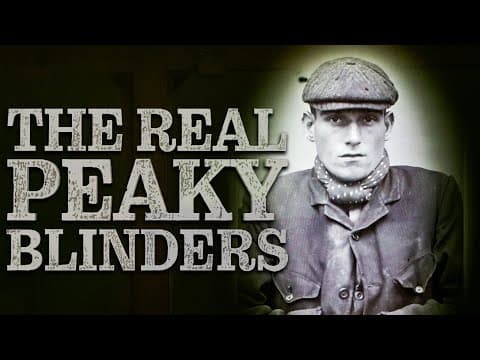
[0:04]In 1890, an incident occurs in these back streets, that reveals a phenomenon that will rock Victorian society and lead to the explosion of organized crime in Britain. On the 22nd of March 1890, George Eastwood, an inoffensive chap, goes into the Rainbow pub.
[0:30]He's a teetotaller and he's enjoying a ginger beer when three tough nuts start to insult him. George decides to go home, and when he gets outside, he hears the shout, give it to him hot lads. They savagely attack him. He's in hospital for three weeks and he has to be trapan. A piece of the bone from his skull removed. So what's so important about this particular violent incident? Well, it's the first time that the term "Peaky Blinders" is used and the legend is born. The real Peaky Blinders go on to become the godfathers of organized crime in the 1920s. There was this organized gang system that was every bit as bad and good as the one that operated in Chicago. But their origin stretched back 50 years earlier to the 1870s. These young men aren't focused on money-making. They're waging street war for status. They're about fighting. They attack policemen. They fight each other. It's the first modern youth cult. The gangs erupt from Birmingham's back streets where they face poverty and racism. He denounces them as cannibals. This is the story of the rise and fall of Britain's first modern mass gangland.
[2:07]Who change our cities forever. The Real Peaky Blinders, Episode 1: Street Fighting Gangs. My dad was the main source of stories about the Peaky Blinders, and the story my dad told that really made me want to tell this as a drama is that he was probably eight years old and his dad gave him a message and said take these to the Peaky Blinders and he was terrified. And he walked in and he said inside there are eight men immaculately dressed, a table covered in coins, in a place where no one had any money. And he said the men were all drinking beer and whiskey out of jam jars. Because they wouldn't spend any of that money on something like a glass or a cup. Every penny they had was spent on how they looked.
[2:59]And it just made me think that in an environment where you have no control, you have no authority, everything's pretty grim. The only thing you can do is make yourself the thing. The Sheldons were his uncles and they were the people who were sitting around the table. And it wasn't until many years later when I started researching this that I started seeing the name Sam Sheldon. Steven Knight sets his drama in Birmingham after World War One. When the Sheldons, the inspiration for Knight Shelby, are well established. But this film explores the early days of the Peaky Blinders. I've done a lot of research into the Sheldons, and three of the brothers, John, Samuel and Joseph were notorious criminals.
[3:51]This is really important. This is a photo of Samuel Sheldon. He's only five foot one and a quarter, but he's not a man that you want to mess with. He was involved in riots, brutal beatings, shootings and the worst gang war in the city's history. He would be Tommy Shelby. I wouldn't want to meet him in a dark alley, that is for certain.
[4:15]Because Samuel Sheldon gets done in the 1880s for attacking the police in a gang. He gets done for attacking other people and throwing stones. The Sheldons have their own gang. But it's obvious they're teaching from a period earlier than when the drama is set. This mugshot of Sam Sheldon isn't the only one.
[4:45]So this is the Birmingham City Police mugshot book. Here he is. Samuel Sheldon.
[4:57]Who many people might associate with the fictional Tommy Shelby character from the Peaky Blinders. Who was part of the Sheldon family criminal family in Birmingham. This occasion, he was sentenced to five years penal servitude for being in possession of a base coin, which was a common offense at the time. It was it was forgery, forging coins, fake currency.
[5:26]It's probably the biggest police mugshot collection in the UK. This contact with the law gives a rare insight into working class history where so often no records exist. It's part of a remarkable collection that reveals how widespread the early Peaky Blinders were. You can see some of the Peaky Blinder mugshots. You can see the date they were born, the offenses, the date of the offense and what punishment they received.
[6:04]This is baby-faced Henry Fowler. He and his brothers were convicted of numerous crimes around Birmingham in the late 1800s. Ernest Bales here, sentenced to two months imprisonment for stealing a bicycle. Young Ernest there with his peaked cap and his typical frown. Looks quite hardened. Every single one of them has got a story to tell. They're just a window into another lifetime, aren't they? This is Edward Derrick, who I believe is a an ancestor of Carl Chinn, Professor Carl Chinn. Looks quite surprised to be having his photograph taken.
[6:53]The Peaky Blinders are very close to me and my family. Unfortunately, my great grandfather, Edward Derrick, was a Peaky Blinder. His older brother was a leader of the Sparkbrook Slogging Gang, and Edward, my great grandfather, followed him for violence. He got done for assault for assaulting the police as well. He was a petty criminal. So petty that on one occasion he actually stole a side of bacon from outside a butcher's shop. But he was a nasty, vile man and he used to beat up my great grandmother. So he's not a man to be admired.
[7:26]By trawling the records of hundreds of Peaky Blinders, it's clear that the early Peakies are a Birmingham wide phenomenon.
[7:40]The real Peaky Blinders are not just a 1920s gang, one gang. The real Peaky Blinders are the men and youths who belong to numerous backstreet gangs in Birmingham in the 1890s and turn of the 20th century. But their roots go back much further. They're just known then as street ruffians, but from 1872 they have a name: Slogging Gangs. And that name is from the word slogger, which means to hit somebody with a fierce blow. It's the start of an urban movement that will ultimately transform attitudes to the working classes and life in the inner cities. The rise of these slogging gangs is mirrored in other industrial centers across Britain. By the late 19th century, we're hearing lots of reports of territorial youth gangs in England's major cities and without exception, the gangs are located in the working class residential districts.
[8:42]So these will be the factory or workshop districts of cities like Birmingham and Manchester. The rampant ruffianism of the back streets, that's the problem of the big cities, Birmingham, Manchester, Salford, London and Liverpool. Charles Dickens describes the city as a vision of hell. Life expectancy is below 45 years. Around one in five children die before the age of five. People are working long, long hours, they're working in hot, noisy, often dangerous conditions.
[9:20]Into this world are born the members of this early gang movement, the precursors to the Peaky Blinders. Certain names crop up more often than others. One of them who's central to our story the Peaky Blinders is called Thomas Joyce.
[9:54]The first mention I find of Thomas Joyce in the local press is in September 1874. He and a pal from the Park Street gang are on Deritend Bridge just over there, and they attack William Smallwood, a top fighter from the nearby Milk Street gang. They use very filthy language and draw their knives. Smallwood strikes out with his buckle belt. Joyce and his pal end up in court with their heads bandaged. And the magistrates look at them and go, you've had a good trashing. Taste of your own medicine.
[10:30]A ticking off from the law won't deter Joyce, he's already a hardened gang leader with a taste for violence. Making money doesn't motivate him. Fighting does. Thomas Joyce would have become captain of the Park Street gang because he was the toughest, the nastiest, the most brutal in a fight. What we need to understand is why was fighting so important to so many poor working class youths? They own nothing, but the one thing they did own was the street that belonged to them. So territory and masculinity come together. If you can defend your street and beat another street, you enhance your own status.
[11:13]There's a ritualistic component to confrontations between gangs. I think there's lots of shouting at the outset, lots of threats being issued. These are not criminal gangs in a conventional sense. So they're not organized for the purposes of street robbery or theft. They're much more fighting gangs. So really what they're interested in is defending their territory. There was much more acceptance of violence. I think people were much more violent then. There was sort of an acceptance of not casual violence, but just that there would be a fight, and men would fight each other.
[11:54]To understand why Thomas Joyce becomes a Peaky Blinder, Carl has been tracing his story. He's here in the 1871 census. You can see him there he is with his mum and dad and his younger brother. He's 18. His parents are both from Ireland and they settle here in Park Lane, next to Park Street. It was a very poor neighborhood.
[12:21]There's a quarter of a million people in Birmingham living in 43,000 back to backs. Birmingham's back to backs are actually houses split down the middle with one half facing the street and the other a central courtyard.
[12:39]The living conditions of the poor are atrocious. There's only one room downstairs. The people are packed together. It's insanitary living. Toilets are dry pan privies shared between two or three families. There's one tap in a yard for perhaps 100 people to get cold water. There's smoke everywhere. It's dirty. Life is hard and poverty kills.
[13:08]Thomas Joyce lives in the squalor of these courtyards and lanes, but the census reveals a detail that's surprising. He's a youngster in the 1871 census. We can see that he's a laborer.
[13:25]Like most of the early Peakies, he isn't unemployed, he's working.
[13:33]At the time, employment rates reach a record high. It's said that any 12-year-old can get a job.
[13:43]The overwhelming majority of gang members are young men and adult men who are unskilled. Lots of them are factory workers, they're hard-working chaps. Others are street traders. There might have been quite a lot of work around, but it's badly paid. And so they haven't got a lot of spare cash. So what they're doing is that they're looking to enjoy themselves in the cheapest way possible. From 1851 to 1881, the average age was just under 25. The middle class birth rate declines, but it doesn't drop in poorer areas. So in poorer neighborhoods, there's lots of youngsters, lots of children and they're out on the street. They've got no gardens, they've got no front rooms. So the streets their playground. If we think about these boys being quite marginalized, often in work that has limits to its satisfaction. There's a limit to how much they can progress in life, so perhaps the gangs give them something different. It's a testing ground for their masculinity. It's somewhere where they can prove themselves.
[14:49]There's a great deal of loyalty and identification with the gangs, and gangs have these, you know, they have a particular association with with specific areas, streets or clusters of streets. And so we have boys who are associated with named gangs in this period.
[15:09]There may have been one other explosive ingredient that sucks Thomas Joyce, the son of Irish parents into the gangs. Racism. Irish immigration to Birmingham happens in a big rush in the 1800s, and a large amount of that happens in the 1840s and the early 1850s. So you have the population, if you look at the census, of Irish born people in Birmingham, basically doubling between 1841 and 1851. And that great rush of migration into Birmingham is happening because of the disaster of the Great Famine in Ireland. The Famine of 1845 to 1851 leads to death by starvation and disease of more than a million Irish men, women and children. Up to 2 million are forced to emigrate.
[16:11]The Irish who move to Birmingham are often living in the very poor, very central areas of Birmingham, streets such as Park Street. Now those areas are very badly served by things such as water and drainage and sanitation. These new immigrants, like the Joyce family in Park Street, are confronted by age-old anti-Catholic hatred. And in 1867, that hatred is brought to the boil by a Protestant rabble-rouser, William Murphy. William Murphy works as a preacher. So he moves around from town to town, giving fairly bloodcurdling speeches about how English men and women should not trust the new Irish arrivals who are living in their midst.
[17:05]He denounces them, he denounces them as cannibals and he denounces their priests as pickpockets and liars.
[17:14]In June 1867, a mob marches on Park Street, one of the poorest neighborhoods in Birmingham. A huge number of people who view themselves as English patriots, turn up in the Irish area of Birmingham and decide to smash up the homes of the people who live there. And at one stage, the mayor of Birmingham estimates that there are about 50 to 100,000 people in the streets during those very riotous events. The Murphy Riots are focused on Park Street, which has an almost entirely Irish born or second-generation Irish population.
[17:57]And the people who live on Park Street put up quite a fight, and the police very much take the side of the people who are attacking those Irish residents. And when the police do that, really the fight is is over. And there are some very sad descriptions then of those Irish homes being ransacked, having their furniture brought out into the street and smashed.
[18:21]It's the Irish victims of the mob who are charged with rioting and have their claims for compensation turned down.
[18:31]Many of them live in the same streets as the Joyce family. And soon after this injustice, Thomas Joyce rises through the ranks of the Park Street gang. The roots of the slogging gangs are in the tail end of the 1860s, when a number of people in Birmingham who are children at the time, or teenagers at the time, see the Murphy riots.
[19:00]They see their homes being smashed. What then happens in the 1870s is that this this group who've lived through that period have seen the way that being skilled at things like stone throwing or being uh being part of a big group might be a really sensible measure. It might help you to protect your own and your community. So I think that is the legacy that we then see in some of the activities of the 1870s. We find names such as the Joyce family of Park Street being involved in leadership positions of the slogging gangs in the record from the 1870s.
[19:38]Thomas Joyce thrives on this ethnic tension. But the gang wars between Irish and English Peakies lead to family casualties.
![Thumbnail for 🔴 [MULTISUB] BABYMONSTER COMEBACK LIVE LET'S CHOOM | Weverse Live PART 1 - [04.05.2026] by Kpopgirls](/_next/image?url=https%3A%2F%2Fimg.youtube.com%2Fvi%2FzT9WpzV7PzA%2Fhqdefault.jpg&w=3840&q=75)