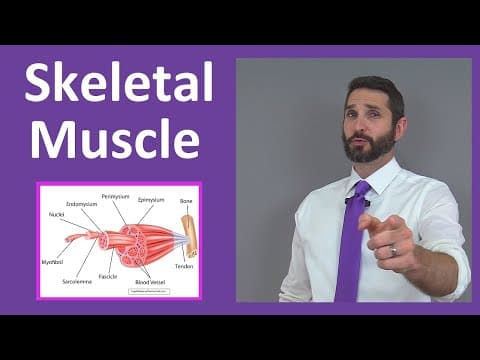
[0:00]Hey everyone, this is Ben with Registered Nurse RN.com, and did you know that there are three types of muscle tissue found in the human body? We have skeletal muscle, cardiac muscle, and smooth muscle tissue. In this video, I'm going to give you a quick review of skeletal muscle tissue. Skeletal muscles most commonly attach to bones, and they help you move your body. Unlike the other two types of muscle tissue, skeletal muscles contract on a voluntary basis via the somatic nervous system, allowing you to move your body at will. Skeletal muscles also serve important functions, such as supporting your posture, protecting delicate organs, and they even produce heat during contraction, which helps the body maintain a proper temperature. Each skeletal muscle is considered an organ, and it's made up of connective tissue layers, muscle fibers, blood vessels, and nerves. Skeletal muscles attached to the bones through tendons or direct attachments. Now, as we look at this muscle diagram, you'll notice an outer layer of connective tissue covering the muscle called epimysium. The prefix "epi" means upon or over (think epidermis as the layer upon your skin), and "mysium" comes from a Greek word that means "muscle." Therefore, epimysium is that layer of connective tissue that is over or upon the entire muscle organ. Next, you'll notice that the muscle fibers are going to be bunched together into something called fascicles, which means bundles. And these fascicles are going to be surrounded by connective tissue called perimysium. "Peri" means around, and again, "mysium" refers to muscle. So the perimysium is around the fascicles that bundle up these individual muscle fibers. Now, inside these fascicles, you will find another connective tissue layer called the endomysium, and this surrounds the individual muscle cells inside those fascicles. And "endo" just simply means within, so that will help you to remember that it surrounds the individual muscle fibers within the fascicle. Now, let's take a look at some of the individual muscle cells, which are called muscle fibers. These fibers are long and cylindrical, and they contain several nuclei, which are located around the peripheral portion of the cell. Now, these muscle fibers are going to be wrapped in a cell membrane called the sarcolemma. Inside each muscle fiber, there are tiny rods called myofibrils, which are surrounded by sarcoplasm. These myofibrils, also called fibrils, consist of repeating segments called sarcomeres, which are the tiny units responsible for skeletal muscle contraction. As we take a closer look at the structure of a sarcomere, you'll notice these zigzag sections that mark the endpoint of each sarcomere. These are called Z discs or Z lines, and they allow for the attachment of the thin (actin) filaments, as well as an elastic protein called titin. Each sarcomere contains thin (actin) filaments and thick (myosin) filaments. The thin (actin) filaments represented here in blue, anchor to the Z disc. The thick (myosin) filaments represented here in red, attach to an elastic, springy protein called titin, which then attaches to the Z disc as well. The actin and myosin filaments engage during muscle contraction, which I'll discuss in just a moment. The M lines or M bands, anchor to the center of the myosin filaments, holding them together while acting as a shock absorber. To help us understand the parts of the sarcomere, anatomists divide the sections into bands or zones. The arrangement of filaments within these bands accounts for the striated or striped appearance of the skeletal muscle fibers, and that's an important characteristic about skeletal and cardiac muscle tissue that you're going to want to remember: they both contain striations. First, there is an A band on each sarcomere, which is a section that contains the entire length of the thick myosin filaments, along with an overlapping portion of the thin actin filaments. This section makes up the dark part of the striation pattern. There's also an I band, which is the section of the sarcomere that surrounds the Z disc and contains only thin (actin) filaments. And this section makes up the lighter band in the striation pattern. The H zone is the section within the A band that consists of the thick myosin filaments and its embedded M lines. There are no thin filaments in this section of the sarcomere when it's relaxed. And again, the Z disc is going to be that zigzag portion that marks the end of each sarcomere and allows for the attachment of the actin filaments and titin. During muscle contraction, thick myosin filaments located within the sarcomere bend, and the knobby head part attaches to the thin actin filaments and slides them toward the middle of the sarcomere. This sliding of filaments causes the sarcomere to shorten or contract. As this takes place all along the sarcomeres within that myofibril, the entire muscle fiber contracts, which causes the entire muscle organ to shorten or contract. Okay, that wraps up this video over skeletal muscle tissue. You can take a free quiz on our website by clicking the link in the comment or description below. In addition, I have a major muscle song that will help you learn some of the major muscles of the human body. And we even have an entire playlist of anatomy videos, which again, you can check in the description below. So thank you so much for watching and please subscribe.
Skeletal Muscle Tissue: Contraction, Sarcomere, Myofibril Anatomy Myology
RegisteredNurseRN
6m 2s899 words~5 min read
YouTube auto captions
Transcript source
YouTube auto captions
This transcript was extracted from YouTube's auto-generated caption track. The transcript below is server-rendered so it can be read, searched, cited, and shared without opening the original YouTube player.
Pull quotes
[0:00]Hey everyone, this is Ben with Registered Nurse RN.com, and did you know that there are three types of muscle tissue found in the human body?
[0:00]Skeletal muscles most commonly attach to bones, and they help you move your body.
[0:00]Unlike the other two types of muscle tissue, skeletal muscles contract on a voluntary basis via the somatic nervous system, allowing you to move your body at will.
[0:00]Skeletal muscles also serve important functions, such as supporting your posture, protecting delicate organs, and they even produce heat during contraction, which helps the body maintain a proper temperature.
Use this transcript
Related transcript hubs
Watch on YouTube
Share
MORE TRANSCRIPTS


