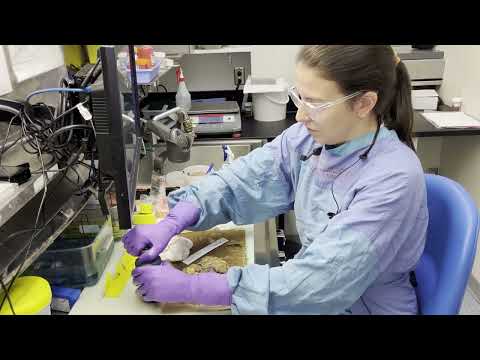
[0:17]Hi and welcome. My name is Susanna Gorski and I'm a resident in anatomical pathology at the Ottawa Hospital. Pathologists are specialist medical doctors trained to examine tissue under a microscope. However, before the tissue gets to a pathologist, it undergoes a gross examination or examination without a microscope. The purpose of a gross examination is to describe the type of tissue received, identify, measure, and document any abnormalities. And for large tissue samples, select the best tissue for microscopic examination. In many hospitals, this examination is performed by a pathologist assistant. In the following video, we will walk you through the process of gross examination of a real specimen. Most large specimens are left for several days in a liquid called formalin before being examined. Formalin is a fixative that helps preserve and protect the tissue. The specimen shown here is part of the right colon called the secum. The pathologist assistant starts by measuring the specimen and describing any normal structures present.
[1:54]Next, the pathologist assistant identifies and measures any abnormalities present. In this case, there's a tumor located on the inside of the colon.
[2:26]Next, ink is applied to the margins of the tissue. A margin is an area of tissue that was cut by the surgeon when the specimen was removed from the body. All margins must be closely examined to make sure there's no tumor at the cut edge.
[2:53]The pathologist assistant then uses a scalpel to cut the tumor into thin sections. The purpose of this is to allow the pathologist assistant to see how far the tumor has spread into the wall of the colon. This information is important because it can be used to determine the cancer stage.
[3:40]Next, the pathologist assistant selects the pieces of tissue that will be turned into glass slides for examination under the microscope by the pathologist. Pathologist assistants work closely with pathologists to determine which pieces of tissue are required. These pieces of tissue are placed in plastic containers called cassettes.
[4:12]That is the end of our video. We hope that it helped you understand one of the most important steps in the pathology process. If you would like to learn more about pathology or have questions about your pathology report, please visit mypathologyreport.ca. Thank you.