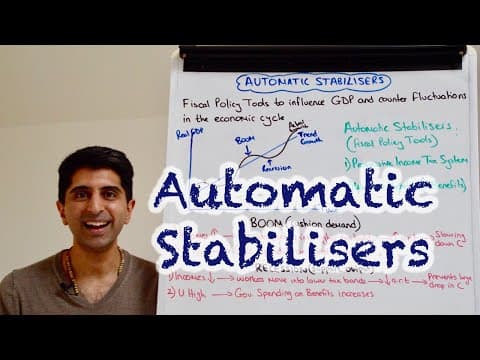
[0:00]Hi everybody, automatic stabilizers are fiscal policy tools to influence GDP and to counter fluctuations in the economic cycle. So here is our economic cycle and in it we can see the fluctuations of actual growth compared to our trend rate of growth.
[0:15]We can see that in a boom, actual growth is way beyond trend rate of growth, in a recession, actual growth is below trend rate of growth with a large negative output gap.
[0:24]But these automatic stabilizers are automatic fiscal policy tools that will come into play in a boom and in a recession.
[0:32]Whereby in a boom, they will cushion demand to make sure the economy doesn't overheat wildly. And in a recession, they will come in to support demand, to support output, to prevent a really deep recession.
[0:43]So what are the automatic stabilizers? What are these fiscal policy tools? Well an economy needs to have a progressive income tax system and they've got to have welfare benefits, mainly unemployment benefits that we're going to focus on in our analysis.
[0:58]So let's see how these come into play in a boom and then in a recession.
[1:02]Let's start by looking at the role that a progressive income tax system plays in cushioning demand in a boom. We know that in a boom, growth is going to be rampant and therefore incomes across the economy will be rising.
[1:13]As workers are paid higher incomes, they're going to be pushed into higher income tax bands, they're going to be paying higher rates of income tax. That's going to increase the average rate of tax, which is the amount of income tax paid as a proportion of total income.
[1:27]Which basically is going to slow down increases in consumption and with that it's going to slow down increases in aggregate demand.
[1:33]So it's still going to rise, but not as much as it would have done otherwise and that's going to control the extent of the boom and hopefully therefore demand pull inflation is not going to overshoot the target significantly, which is good news.
[1:47]The economy is not going to overheat as much as it would have done otherwise. What about benefits, welfare benefits? Well we know in a boom, unemployment is going to be low and therefore government spending on benefits, especially unemployment benefits, is going to be low, it's going to reduce.
[1:59]And that's also going to help cushion demand. And all of this put together means the extent of the boom's going to be lower, the risk of wild demand pull inflation is going to be much lower.
[2:07]What about in a recession? What role does a progressive income tax system play in supporting output in a recession? Well, it's the opposite than in a boom. We know that in a recession, economic growth rates are going to be negative and with that incomes will be falling.
[2:20]And therefore workers may well move into lower income tax bands and pay lower rates of income tax. That's going to reduce the average rate of tax, the amount of income tax paid as a proportion of total income, and that therefore is going to prevent large decreases in consumption.
[2:35]So aggregate demand is still going to fall, but it's not going to fall by as much as it would have done otherwise, which is good news.
[2:41]That helps keep output up to a certain level and prevent a really, really deep recession. We also know that in a recession unemployment's going to be higher and therefore automatically government spending on unemployment benefits is going to increase and that's going to help prop up aggregate demand and prevent a really, really deep recession that we would get otherwise.
[3:00]So you can see how these automatic stabilizers come in automatically, as long as the economy has these two things in place, and therefore can help cushion demand in a boom and support output in a recession.
[3:12]Now that's great news because what it means is that fluctuations in the economic cycle will not be as great.
[3:28]So there are still fluctuations, but you can see much smaller than they were otherwise. And that's great news, but also very good to use this when you're discussing expansionary fiscal policy because if the role of the automatic stabilizers in a recession in particular are very large, it reduces the need for discretionary fiscal policy.
[3:47]That is expansionary fiscal policy on top of the automatic stabilizers. And that means the government don't have to spend a huge amount of money on top, they don't have to cut taxation massively on top, because the automatic stabilizers will do a good job and that reduces the impact of government finances in a deep recession.
[4:06]So that covers automatic stabilizers guys, everything you need to know there, interesting stuff. I'll see you all in the next video.


