[0:00]Let me ask you a simple question. What is the most important piece of water on the planet Earth right now, not the Pacific Ocean, not the Atlantic, not the South China Sea. It is a narrow strip of water, only 21 miles wide at its narrowest point, squeezed between Iran on one side and Oman on the other. 21 miles. You could drive that distance in under 30 minutes. And yet this tiny corridor, the Strait of Hormuz, is the singular chokepoint through which approximately 20% of all the world's oil flows every single day. One fifth of global energy gone, just like that. If that straight closes, the entire world economy shutters. Japan runs out of oil in eight months. South Korea's manufacturing sector collapses. China's industrial engine, the engine that builds everything from your phone to your refrigerator, begins to stall. And Europe, already weakened by the war in Ukraine and dependent on Middle Eastern energy to keep its lights on, faces economic paralysis. 21 miles of water. That is what the United States and China are now fighting over. And the stakes have never been higher in modern history. Now, let me explain why this matters, and more importantly, why most people in the West and in the East are fundamentally misreading what is happening here. Because the conventional framing is wrong. People say this is a war between the United States and Iran. They say it is about nuclear weapons, about regime change, about Trump's political calculations, about Israel's security. And yes, all of these things are factors. But at the deepest strategic level, this is a war between the United States and China for control of the global energy architecture. It is a war for the future of the petrodollar. It is a war for who gets to sit at the center of the world economy in the 21st century. And the Strait of Hormuz is the battlefield on which that larger war is being decided right now, today, whether the generals in Washington and Beijing explicitly acknowledge it or not. To understand this, you need to understand what the petrodollar actually is. Since 1973, a quiet deal was struck between Washington and Riyadh. Saudi Arabia and the Gulf Cooperation Council states agreed to price all their oil in US dollars. In exchange, the United States provided military protection, security guarantees, and political backing to these monarchies. This arrangement gave America an extraordinary structural privilege. Every nation in the world, China, India, Japan, South Korea, Germany, everybody, needed US dollars to buy energy. This created a permanent, automatic global demand for the American currency. It allowed the United States to run enormous trade deficits, to borrow money cheaply, to finance its military adventures and its welfare state simultaneously, in a way that no other country on Earth could replicate. The petrodollar is not just an economic arrangement. It is the material foundation of American imperial power. Without it, the United States is just another large economy with serious debt problems. Now, here is where China enters the picture. China is the world's largest importer of oil. The majority of that oil comes through the Strait of Hormuz. China knows this. Its policy makers understand viscerally that their entire economic model, export-driven manufacturing, rapid industrialization, the social contract that the Communist Party has built with its 1.4 billion citizens, all of it depends on reliable, affordable energy flowing through that 21-mile chokepoint. And China also understands something else. If the United States successfully controls the Strait of Hormuz, if it succeeds in strangling Iran and dominating the Gulf states, then China's energy supply becomes permanently dependent on American goodwill. That is not a position any serious strategic power would ever accept. That is a structural vulnerability that Beijing has been working for decades to eliminate. So when you watch what is happening in the Middle East right now, understand that China is watching every single development with extreme intensity. Every airstrike, every naval maneuver, every diplomatic negotiation, every barrel of oil that does or does not pass through that straight, China is calculating, updating its models, deciding how and when to act. The reports of Chinese military cargo aircraft flying into Iran, the quiet resupply operations, the diplomatic back channels, these are not random events. They are pieces of a coherent strategic response from a nation that understands that what happens in the Persian Gulf directly determines what happens in Beijing's boardrooms and Beijing's politburo for the next 50 years. Now, let me use a concept from game theory to explain the dynamic here, because I think it clarifies everything. In game theory, there is the concept of a credible commitment, an action that one player takes that makes their future behavior predictable and reliable, and therefore shapes how all other players move. What the United States is trying to do in the Middle East is make a credible commitment to the Gulf states that America can guarantee their security and their access to trade. As long as that commitment is credible, the GCC nations price their oil in dollars, recycle petrodollar revenues back into American financial markets, and the entire system hums along. But here is the problem. Every time the United States fails to achieve its military objectives quickly and decisively, every time Iran absorbs American strikes and keeps fighting, every time a US base in the region gets hit by a ballistic missile, every time the Strait remains closed for another week, the credibility of that American commitment erodes. Japan watches, South Korea watches, India watches, Saudi Arabia watches, and they all start asking the same question: Can America actually protect us? Can America actually keep the oil flowing? And if the answer starts to look like no, then the entire architecture unravels. This is exactly the dynamic that China has been patiently, strategically cultivating. China does not need to fire a single shot to win this confrontation. It simply needs to ensure that Iran remains resilient enough, cohesive enough, and capable enough to deny the United States a quick, decisive, overwhelming victory. Because every month that this war drags on without resolution is a month that the credibility of American imperial power diminishes. Every oil tanker that cannot pass through the Strait is a data point in the calculations of every Asian economy asking whether they need to find an alternative to the dollar-based system. China has been building those alternatives for years. The petroyuan, the Belt and Road infrastructure investments, the bilateral currency swap agreements, the Shanghai Cooperation Organization, all of it is infrastructure for a post-petrodollar world that China has been methodically constructing while Washington has been fighting wars in Afghanistan, Iraq, Syria, and now Iran. Let me be very specific about what China's strategic interests are here. China wants the war to end as quickly as possible, but not on America's terms. If America wins, if it succeeds in regime change in Tehran, if it installs a government in Iran that is friendly to Washington, if it reopens the Strait of Hormuz under American supervision, then the petrodollar system is reinforced. The GCC states recommit to American security guarantees. And China is back to square one, with its energy supply dependent on a system it does not control. That is the worst possible outcome for Beijing. On the other hand, if America loses, or more precisely, if America is bled into a strategic exhaustion where it must eventually withdraw without having achieved its objectives, then the entire regional architecture shifts. Iran, battered but unbroken, will emerge controlling the Strait of Hormuz. The GCC states, having watched America's inability to deliver security, will begin accommodating themselves to Iranian power. And in that new regional order, China, which has maintained economic relationships and diplomatic contacts with all parties, is perfectly positioned to become the indispensable external partner, the guarantor of stability, the nation that can talk to everyone and threaten no one. This is the deeper meaning of China's careful, calibrated posture. It is not passivity. It is strategic patience with a very clear endgame. China is watching the United States make what historians will likely call the equivalent of Athens's Sicilian expedition, a massive overextension of military power against a resilient adversary in terrain that does not favor the attacker, driven by hubris and imperial overreach rather than sober strategic calculation. Athens sent its fleet to conquer Sicily and lost everything. The empire never recovered. The United States went into Afghanistan, went into Iraq, and now it is in Iran. And each time the script is the same. Overwhelming air power, initial tactical success. And then the grinding, slow, demoralizing reality of fighting a nation that has been preparing for this confrontation for 20 years, that has drones and missiles that cost $50,000 a piece, and that understands what the American military fundamentally does not, that modern wars are not won by the side with the most advanced aircraft. They are won by the side with the most strategic patience, the most cohesive national identity, and the clearest sense of what it is actually fighting for. Iran is fighting for its survival and for control of its own destiny. That is a cause that motivates extraordinary sacrifice and resilience. What is the United States fighting for? To preserve the petrodollar, to protect Israel's regional ambitions, to signal strength to China and Russia? These are not causes that generate the kind of national mobilization needed to win a prolonged war of attrition. And this is the structural problem that no amount of American air power can solve. You can bomb a country into rubble, but you cannot bomb away the will of a people who believe they are fighting for their existence. And so we come back to the Strait of Hormuz. Because in the end, everything converges on those 21 miles of water. Iran's ability to keep it closed, or to charge a toll on anyone who uses it, is the ultimate leverage point in this entire strategic contest. If Iran can maintain even partial control over that waterway, then Japan, South Korea, China, India, all the great Asian industrial economies, face an existential energy crisis. They will be forced to act, either diplomatically or militarily, to resolve the situation. And in that moment of crisis, the question becomes, who do they turn to? Do they line up behind the United States, accepting American management of their energy supply? Or do they begin to construct a new order in which regional powers manage regional resources, and the dollar is just one currency among many? That is the choice that the Strait of Hormuz is forcing upon the world right now. It is not a choice about Iran. It is not even a choice about oil. It is a choice about what kind of world order governs the 21st century. Is it a world where one nation, however powerful, however technologically advanced, can manage and tax the global energy supply in perpetuity? Or is it a world where the nations that actually consume and produce energy have a say in how that energy flows, at what price, and through whose infrastructure? China has already voted with its actions. It has spent 30 years building the economic, diplomatic, and military relationships needed to ensure that the second kind of world is possible. The United States has spent 30 years fighting wars to ensure the first kind of world persists. And right now, on the waters of the Persian Gulf, those two visions of the future are in direct collision. History tells us something very important about these collisions. Empires in decline rarely recognize the moment when their strategic overextension becomes irreversible. They always believe that one more strike, one more campaign, one more show of force will restore the credibility and dominance they are losing. And they are almost always wrong. The arc of this story is not yet complete. The final chapters are still being written by soldiers and diplomats and tanker captains and policy makers whose decisions over the coming months will ripple forward through decades of history. But the structural forces at play, the economics of energy dependency, the logic of imperial overextension, the patient accumulation of Chinese strategic leverage, these forces do not reverse easily, and they do not reverse quickly. Watch the Strait of Hormuz.
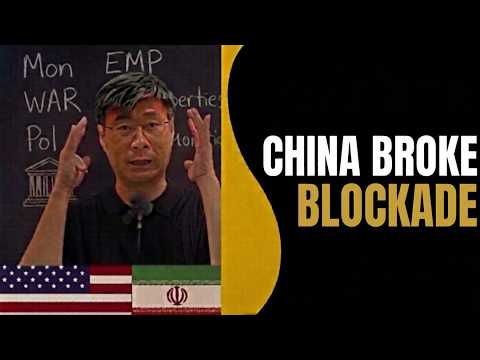
U.S. vs. China: The High Stakes Battle for the Strait of Hormuz | By Prof. Jiang Xueqin
The Jiang Academy
13m 14s2,069 words~11 min read
YouTube auto captions
Transcript source
YouTube auto captions
This transcript was extracted from YouTube's auto-generated caption track. The transcript below is server-rendered so it can be read, searched, cited, and shared without opening the original YouTube player.
Pull quotes
[0:00]What is the most important piece of water on the planet Earth right now, not the Pacific Ocean, not the Atlantic, not the South China Sea.
[0:00]It is a narrow strip of water, only 21 miles wide at its narrowest point, squeezed between Iran on one side and Oman on the other.
[0:00]And yet this tiny corridor, the Strait of Hormuz, is the singular chokepoint through which approximately 20% of all the world's oil flows every single day.
[0:00]China's industrial engine, the engine that builds everything from your phone to your refrigerator, begins to stall.
Use this transcript
Related transcript hubs
Watch on YouTube
Share
MORE TRANSCRIPTS


