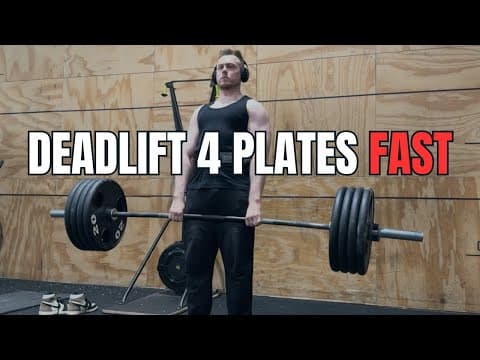
[0:00]Every healthy adult man should be able to deadlift four plates. If you heard that and your first reaction was, oh, what's this guy talking about and you ran to the comments to tell me how only 1% of gymgoers can deadlift four plates.
[0:11]You should go watch another fitness YouTuber. Some of those other influencers will stroke your ego and tell you, oh, it's okay that you can't deadlift four plates.
[0:19]I would rather just tell you exactly how to do it, teach you so that you can become a more confident and competent man.
[0:26]Being physically strong is essential if you want to be mentally strong. We all know that, we all want to be stronger, so let me help you do it.
[0:32]I was in your position once where a four-plate deadlift was like this huge unachievable number.
[0:39]Now I can deadlift four plates for fun and I want to show you exactly how to do it as well.
[0:42]So if you don't have time to watch through this whole video and apply the concepts, top link in the description to hire me as your personal strength coach.
[0:49]I'll get you to four plates and beyond, or a second link if you just want some good strength training programs to go and follow.
[0:54]So, a four-plate deadlift, 180 kilos or 405 pounds as the Americans call it.
[1:00]might seem like a big, like scary, intimidating number to you right now.
[1:04]And I get it. I was in that same position. Four plates on the bar looked crazy.
[1:08]And I promise you, it's actually very achievable, and when you get there, it will redefine your definition of strength.
[1:14]And you'll look back and you'll be like, wow, four plates really like isn't a huge number at all.
[1:20]I've coached hundreds of guys to a four-plate deadlift, so it is definitely achievable, okay?
[1:26]Now, the reason why you think it's this big, unachievable number is because you are running terrible training programs.
[1:31]I'm willing to bet that you either do a cookie cutter program like 5x5, 531, Texas method, something like that.
[1:38]Or you use like an AI app like Juggernaut AI or something like that, or you just run your own training program that you've basically pieced together from random pieces of all these different programs.
[1:48]And I'm willing to bet that it probably has you deadlift quite hard.
[1:54]You do a lot of high effort sets that are slow and grinding. Your back feels quite beat up most of the time.
[2:01]You probably only deadlift like once a week because of your bad recovery, aka, you train like a fucking moron, pretty much.
[2:08]Um, you try and force weight on the bar every single week. Your approach is basically, if I deadlifted 140 kilos today for my 5x5, next week I need to do 145 kilos for 5x5.
[2:20]You just keep doing that until your progress stalls out and then you reset and you build back up. It's it's a bit random.
[2:26]And that's why you're not at four plates. Then on top of that, you probably do like a bunch of like bent over barbell rows, you do heavy pull-ups, stuff like that, right?
[2:37]Because the old school bodybuilding and strength coaches told you that you have to do that stuff because barbells are better than machines and, you know?
[2:41]Um, so I'm going to give you a much better approach. Literally, just follow this step by step, you'll get to a floor plate deadlift.
[2:46]When you get to four plates, you can come back, hire me, and I'll get you to five plates and beyond.
[2:50]So here is exactly what I want you to do. This is for those of you who are stuck in like that three to five plate range, so you're between like, let's say 140 to 220 kilos in that kind of range.
[3:02]This is what I would apply to most of you. So, this is exactly what you're going to do. You're going to deadlift on Tuesday and Friday.
[3:08]Tuesday's primary deadlift, Friday's secondary deadlift.
[3:12]So, for the primary deadlift, super simple. I want you to do a top double at an RPE five.
[3:19]That might sound really light to you and it is and I'll explain how to progress it, but initially, we're just going to do one set of two at an RPE five.
[3:26]That means a weight that you can do for two reps with about five reps left in the tank. It doesn't need to be exact, like you don't need to like measure exactly you can only do five, just somewhere in that kind of ballpark.
[3:36]When you've done that top set, we're going to do four sets of four reps at 63% of the estimated one rep max.
[3:43]So you do that top set, you use that top set to estimate your one rep max. You can use an online calculator.
[3:49]My clients get access to like a spreadsheet that does it for them, but do the top set, calculate an estimated one rep max for that day, then do four sets of four at 63% of that estimated one rep max.
[3:59]One rep max, okay? Super simple. That's all you're going to do for day one.
[4:02]On day two, this secondary deadlift, you're going to do a pause deadlift.
[4:07]So all that is, is the regular deadlift, but on the way up, when the bar is about one inch off the ground, so literally as soon as the bar leaves the floor, you're going to pause for one second, then complete the rep.
[4:16]Bar goes back down, lift it up an inch, pause for one second and do the rep again.
[4:21]This is great for improving positioning for those of you who aren't great deadlifters yet. It's going to really force you to improve your start position because it's very difficult to pause a heavy weight in a bad position.
[4:32]So on this day, we're going to do a top set again, but this time it's a set of five reps to make it a little lighter.
[4:38]It's going to be a set of five at RPE five to six, okay?
[4:42]Exactly the same principle applies, you work up in your warm-ups to a top set of five where you've got approximately four to five reps left in the tank.
[4:50]Then we're going to do some back-off work. We're going to take 16% of the weight off the bar for three sets of six reps.
[4:57]Super simple, that is your micro cycle, okay? Day one primary, day two secondary, so this is week one of your training.
[5:03]Now, what we're going to do from there is we are going to keep running this week of training until you can no longer add weight to the bar.
[5:10]And the intensity is going to increase slightly from week to week, okay?
[5:14]And I'm going to give you an example on screen to show you how to actually progress that.
[5:19]So keep running it until you can no longer add weight to the bar.
[5:22]So let's say for the first four weeks, you can add weight to the bar on the top sets.
[5:27]The back-offs can stay the same, basically. Once you are unable to continue adding weight to the bar, so you get to week four, your heaviest week, and then week five gets harder, week six gets harder again.
[5:37]Week four was your peak. That was your best performance, so we are going to run four week blocks, okay?
[5:41]Now the way this block would look is week one. So we've got these initial intensities that we were doing, RPE five, RPE five to six on the top set.
[5:51]And we're going to make them a little bit heavier week after week. So we go from five to RPE six, RPE seven, RPE eight.
[6:00]And this one follows a similar pattern. So it's going to go five to six, six, maybe like six to seven, seven, seven to 7.5, something like that.
[6:05]I'll give you the exact progression on screen. We keep progressing through until that peak week. Once we hit the peak week, we stop, we reset and we move into block two.
[6:14]Here is the structure for block two. We're going to make very minor changes.
[6:19]That top double becomes a top single. This set of five becomes a set of four. Instead of taking 16% off the bar, we take 14% off the bar.
[6:28]So very minor changes just to increase the intensity a little bit and bring the rep ranges down.
[6:32]We're going to repeat this for three separate training blocks. And I'm going to give you all three blocks on screen.
[6:37]So block one, block two, block three, and this will give you a total of three training blocks that forms an entire strength cycle.
[6:47]And by the end of block three, on this final week, that's when you can like send it a little bit and try and go for a PR, okay?
[6:54]So on the final week of block three, however long these blocks needs to be like based on your individual response.
[6:58]And if this is all a bit confusing and you just literally want me to like write your blocks for you, find out how long you take to peak and stuff like that.
[7:05]Top link in the description or if you click the second link, it'll take you to like a paid product that includes all of these training programs structured out for you with the exact sets, reps, you just go do them, okay?
[7:16]So that's exactly what to do for the program. Now in terms of progression, what I want you to do, for the top sets, so this top double and this top set of five, I want you to aim to add weight to that top set every single week.
[7:28]Now, make sure you hit the target RPE on week one because if you start out too heavy, you'll run out of room and you won't really be able to add any weight to the bar, okay?
[7:37]So avoid starting out too heavy, start out on the lighter end if you're in doubt.
[7:41]Then it gives us room to build momentum, okay? So aim to add weight every single week.
[7:45]I would aim for 5 to 10 kilos on a weekly basis, then when you end the block heavy, we want to start the next block light.
[7:53]So if we say on block one, you went 140, 145, 150, 155, the next block we might go 145, 150, 155, 160.
[8:03]And you see how it follows this like wave, it's like step model, okay?
[8:06]So we start light, heavy, light, slightly heavier and it keeps going like that, okay?
[8:11]And yeah, it's super simple. So you just aim to add weight to the top sets each week.
[8:16]For the back-off sets, I want you to keep those static. So basically just keep them at the same weight.
[8:20]So if your back-offs on week one were like 110 kilos, just keep them the same.
[8:27]Obviously, on the secondary day, you've got a specific like load drop that I give you, so that will kind of guide you on where to go.
[8:33]But on the primary day, just keep it the same. If it's working, no reason to change it.
[8:36]Now, alongside this strength training, I also want you to do some bodybuilding accessories.
[8:41]You need to do this entire list once per week, fit it in your entire training week and just take each exercise off, okay?
[8:47]Now, the list that we're going to do is here. I'll show it on screen, but we're going to do some kind of hamstring curl seated or lying.
[8:53]We're going to do a wide grip overhand lap pull down. We're going to do a narrow grip lap pull down. This is a bit more lap biased.
[9:00]Then we're going to do a wide grip row with the elbows a little higher and flared to target the upper back.
[9:06]Then we're going to do a narrow grip row that's neutral, like this kind of grip, pulling towards the hips to emphasize the lats.
[9:12]Then we're going to do a rear delt isolation of choice, like a a cable rear delt fly, dumbbell rear delt fly, something like that.
[9:19]And then two bicep isolation exercises, okay?
[9:23]This just basically covers like the entire posterior chain, all of the muscles that are somewhat involved in the deadlift, because having more muscle mass is never going to be a detriment to your strength.
[9:34]So on these movements, super simple. I just want you to do two to four sets, five to 10 reps, maybe 12 if you prefer that rep range.
[9:42]RPE seven to 10. Start them on the lower intensity on week one, so maybe you start like RPE seven or eight.
[9:48]End of the block, just push it all the way like RPE nine, maybe even go to failure.
[9:51]This stuff is so much easier to recover from that it's not going to interfere with the strength work.
[9:56]You don't need to worry about stuff like bicep curls, rear delts, impacting deadlift performance, so just push that stuff super hard, try and beat the logbook and try to gain as much muscle mass as possible.
[10:07]So thank you so much for watching this video. I really hope that it helps you to hit a four-plate deadlift.
[10:11]All of you are capable of hitting a four-plate deadlift. Before you go to the comments and say, actually no, like, not all of us can, you don't understand like,
[10:20]which mindset is better to have? Like, just really consider it, like, my mindset where everyone can do it, everyone can get to four plates,
[10:28]or your mindset where I can't do it, not all of us can do it, I've got this excuse, I've got bad genetics, I've whatever it is, right?
[10:35]You've already told yourself you're not going to do it. And you're right. Like if you've already told yourself you're not going to do it, you're right.
[10:42]And the guys who have told themselves they are going to do it, they're also right and they will go and do it.
[10:46]So change your mindset before you run to the comments.
[10:49]I am trying to reassure you all that you can get to a four-plate deadlift.
[10:53]I truly believe that every healthy guy watching this video can get to a four-plate deadlift, provided that he trains intelligently, he gains a bit of weight.
[11:00]He gets his recovery in check, you will get there, okay?
[11:03]So follow my advice step by step and you'll get there. Then when you get stuck above four plates, come back to me and I'll help you get to five plates and beyond.
[11:10]Just click the top link in the description or the second to follow my programs, okay?
[11:13]Have another video here on the deadlift and how you can improve yours. It's just some extra tips and tricks.
[11:19]Any questions, comments and stuff like that, post some down below, and until next time, I'll catch you in the next video.