[0:16]Welcome back, folks. This is lesson 4.3 of the January 2017 ICT mentorship. Continuing our discussion on seasonal tendencies, we're going to be highlighting ideal seasonal tendencies in higher time frame analysis. This is going to be specifically dealing with foreign exchange or FX pairs.
[0:37]Okay, but before we begin, uh, just a reminder that seasonal tendencies are a tendency. They're not a panacea, they're not a be all, they're not a absolution. They're just road maps of what has happened in the past with price action. So when we look at these charts, the orientation is, for instance, for the Forex pair, the Australian dollar. The chart on the left is the Australian dollar futures price seasonal tendency and the chart on the right, US dollar index seasonal tendency for the futures price. When I'm sharing with you the ideal seasonal tendencies, what we're actually looking at is we're comparing the two seasonal tendency charts. We're looking for the most diametrically opposed price action between the two. So when we're focusing on high probability, or in my definition, an ideal seasonal tendency, is when the underlying market is predisposed to go in a direction that seasonal tendency is being outlined in here. So it doesn't mean every single year this seasonal tendency may may not come to fruition, but that's okay. It's a general rule of thumb, there's plenty of these seasonal tendencies as we go through the major pairs. So there's something always every year that would set up a potential long-term trade. You see here on the Australian dollar, the strongest seasonal tendency in contrast to that of the dollar index on the right. The shaded in area here shows the strongest tendency for Australian dollar futures prices to rally in March and make a top sometime in May. Now, if this is true, we should see a sell-off in the dollar index, and we do in fact see that same thing occurring between March and a decline making a low in May. So between the two, we have a qualified ideal scenario for the Australian US dollar pair in FX to rally because it's the first currency in the name of the pair, Australian dollar. Ozzie looks to rally at time of year, same time the dollar index to the pair construction in the way it's designed and when we watch price of Ozzie dollar, when we see price rallying on that chart, we're actually seeing the rise of Australian dollar futures or Australian prices versus lower prices on the dollar index. So in an ideal scenario, this trade would be best suited to be found on a long-term primary bullish market or if we made a long-term low, we could potentially test this theory in terms of catching a long-term trade.
[3:13]Okay, our next pair we're going to look at is the New Zealand dollar or Kiwi coupled with the dollar index. On the left hand side, that's the New Zealand dollar futures contract seasonal tendency, and again, on the right hand side, it is the US dollar index futures seasonal tendency. You see here again, just like we saw on the Australian dollar, we can see a rally that's typical for a March, April time period making a high in May for the New Zealand dollar futures price. And again, if this is true, we're going to see a contrasting sell-off at the same time of the year. Again, we do see that May, April high and a low forming in May. Now, these are only focusing on the highest ideal long-term setup. I'm not looking for every possible scenario for seasonal play, but for long-term analysis, we're focusing only on the most obvious ones that jump off the chart and they have historical data to support it. And again, because it's a tendency, it doesn't mean it's going to happen every single year. So the best scenario would be when you're in a bullish condition, and you're seeing underlying bullishness for New Zealand dollar, this seasonal tendency should have an effect on price that time of year between March and April, we should be seeing a seasonal low and for a couple months, see a rally up into around May.
[4:38]The next pair we're going to look at is the Euro dollar or fiber, and we're going to be focusing on the left-hand chart for the Euro futures price. And then we're going to look at the chart on the right for the futures price on the US dollar index. As you can see here, we have a seasonal load that usually forms between June and July and that should be seen with a high that forms in the dollar index. So as a long-term high time frame scenario, this is the ideal scenario you would look for a low to form in the summer of Euro dollar. Okay, next we're looking at is the Cable or British pound versus US dollar. The chart on the left is the British pound futures price and seasonal tendency, and the dollar index is on the right hand side seasonal tendency for the futures price as well. For the British pound, we have the strongest tendency to make a low in March with a high forming in May. And if this is true, we would be seeing a high form between March and April with a low forming in May, and we do see that here. So this is the highest probable or ideal scenario for seasonal tendencies. Again, not a panacea or be all end all, but it is a really good time to expect a bullish scenario. At least for a long-term trade, if the underlying market for the British pound is bullish. So if you're studying the futures price of the British pound, or if you're just watching the uh pound dollar FX pair, and on the higher time frame charts, we're expecting to see higher prices, we're in a long-term uptrend. If we enter this time of year between March and April, we would be expecting some seasonal load to form, and we can see that actually uh is supported with a sell-off in the dollar seasonally as well. I'm going to contrast also the difference between these blue and red lines. Uh on the chart on the left hand side, that's the British pounds futures seasonal tendency. The blue line represents 40 years of data, and the red line represents 15 years of data. So by contrasting that, you have a lot of time factored into these tendencies. So it's to me, in my opinion, this is a really strong one because it's it's many years worth of data, and it's also contrasting it with a smaller short-term view of the marketplace where, you know, the last 15 years it was there, and then the last 40 years it was still there. So between March and April, there's usually a seasonal low that forms, and then it rallies up to making a a spring high around May. And again, it's really, really, uh, positive and most likely expected to see happen when you have the underlying British pound in a strong uptrend or you suspected a turn has taken place long-term. And we haven't started trending up higher. We can test this theory by taking a trade and see if it does in fact pay now. Here the next pair is the dollar Swissy, okay, or US dollar versus the Swiss franc. Dollar index is on the left-hand side, is a seasonal tendency for the futures price of the dollar index, and on the right-hand side, it is the futures chart, seasonal tendency for the Swiss franc. Okay, so what we have on the dollar index, we have a seasonal tendency for the dollar to make a seasonal high in the June, July time period. So summer highs forming in dollar index and a contrasting low that forms in June, July in the Swiss franc. So we have a strong tendency for that to make a major turning point in the summer months for this particular pair. And again, this would be an ideal scenario where the dollar is in a bearish market, a primary downtrend. Or if we are in a primary uptrend for the Swiss franc, this will be a good scenario to trade this as well. Okay, the dollar versus Japanese Yen. On the left hand side, we have again, the seasonal tendency for the futures price for the dollar index. And then on the right, we have the seasonal tendency chart for the futures price of the Japanese Yen. Strongest tendency on the dollar is to see a high form and a sell-off into May, and the opposite is seen with a seasonal low forming in March and April and we see that that generally makes the long-term low for the Japanese Yen at that time across the calendar year. If we're looking at seasonal tendencies again, um the way you can trade this is if you are in a downtrend for the dollar index, this would be a really good one to sell dollar versus Japanese Yen. Or if you are in a bullish uptrend for the Japanese Yen, uh this is a good time to sell short this currency pair because you'd be buying strength of the Japanese Yen while selling dollars.
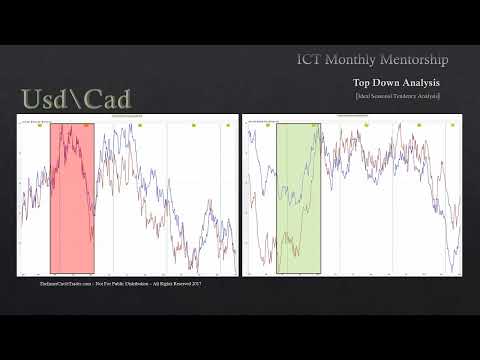
[10:00]Okay, our next pair is the dollar CAD or US dollar versus Canadian dollar. On the left hand side, we have the dollar index futures seasonal tendency, and on the right, we have Canadian dollar futures seasonal tendency. And for the dollar, we have a strong tendency to create a high again in that March, April time period making a low in May. And we see the opposite is seen with the Canadian dollar making a low in March, April and that high forming in May. So the way you would use this seasonal tendency is if you're bearish on the dollar index, this is a good time to be selling short dollar CAD. Or if you're long-term bullish on Canadian dollar, this is a good time to sell this pair because you can see the weakness in the dollar index and the strength underlying with the Canadian dollar. So I want kind of like go back in summary with these seasonal tendencies. Just because we're looking at one seasonal tendency, for instance, when we're looking at the seasonal seasonal tendencies for the dollar index, when that occurs, for instance, between March and April time period, we expect the dollar index to create some measure of a high long-term, seasonally. It doesn't mean it's going to happen, but we're expecting it to occur. By itself, it means that if we're primarily bearish on the dollar index, this is an ideal scenario to be selling dollars. Now, that may not be apparent in the dollar index, but if we see a pair or a currency that is coupled with the dollar that has a strong seasonal tendency to rally in a specific time of the year, like that March, April time period, like we're seeing here with the Canadian dollar, that means we don't have to be in the uptrend for dollar index. We could be in a long-term consolidation, but say the Canadian dollar is in a bullish uptrend. You're focusing in on that time of year, where March, April creates a low in Canadian dollar, and it rallies up into May. So with that seasonal tendency underlying strength for the Canadian dollar, that also would sell off the dollar versus CAD pair. So it's a it's a blending of the ideas, it's not simply, well, it has to be the uh downtrend for the dollar, and it has to be the uptrend for the Canadian dollar. You only really need one, and by blending these two elements together, and applying the seasonal tendency, you're really focusing in on when seasonally, the highest probability for a big move is to occur. You narrow it down to a specific time of the year, certain calendar months, and highest probability seasonal tendency. So you can go through your calendar ahead of time and write down certain months where you want to be focusing on specific place that may unfold in price. It's real easy to forget about these seasonal tendencies when you get caught up in the day trading and short-term trading and read other stuff about ICT material. But you want to have this stuff in your in your calendar on your trading desk, there should always be things to watch this month, things to watch the coming month, okay? And these are the types of things you want to have in your notes. So when you're working at your desk and you have your your your trade desk open, you're looking for trades, always start your trading day every single day with reviewing of macro perspective like this. Are we coming on a time period where there's a high probability for a sustainable move and it's seen by these types of seasonal tendencies. Very rarely do you have things that would line up or give you clues that future price should do certain things or have a rhythm to it like seasonal tendencies. And when we study these, you're going to see that we're going to refer to these actually uh multiple times throughout the disciplines of trading. We're going to use them again in swing trading and in short-term trading. So we're not done with them because we're doing high time frame analysis, but for high time frame analysis, these are the scenarios you want to be uh focusing on specifically for these respective pairs. So until we talk again, I wish you good luck and good trading.