[0:00]Can you become fluent in a language even if you're not good at learning languages? I want to talk to you about this in today's video because this is something that a lot of students worry about. A lot of people learning a second language, whether that's English or any other language for that matter, worry that they're never going to become fluent because they're not good at learning languages. They don't have a natural talent. Now, this is going to be a completely unscripted video. I think this is such an important topic. I want to take a few minutes here to share my thoughts and my experience having taught thousands of students around the world. Let's be 100% honest with ourselves and we need to accept the fact that yes, some people are naturally more talented than others at learning languages. That's an undeniable fact. Maybe it hurts to admit that to some degree, but it's a truth. It's a totally undeniable fact that some people are naturally more talented at learning languages. Just as some people are better at math, some people are better at music, some people are better at sports than other people. Now, if you've accepted this, and you have to accept this, and you've accepted the possibility that, hey, you might not be naturally talented at language, you basically have two options here. The first option is to give up, to accept that you will never become fluent in English, that you're bad at languages, that there's no point in even trying or putting the work in. That's the first option. The second option is to accept the reality of the situation. To accept that maybe some people are better or more talented at learning language and to do it anyways. To not let that fact that, honestly, you can't control, to not let it get to you, to not let it affect your studies or your motivation. Now, to this second point, I want to say something else. This is a philosophy that I personally subscribe to. It's called stoicism and maybe you've heard of stoicism. I think it's quite misunderstood. But fundamentally, stoicism is the idea that you can't control what happens to you, but you can control your response or your reaction to it. And I think this applies perfectly in this situation. If you are somebody who is maybe not naturally talented at learning a language, you can't control that. You can't change the cards you were dealt. You can control your reaction to that. You can control your response. And I think this is so important. Keep in mind that there are people who are naturally gifted and talented who have wasted their talent because they assumed that their talent would take them places without them having to do anything. They took it for granted. And on the flip side, there are people who haven't been as blessed by nature, but who have achieved more in life because they didn't let that get them down and they didn't let that affect their work ethic. Somebody who has talent will always achieve more if they have a good work ethic. But somebody who has talent without a good work ethic will never achieve the same level of success as somebody who has a good work ethic, but not as much talent. So yes, if you have both, you're set. But if you have talent and you don't actually put it to use, you don't put in the work, somebody who is less talented but harder working than you will be more successful. This is the classic nature versus nurture debate. Are smart people or geniuses born with it or do they learn it? Do they acquire it in their childhood, their adolescence, and adulthood with hard work and proper instruction? I don't know the answer to that question, but I can tell you in my opinion and in my experience, I think it's a bit of both. Talent helps you, but it's not the only thing in the equation. And again, you can't control it. This is out of your control. So, honestly, there's no point in even worrying about it too much. Get it out of your mind and don't let it affect you because your actions would be the same regardless of whether you were talented or not. You'd still need to sit down and study grammar, you'd still need to practice conversation, you'd still need to listen to podcasts and write vocabulary down, no matter how talented or untalented you are. I'll say one other thing. Think about our place in the world as human beings. What makes us different from all the other species, all the other animals, all the other organisms on this planet? I can think of a few things, but one of the things that sets us apart is our capacity and ability to communicate complex thoughts and complex ideas through language. You can make the argument that maybe dolphins are also capable of doing that. We're probably not 100% sure at this point, but the reality is human beings are unique in that sense. We can communicate complex ideas through language. We are built to communicate. We are built to speak. We are built to acquire language and to learn language. So don't forget that. Just as we are built to breathe, to eat, to sleep, we are also built to learn language and to speak. So yes, if you are a human being, it's in your DNA. It's hardwired into your biology. Don't ever forget that. If you ever feel like you're bad at learning languages or you feel like you can't do this, remember that you can because you are human and you are designed to acquire language. I hope you found this video helpful. I wanted to speak to you honestly today because I received a few questions about this recently, and I think this is a topic that's very, very important. And it's one that many people worry about because they think that they'll never become fluent simply because they're not talented. And as I've demonstrated, that's not true. Make sure to subscribe to English At The Ready here on YouTube if you found this video useful, if you want more English lessons on different topics. Leave a like, subscribe, and let me know in the comments. Do you think you have a gift or a talent for learning English? I'll see you in the next video.
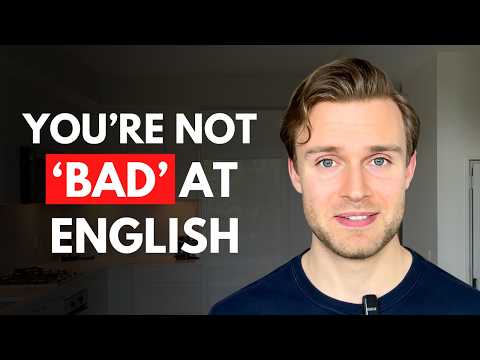
How to Learn English (Even If You Think You’re 'Bad' at Languages)
English At The Ready
6m 49s1,090 words~6 min read
YouTube auto captions
Transcript source
YouTube auto captions
This transcript was extracted from YouTube's auto-generated caption track. The transcript below is server-rendered so it can be read, searched, cited, and shared without opening the original YouTube player.
Pull quotes
[0:00]Can you become fluent in a language even if you're not good at learning languages?
[0:00]I want to talk to you about this in today's video because this is something that a lot of students worry about.
[0:00]A lot of people learning a second language, whether that's English or any other language for that matter, worry that they're never going to become fluent because they're not good at learning languages.
[0:00]I want to take a few minutes here to share my thoughts and my experience having taught thousands of students around the world.
Use this transcript
Related transcript hubs
Watch on YouTube
Share
MORE TRANSCRIPTS


