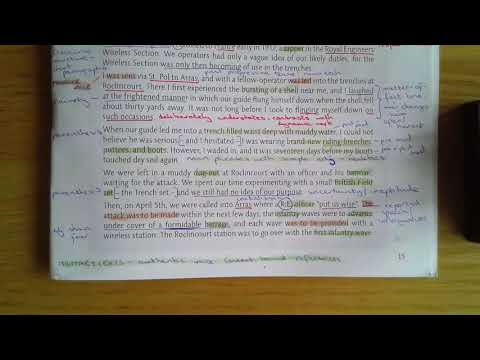
[0:03]Okay, so next up we're looking at the eyewitness account written by a young radio operator in the First World War. So in terms of the gap, I'm really sorry I had to squish this in here. What we have is a memoir. So this has been edited from his diary, so obviously he's aware that there's a a readership to this. It's been, it's been written for publication. The audience is going to be anybody with an interest in World War I. Lots of people have an interest in kind of soldiers' personal experiences and in reading first-hand accounts of warfare and battle. The purpose is to inform, um, the readers about the reality of war. Remember, particularly at the time, just after the First World War, there was a real gap between the people at home and the people in the front line. And they didn't necessarily communicate honestly about what the front line was like. Um, and also, Neyland clearly wants to share his experiences of World War I. So we know it's a memoir and it's written up from a diary, and he's also a sapper. Okay, so it's a bit of military terminology there. And what that means is, um, he's a particular type of soldier involved in engineering. And here he's from the Wireless Section, which is not anything to do with Wi-Fi, um, which means that he is, um, involved in the radio. So it's interesting, isn't it, that that military terminology is used by him? He describes himself as a sapper. Um, and actually that military terminology, I've highlighted it in green all the way through, and we'll look at that as we go. And that gives a real authenticity to the voice. Um, in terms of genre conventions, at the beginning, um, we've got this kind of linear retrospective voice at the age of 18. And we've also, of course, got the first person, um, which we had in Bennett as well. Um, so further authenticity comes from the proper nouns, things like, uh, I crossed to France in early 1917, a sapper in the Royal Engineers. These proper nouns continue as he goes on to name places as he goes through, and I've underlined those for you. Um, they have to give a context of World War I. Now, most of us have a kind of broad contextual knowledge of World War I. Um, and that assumed knowledge means that we know he was incredibly lucky to have survived his time in the trenches. Um, in terms of discourse structure, you'll also need to contrast with Bennett's diary, which is that this is written in very short sentences. Ah, not short sentences, sorry. This is written in very short paragraphs. Um, and what that does is it gives a really clear narrative that we can follow as he recounts his experience and what he went through. Now, contextually, it's also important to be aware that the Wireless Section was kind of like new technology. And he makes that clear in the opening. We operators had only a vague idea of our likely duties, for the Wireless Section was only then becoming of use in the trenches. What we get here is a bit of past progressive tense, was past tense and becoming, okay, present tense, so we call that past progressive. What that does is it really emphasizes that this is new technology, and it was only just starting to be widely used at this time in the past. Throughout this, um, extract, there's a lot of the passive voice. For example, I was sent, passive voice, by St. Pol to Arras, and with a fellow-operator was led, okay, passive voice, what I've done is I've colored this in orange so that you can pick them up as you go through. into the trenches at RoclinCourt. Um, now, the passive voice is probably there because what we've got is this sense of like military hierarchy. So he's not choosing where he goes to. He has to go where his superiors sent him to. Um, we then get a little bit more kind of military lexis coming in. There, I first experienced the bursting of a shell near me. And then what we see next is this kind of his naivety. Um, now that's something contextually that most people will be aware, um, of, and that's the fact that lots of these young men who were going out to the trenches had no idea about the reality of trench warfare. And they arrived really thinking it was going to be rather jolly and some kind of a game. Um, and we see this coming through in his account. And I laughed at the frightened manner in which our guide flung himself down when the shell fell about 30 yards away. It was not long before I took to flinging myself down on such occasions. Now, the fact that he laughs really demonstrates his naivety, doesn't it? He completely underestimates the danger. Um, this very quickly changes because he tells us, it was not long before I took to flinging myself down on such occasions. Now, he's deliberately a little bit vague here and understates the kind of shells exploding by saying, on such occasions, which also gives it a slight kind of formality. And that really contrasts with the dynamic verb flinging. Okay, so we get this juxtaposition between, um, actually the sort of brutal warfare that was very frightening and that was happening around him. And the fact that he just had to kind of make do. And that making do and kind of just getting on with that attitude is evident all the way through. The way that he relates this little story as well, um, I've said, I think it's quite a matter-of-fact tone. He's also really clear about how war changes him, and I think that gives this a very kind of open and honest voice. And we feel like we can trust in the truth that he is telling us. Um, he then continues to tell us a little bit more of his experience of first arriving in the trench. So he says, when our guide led me into a trench filled waist deep with muddy water, I could not believe he was serious, and I hesitated. I was wearing brand new riding breeches, puttees and boots. Um, there's a few interesting things going on in this paragraph, okay, so let's first of all look at the bits that I've highlighted here, here, and here in yellow. Um, these are all noun phrases, and they've got quite simple adjectives with them, um, like muddy, okay, dry. Uh, and what that does is that helps us to see the reality of the, the trenches and what it was like. Um, some of them are pre-modified, some of them are post-modified noun phrases, if you want to kind of up that terminology, we can look at that. So this one, trench filled waist deep with muddy water, that's all, uh, post-modified. This one's pre-modified, brand new riding breeches, and the last one is both pre- and post-modified in the noun phrase, we get information before and after the noun. Um, alongside that, we've got, um, a little bit more military lexis coming through in the kind of the description of his uniform. And again, that adds to the kind of authenticity of it, as we find out what he was wearing. Um, in terms of his naivety, the parenthesis here, and I hesitated, also helps to show his shock at the conditions, okay? He was not expecting to see a trench filled waist deep with muddy water. It also kind of creates the sort of making do approach that we see throughout the whole, um, extract. Potentially, it's also creating a slightly negative perception of the British Army. And I think we get a little bit of that when he talks about his superior officer later on.
[7:43]Um, we see though that he is determined to just get on with it. And the dynamic verb, um, so we get the, the fronted conjunction however, which shows that that he's just going to get on with it even though he feels really unsure about it. And then we get the dynamic verb, I waded in, okay, which shows us that he just, he just gets on with it and has to adapt very quickly. Um, we've got a lot more kind of military jargon coming in here. We were left in a muddy dug-out at Rolincourt with an officer and his batman waiting for the attack. We spent our time experimenting with a small British field set, the trench set, and we still had no idea of our purpose. Then, on April 5th, we were called into Arras where a RE officer "put us wise." So again, in green, we've got all the kind of military lexis there and all the context-bound references. Now, this one, his batman, is particularly interesting. From the sound of it, you might guess it's a bit of a, a kind of cricket reference. And um, what happened, uh, which I'm sure lots of you are aware of is that if you were a member of the aristocracy, if you had gone to boarding school, you automatically became an officer. Um, now that didn't necessarily work in your favor because actually the officers were were more likely to die because they had to lead a lot of the attacks. But may have meant that you would have had somebody to come alongside you. So this reference here to his batman would have been, um, it could even have been somebody like his butler who came alongside him. And it it is a reference that comes from cricket.
[9:40]Um, here with the parenthesis it's got a slightly different function, the trench set. It's used to add a little bit more information, which again gives that authenticity, um, and feel like we can trust in him. Now, this last little bit is interesting. There's a sense of ineptitude and uncertainty, isn't there? And we still had no idea of our purpose. And we see all throughout this extract that kind of, um, uncertainty coming through. Then, on the 5th of April, we were called into Arras where an RE officer "put us wise." So this is a little initialism here, the RE officer, um, so that, um, is a little bit of specialist lexis, which kind of furthers the authenticity. And then interestingly, we get a bit of direct speech, a bit of reported speech here, which is also written, um, as a colloquialism, which gives a sense maybe of, um, kind of camaraderie, even though it's an officer, or maybe it's a little bit condescending, he puts us wise. Um, it's up to you to think what you make of that. And we have got a little then another example of the passive voice, the attack was to be made, which suggests, doesn't it, that he's got no agency, it's just got to happen. Um, and then the sort of military lexis continues with the infantry waves were to advance under the cover of a formidable barrage. And each wave was to be provided with a wireless station. The RoclinCourt station was to go over with the first infantry wave. Okay, that's done over.
[11:51]I'm just going to move this up a little bit for you now. Um, so we start off the next section with this minor exclamative. Uh, the RoclinCourt station. That was Hewitt and I and an officer. Okay, so this also this idea that there's just the three of them are determined to be a station. So clearly he's really shocked by this, and perhaps there's an element of like indignation as well, he can't believe it. Four infantry men were to assist us in carrying our weighty apparatus, the set, accumulators, dry cells, coils of wire, earth mats, ropes, and other details. What we've got there is not just military language, but the specialist lexis of wireless equipment. Now, all these kind of context-bound references to clothing, technology, the military jargon all the way through, helps to underline that this is a true and first-hand account, and it contributes to that knowledgeable and authentic voice that we've been talking about. That carries on in the next paragraph, where he says, we returned to RoclinCourt and sent many practice messages to our Directing Station at Arras. That night one of our aerial masts was shattered, and we were instructed to erect another. Now, this is interesting. The fact that he chooses to basically omit the enemy, the aerial mast was shattered. He doesn't say that it's the Germans that do it, um, so there's no sense that he's kind of creating a kind of political narrative about, um, how awful the Germans were. It's just very much grounded on his experience, you know, it actually doesn't matter how the aerial mast got shattered. It's just that he has to fix it, which is showing the passive voice, we were instructed to erect another. Now, they're in a tricky situation because they, uh, he says, we've got, we had no reserve mast, but fortunately, we found a large crucifix nearby. Which shows us that need to kind of, that shows us that kind of make and, um, make do attitude. They have to improvise. Now it's interesting that it's a crucifix, okay? I don't know if this is a kind of ironic or not, um, but obviously we would associate that with Jesus and with the sacrifices that he made, um, in terms of how it's described in the Bible. Um, and obviously these soldiers are very much being expected to, um, sacrifice themselves. So it seems somewhat ironic that the way that they have to, um, fix everything and and go under enemy fire is on, is on the back of a crucifix. Perhaps it'd be more accurate to say, uh, it seems symbolic.
[15:00]Then we get this direct speech. That's it, said the officer. Hewitt, climb up there and attach the aerial as high as possible. So I think the direct speech is adding to the realism, but we have to remember that it's coming from memory, okay, so it's maybe not completely accurate. Interestingly, we've got an imperative, climb up, so that's showing us the hierarchy, they have to do as the officer says. Um, and then we, it is Paul Hewitt that has to do it. So Hewitt clambered up over the figure of Christ just as a German machine gun swept the line, the Verrey lights revealing Hewitt distinctly. He soon fell into a depth of slime, frightened, but unhurt. It was our first experience of enemy machine-gun fire. Okay, so we can really see his fear here, can't we, that he falls into the slime. He makes it clear, he's frightened, but that is tempered by the need to get the job done. The officer then, clearly not very pleased with this, we get the direct speech again, "You try!" Not only is that an imperative, but it's also a a very short sentence. So that gives us this sense of of realism, um, and definitely, uh, the hierarchy is evident there.
[16:51]Let's going to move this up a little bit for you now. Um, he says, uh, Neyland then goes on to say, it is an eerie sensation to climb over an effigy of Jesus, to dig your feet into any parts of the figure offering foothold, to hold on to the outstretched arms, and breathe on the downcast face, to fix a rope somewhere on the cross, and to hear the German machine gun tat-tatting all around. Now, I think this whole section goes into more of a like a storytelling mode. We get a few more literary techniques here, um, and obviously that helps to engage the reader. There's also a juxtaposition, I think, between the very grim, um, military situation that is, is life-threatening, and then this idea that he's climbing over the effigy of Jesus. Now, Jesus, obviously, we think of us being kind of loving and caring, and maybe reminiscent of home. So we've got perhaps that juxtaposition between, uh, the, the grim military situation and the kind of love of God and feelings of home.
[18:10]Um, we get the alliteration here, the figure offering foothold. Now that is a fricative alliteration. And and it's quite a sinister sound, uh, the fricative fricative sound is quite a hard one. And what we also get is a juxtaposition between the figure, Jesus, and the kind of foothold that he's offering. So there's this juxtaposition between kind of salvation and imminent death. Um, to hold on to the outstretched arms and breathe on the downcast face, okay, and then that carries on and finishes with to hear the German machine gun tat-tatting all around. So we've also, we've got the alliteration, we've also got the assonance because it's basically a repeated sound. And that creates the kind of onomatopoeic sound of the machine gun fire. And that's another kind of literary technique which gives it this more kind of multimodal feel of a story here. Unfortunately, he's not successful. Failing to secure the rope, I slid down and we returned to the dug-out with our officer extremely annoyed. So we can see the hierarchy here. You know, we could sense through the direct speech that he was displeased and through that kind of the tone that he was speaking in there, but here it's made evident that he certainly is. Early the next morning, we secured the aerial to the ruins of a building. On April the 7th, our officer laid a plan of the German sector opposite us on the table, and he detailed our instructions. Okay, so we've got the first person plural, R, which is again kind of reinforcing this sense of military hierarchy that comes all the way through. Um, let's just look at this last little section then where he describes his feelings. Um, so, I felt intensely relieved that I was to be given an opportunity of doing something useful, and of feeling that at last I was to play a real part in the Great War. Now, this is an interesting metaphor. And I think it really fits into the ideology of the time. Um, that young boys were very much given this idea from the stories that they were reading, from the rhetoric that they would have heard all around them and in the posters that you need to come and play your part, you know, come and act out, be the hero. Um, and obviously that doesn't show the kind of real reality of the conditions that they found themselves in. I found that Hewitt, too, experienced this sense of relief.