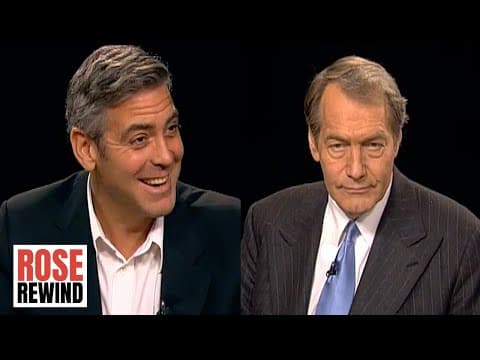
[0:00]George Clooney is here. He is an actor, he's a director, he is a producer, he is much more. Early this year he won an Oscar for his performance in Syriana. His latest film is called The Good German. It is his sixth collaboration with director Steven Soderbergh. Here is the trailer for the film. Berlin, 1945.
[0:26]The war is over. A military journalist sent to cover the peace, is about to become part of the story. If war is hell, what comes after? An American service man turns up dead on the eve of the peace conference. The Russians want us to go away. We wanted to go away too. Whoever wanted them dead, had access to the delegation, that means somebody pretty high up. What's your angle? Why do I have to have an angle? My driver, a kid named Tully, the Americans are looking for him, and the Russians. Why? Hey! Where'd you get those bruises on your face? It was for a girl, wasn't it? I show up in Berlin and the driver assigned to me is running around with my old girlfriend. I'll get you out of here. You won. That's a coincidence. You should never have come back to Berlin. If I can find you so can they. What is it you're not telling me? I would have gotten you out. I still would. You can never really get out of Berlin.
[1:40]You've seen what one bomb can do to a city. That's the future. The future of mankind is in our hands. She's playing you, Jake. You have no idea what you're dealing with. Who got to you? I want to know. You find that girl? We'd like to talk to her. Get the out. Now. Go, before you get hurt. At the end of war, not everyone finds peace. George Clooney, Cate Blanchett, Tobey Maguire. Let's not forget that we are fighting for peace and for the welfare of mankind.
[2:22]The Good German. For the second time, George Clooney is People Magazine's Sexiest Man Alive! I am pleased to have him right back at this table. Welcome. Thank you, Charlie. How are you first of all? I'm good, I'm very good. How are you? I'm very good too, thank you for being here. I haven't seen you since you've been the most so I'm glad to see how you look great. It's glad to be back, you know. Much better than the alternative. Yes, oh. And you're back though, because I meant that in the same way you meant it to me. You had a real trouble because you did some stunts somewhere that wasn't good. It's getting, it's getting better. It's a slow process. I I think that what I learned was it's not going to get well, you know, with a bang, but with a, with a wimper. So it's just a slow process. You must love black and white. Good German is in black and white. It works out better for me. You know, I um, this was one that Steven and I developed for a long time from the, from Cannon's book, and uh, our company developed it. And all along, we sort of thought it was gonna be a one a big epic, you know. And about uh a uh about the same time that I was starting, good night and good luck. Uh, Steven and I sat down with uh people that Warner Brothers and said, well, you're not going to like this, but we think it should be black and white. And Steven really wanted to do it in black and white. Because of the cameras or because he wanted it to to go back to what? He wanted to shoot the film in the in like, like Michael Curtiz would shoot. He wanted it to be shot, he wanted it to be faithful to the style so much so that in a way, it'll, it does throw you off at first. We first see it and the music comes up and the logo comes up and you hear this kind of music. You you feel like, you know, you you feel like it's 1945 and you're seeing a film. Because of the dialogue because of the acting style, everything's sort of had to be done. You had to you had to play like it was 1945 in order to make the the peace work. It's really true. But it was shot with cameras that had fixed lens. No zooming, no no uh uh you know, all boom mic. So everything was everything that was done had a different sound to it and a different look to it. It was a very, it's a, you know, it it's a it's a real commitment to get to that. You know, acting wise, it's a very different commitment. What's the story? It's, it's a it's a fictional story inside a based inside a very true event, which was during the Potsdam conference, um, sort of the battling uh, uh in 1945, but the the immediate start of the Cold War as we were negotiating over borders, um, and the battle between getting who got the German rocket scientists, who got Von Braun, you know, who got the, Right. He just want one for it. Truman was there. Truman was there. Stalin was there. Stalin was there. Churchill. Churchill was there and was replaced. While he was there. Mhm. Yeah, that wasn't a good time for him. Um, and the whole idea was, the movie is based on the idea of uh, both the Russians and the Americans trying to steal or coerce or somehow get the uh the German scientists. Take a look at this scene. Before I do, Kate Blanchett. Yeah, she's something isn't she? Oh yes, but I mean, but you know more about acting than I do. I mean, Actually that that's arguable. Um, she's just, you know, she's just one of those actors that you, you're getting lucky if you get a chance to work with in your lifetime. She's just one of the best I've ever seen, maybe the best I've ever worked with. She's just a great, great actor. And you come to Potsdam and you're in love with her. Yes, I also am in the movie. I come to Potsdam and I'm in love with her. And, uh, And you're a journalist? Yeah, and I we'd had a long before.
[6:12]And I've run into her at the end of the war now. And so we're trying to find out what's going to happen. Is this the whole thing that uh, Yeah, I I'm not sure you know, I, Said against the backdrop of Potsdam. Yeah, exactly. And it's a it's a love affair. Um, that the the trick is to take all those old uh 40s films and turn them on their ear a little bit so that things aren't ending the way you hope or think. What's going on? Why didn't you tell me Emile was with the rocket program? I didn't think it mattered. He worked directly under Franz Betman, and you didn't think it mattered? Who told you about Beckmann? Moller. They were graduated from the same Polytechnic, that's why Beckmann hired him. Why did you talk to Moller? He has Beckmann holed up in a safe house on his way to America to make rockets. That's why they're looking for Emile. They're all going, including the wives. Why didn't you tell me, Lena? You know what Beckmann did. Everybody knows who he is. He was famous before the war. Now you can either tell me or you can tell Bernie. He'll be here in two minutes. No!
[7:08]What was Tully selling that was worth so much money? Is it some sort of rocket secret? No! Lena! How the rockets were built. What's in this box? How they were built.
[7:22]Lena, please.
[7:28]We're just talking about the the science, these guys who came over. I mean, there's a whole story to be told and books and and you would know more about this than I do. There were books written about those people who the United States needed. It saw the Cold War and these scientists are part of that group in which they said, come on over, we'll we'll we'll need you. We'll whitewash your entire record. Exactly. And we'll give you a pass.
[7:58]Yeah, and so, you know, I guess he just sort of assumed that I could sing because I was Rosemary's nephew. And I guess I sort of assumed I could sing too. because you were Rosemary's nephew and there's a song, Man of Constant Sorrow, which was the sort of the lead song in this thing. And they set up a recording studio and I went in there and they were all sitting in the booth and I'm singing and nobody'll look me in the eyes. You know, they're all kind of looking down like this. And I'm like, good, huh? And they tried to find some way around it. And eventually they just had to say, look, and I go, I got it. And I went in there and they were all sitting in the booth and I'm singing and nobody'll look me in the eyes. You know, they're all kind of looking down like this. And I'm like, good, huh?
[8:14]He's like me, no, he said. Yeah. And it's a it's a great joy of your life. Best thing I've ever done for myself. Because it gives you a refuge. Because they it's about Italy. It's not just about the house. It's about a way of life that is different than ours, you know, that the first day I was there, there was construction workers walking home, and they look like every construction worker you've ever seen. The shirts off, they got their helmets under their arm, but they're carrying home like a loaf of bread and a bottle of wine, and some flowers. And I thought I'd never seen that here. And it's not a knock on us. It's just what they do and how they they celebrate dinner every night. I love to travel in Europe because of that reason. You go from country to country. And there's just a sense of the appreciation of life. They're an older older bunch of countries. And they've relaxed a little bit more. We're always sort of in a rush. Let me turn to you to your family. Your dad is now. Did he get involved in Darfur because of you? You took him and he said this is touches my soul and I want to do something. Right. Well, we were doing, it was just after the Oscar sort of season, and you've been around it. You've seen what it's like. It really is a campaign. I mean, it really is a, you're kissing babies. Yes, indeed, it is.
[9:16]Hopefully, that's changing a little bit. And with any luck, I'll be able to, you know, certainly do some fundraising for whoever is, uh, the Democratic candidate, but I'm I'm fascinated with him and would love to help. I worry about what, um, actors can do because a lot of times I couldn't support my father in the 2004 campaign, because it was Hollywood versus the Heartland. Right.
[10:02]Uh, and Kerry wanted us to get on the train and ride after we'd gotten the nomination. And I said, I hurt you guys, you know. You've got to understand that right now they have a, uh, a real, they have the ability to use us as a target. Um, hopefully that's changing a little bit. And with any luck, I'll be able to, you know, certainly do some fundraising for whoever is, uh, the Democratic candidate, but I'm I'm fascinated with him and would love to help. I worry about what, um, actors can do because a lot of times I couldn't support my father in the 2004 campaign, because it was Hollywood versus the Heartland. Right. He wanted us to get on the train and ride after we'd gotten the nomination. And I said, I hurt you guys, you know. You've got to understand that right now they have a, uh, a real, they have the ability to use us as a target. Um, hopefully that's changing a little bit. And with any luck, I'll be able to, you know, certainly do some fundraising for whoever is, uh, the Democratic candidate, but I'm I'm fascinated with him and would love to help. I worry about what, um, actors can do because a lot of times I couldn't support my father in the 2004 campaign, because it was Hollywood versus the Heartland. If he's going to run, I've, you know, listen, I'm a Democrat, I'll support whoever has the ticket, but I'm, I'm fascinated with him and would love to help. I worry about what, um, actors can do, because a lot of times I couldn't support my father in the 2004 campaign because it was Hollywood versus the Heartland. Right. Right. Yeah, but I I I don't think you can say anything. I mean, can you? I can't ever say anything.
[11:17]Not not until they die. Right. No, I I I don't think you can say anything. I mean, can you? I can't ever say anything.
[11:27]I mean, how many times has has it been that we've had someone who has a voice and knows the subject? Right now, we're standing here on the border of Chad and Darfur. A lot of bad things are happening over here right now. My father and I thought we'd come over and take a look for ourselves. We started in South Sudan. It took two days to get to the border of Darfur. We heard there were a lot of refugees pouring South. We found a village called Jacque with over a thousand displaced families. This isn't a refugee camp. There are no tents to shelter them. Most just sleep under trees. No food, no water. These people had jobs and property before the Arab Janjaweed militia burned their villages, raped their women, and killed their children. Since the government of Sudan won't let anyone into Darfur, including UN officials, we traveled North to Chad. Not great timing on our part since Chad was in the midst of a coup. We landed in Jama where nine days earlier armed rebels stormed the city. Having failed, they moved east towards Abet. So did we. On the border of Darfur is a refugee camp called Oure Cassoni. 29,000 survivors of the massacre in Sudan. The problem of the government, she don't she want to want to kill everybody. Just Sudan to become Arab people, Arab country. Not for the black people. Just for the Arab people. So that is the objective of the Sudan government. What do you want to happen to fix this? Now there is United Nations. There are many, many international NGOs. So I like them. I like them to get up to try as soon as possible to solve this problem, because Sudan government, not the Sudan, just want to kill all the black people in Africa. Those of us of a certain age, like me, may have thought they had seen the end of such things as displaced persons and refugee camps 50 years ago. Places where the cruelest death of all may be the death of hope. But hope is stubborn even in a place like this. There are scores of Oure Cassonis on both sides of the border. 2 million people away from their own homes.
[14:59]Time is running out. Right now, we're standing here on the border of Chad and Darfur. A lot of bad things are happening over here right now. My father and I thought we'd come over and take a look for ourselves. We started in South Sudan. It took two days to get to the border of Darfur. We heard there were a lot of refugees pouring South. We found a village called Jacque with over a thousand displaced families. This isn't a refugee camp. There are no tents to shelter them. Most just sleep under trees. No food, no water. These people had jobs and property before the Arab Janjaweed militia burned their villages, raped their women, and killed their children. Since the government of Sudan won't let anyone into Darfur, including UN officials, we traveled North to Chad. Not great timing on our part since Chad was in the midst of a coup. We landed in Jama where nine days earlier armed rebels stormed the city. Having failed, they moved east towards Abet. So did we. On the border of Darfur is a refugee camp called Oure Cassoni. 29,000 survivors of the massacre in Sudan. The problem of the government, she don't she want to want to kill everybody. Just Sudan to become Arab people, Arab country. Not for the black people. Just for the Arab people. So that is the objective of the Sudan government. What do you want to happen to fix this? Now there is United Nations. There are many, many international NGOs. So I like them. I like them to get up to try as soon as possible to solve this problem, because Sudan government, not the Sudan, just want to kill all the black people in Africa. Those of us of a certain age, like me, may have thought they had seen the end of such things as displaced persons and refugee camps 50 years ago. Places where the cruelest death of all may be the death of hope. But hope is stubborn even in a place like this. There are scores of Oure Cassonis on both sides of the border. 2 million people away from their own homes.
[18:19]Time is running out. Right now, we're standing here on the border of Chad and Darfur. A lot of bad things are happening over here right now. My father and I thought we'd come over and take a look for ourselves. We started in South Sudan. It took two days to get to the border of Darfur. We heard there were a lot of refugees pouring South. We found a village called Jacque with over a thousand displaced families. This isn't a refugee camp. There are no tents to shelter them. Most just sleep under trees. No food, no water. These people had jobs and property before the Arab Janjaweed militia burned their villages, raped their women, and killed their children. Since the government of Sudan won't let anyone into Darfur, including UN officials, we traveled North to Chad. Not great timing on our part since Chad was in the midst of a coup. We landed in Jama where nine days earlier armed rebels stormed the city. Having failed, they moved east towards Abet. So did we. On the border of Darfur is a refugee camp called Oure Cassoni. 29,000 survivors of the massacre in Sudan. The problem of the government, she don't she want to want to kill everybody. Just Sudan to become Arab people, Arab country. Not for the black people. Just for the Arab people. So that is the objective of the Sudan government.
[20:25]What do you want to happen to fix this? Now there is United Nations. There are many, many international NGOs. So I like them. I like them to get up to try as soon as possible to solve this problem, because Sudan government, not the Sudan, just want to kill all the black people in Africa. Those of us of a certain age, like me, may have thought they had seen the end of such things as displaced persons and refugee camps 50 years ago. Places where the cruelest death of all may be the death of hope. But hope is stubborn even in a place like this. There are scores of Oure Cassonis on both sides of the border. 2 million people away from their own homes.
[21:49]Time is running out. Right now, we're standing here on the border of Chad and Darfur. A lot of bad things are happening over here right now. My father and I thought we'd come over and take a look for ourselves. We started in South Sudan. It took two days to get to the border of Darfur. We heard there were a lot of refugees pouring South. We found a village called Jacque with over a thousand displaced families. This isn't a refugee camp. There are no tents to shelter them. Most just sleep under trees. No food, no water. These people had jobs and property before the Arab Janjaweed militia burned their villages, raped their women, and killed their children. Since the government of Sudan won't let anyone into Darfur, including UN officials, we traveled North to Chad. Not great timing on our part since Chad was in the midst of a coup. We landed in Jama where nine days earlier armed rebels stormed the city. Having failed, they moved east towards Abet. So did we. On the border of Darfur is a refugee camp called Oure Cassoni. 29,000 survivors of the massacre in Sudan. The problem of the government, she don't she want to want to kill everybody. Just Sudan to become Arab people, Arab country. Not for the black people. Just for the Arab people. So that is the objective of the Sudan government.
[23:54]What do you want to happen to fix this? Now there is United Nations. There are many, many international NGOs. So I like them. I like them to get up to try as soon as possible to solve this problem, because Sudan government, not the Sudan, just want to kill all the black people in Africa. Those of us of a certain age, like me, may have thought they had seen the end of such things as displaced persons and refugee camps 50 years ago. Places where the cruelest death of all may be the death of hope. But hope is stubborn even in a place like this. There are scores of Oure Cassonis on both sides of the border. 2 million people away from their own homes.
[25:18]Time is running out.
[25:40]executive producer charlie rose


