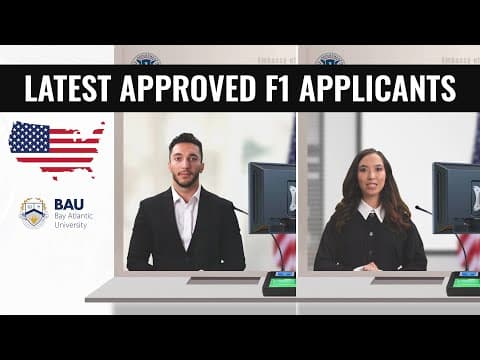
[0:10]Good morning. Please pass me your passport and I-20 form. Good morning! Here they are. Thank you. Why do you want to study in the USA? I want to study in the USA because it offers a flexible education system, diverse cultural experiences, and top-ranked education programs. Specifically, Bay Atlantic University's Business Administration program is highly reputed and provides a unique curriculum that aligns perfectly with my career aspirations in international business. Why did you choose Bay Atlantic University? I chose Bay Atlantic University because of its strong focus on practical business education and its location in Washington, D.C., which offers numerous networking and internship opportunities. Additionally, BAU's small class sizes ensure personalized attention and a better learning environment. How many universities did you apply to? I applied to five universities in the US, but Bay Atlantic University was my top choice due to its curriculum, faculty, and strategic location. What are your plans after graduation? After graduating, I plan to return to my home country to work with leading business firms and contribute to economic development. I am particularly interested in joining [mention specific companies] that have operations aligned with my specialization. How will you finance your education? My parents will sponsor my education. My father is a doctor and my mother is a teacher, and together they have sufficient income to support my studies. Additionally, I have saved some funds from part-time jobs and scholarships.
[2:17]What does your sponsor do? My father is a physician with a private practice, and my mother is a high school teacher. They have been financially stable and supportive of my educational goals.
[2:33]Why not study in your home country? While my home country has good educational institutions, they do not offer the same level of exposure and opportunities as universities in the US. The business programs here are more advanced and provide practical experience that is crucial for my career.
[2:55]Do you have any relatives in the US? No, I do not have any relatives in the US. My focus is entirely on my studies and returning home after completing my degree. What will you do if your visa is denied? If my visa is denied, I will reassess my options and potentially look for other opportunities within my home country. However, I am very committed to studying at Bay Atlantic University and will address any concerns to strengthen my application for a future attempt. How do we know you won't stay in the USA after your studies? I have strong ties to my home country, including my family and a job offer from a reputable company that I plan to join after graduation. Additionally, my career goals are centered on contributing to my country's business sector, which has many opportunities for growth and development. Can you explain a gap year or any breaks in your studies? Yes, I took a gap year after high school to gain practical work experience and save money for my studies. During this time, I worked at [Company Name], where I developed valuable skills that will complement my business studies at BAU. Thank you. Your documents are in order. I'm approving your visa. Have a great time studying in the US. Thank you very much!
[4:52]Hi there.
[4:56]Hello, officer.
[5:00]Please pass me your passport, I-20 and other documents you brought.
[5:08]Here you go. Thanks.
[5:14]So Louisiana State University, huh? Yes, officer.
[5:25]Why this university?
[5:30]My area of interest is electrical engineering with specific focus on large-scale integration and related advanced research work. And Louisiana State University is a leading academic platform for this particular topic. This is the main reason why I want to go to this university. Which are other universities you applied to? There's only one other university I applied to. It is Georgia Tech University.
[6:04]Why didn't you choose this university instead?
[6:10]The reason is that Louisiana State University is rated among the top 100 institutions, and this is a far better university compared to Georgia Tech University. Additionally, LSU has a much better electrical engineering curriculum. So you don't plan to study further here in India?
[6:35]I do not. A lot of big electrical tech companies prefer students with degrees and study exposure plus experience in the US. This is considered more valuable compared to graduates with Indian college degrees and even with hands-on experience. So, the annual expenses are $16,000 USD and your course duration is 2.5 years per your I-20. So approximately, $50,000 USD in total. How will you meet these expenses? Yes, if you look at the bank statements, I have a savings balance of 14.6 lacs and fixed deposits of 2 lacs in my checking account.
[7:26]What is your father's occupation?
[7:31]My father is a structural engineer, officer.
[7:38]What is his income? 4.5 lacs annually, officer.
[7:48]I think this amount is not sufficient. How do you support the estimated $50,000 tuition and expenses? Yes, my brother is also sponsoring me for my education.
[8:06]What is he doing?
[8:11]He is working as a software engineer.
[8:16]Where at?
[8:20]Amazon, in Bangalore, officer.
[8:26]What is his income? 1.8 lacs annually, officer.
[8:37]So, can he also support you for your studies?
[8:43]Yes, officer.
[8:48]What does your mother do?
[8:53]My mother is a house wife and she has property under her name. She gets rents of about 1.3 lacs annually through this property. OK. So what will you do with your electrical engineering degree? I will return to India and work in a large scale company.
[9:20]Why not in the US?
[9:24]I have family ties and all our property is located in India. Plus, I really do want to contribute to my country when I return home. Please take all of your documents.
[9:41]OK. Thank you, officer.
[9:47]Place your right hand 4 fingers on the scanner. OK, officer.
[9:59]Place your left hand 4 fingers on the scanner. Got it, officer.
[10:10]Your visa is approved. Please wait 5 days until your passport is ready to be picked up.
[10:20]Thank you so much, officer. You have a great day!
[10:27]The visa officers are there to help you. Don't think that they're there to reject you! They're trained to read your mind, and they're working in their country's best interests.
[10:42]Don't lie! Be genuine, sound genuine. They'll know it if you're genuine. Sometimes they can be fooled, too, for sure, for they're human beings, after all. But then it's highly likely that they'll catch you lying
[11:02]Be very confident. Not overconfident, though. Appear gentle. Just be you.
[11:14]Before you go for the interview, take advice from people who've been through the process before. Talk to more people than just one. Watch YouTube videos before you get there, know how it's gonna be like.
[11:32]Get all your documents, the visa appointment confirmation letters, DS-160 confirmation, your passport (ofc), I-20. Offer letters, scholarship letters, etc. will help, too. Get the originals as far as possible, but at times, they'll be happy to see the printouts. Read about U.S. immigration laws, read about what type of visa F-1 really is, etc. The visa officer won't be able to help you if you say that or you intend to stay back in the U.S. to find jobs, do your start-up, etc.
[12:20]Remember, Visa Officers are there to help you. Talk to them like you're talking to a normal human being. Not too formal, not too informal! Just be genuine, and don't get scared. They're there to work in their country's best interests, but they're there also to help you.


