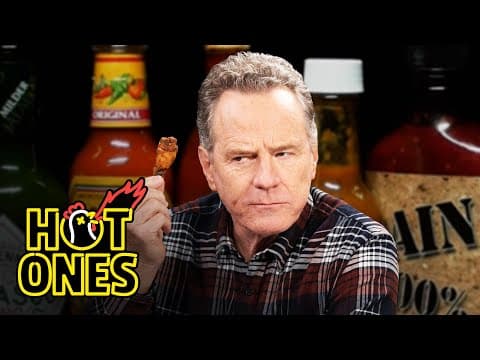
[0:00]It takes a big jump. This was a white napkin when I started.
[0:13]Hey, what's going on everybody? For First We Feast, I'm Sean Evans and you're watching Hot Ones. It's the show with hot questions and even hotter wings and today we're joined by Bryan Cranston. He's a six-time Emmy Award-winning actor, you know from acclaimed Broadway performances, films that include 2013's best picture Argo and iconic TV shows like Malcolm in the Middle and Breaking Bad. He also stars in the crime drama Your Honor, which returns for its much anticipated second season on Showtime January 15th, and I for one can't wait. Bryan Cranston, welcome back to the show. Oh, Sean, I'm already regretting this. What's going through your head as you prepare to take on this gauntlet for a second time? When I did this before, it was like eight years ago uh, when I was promoting Why Him. And I thought when I left, I thought that was the most bizarre interview I've ever done. This won't last. The the this It's a gimmick. No, no, no, celebrity in their right mind is gonna do what I just Oh, my gosh. How many years have you been doing this now? Since then, so yeah, like eight years.
[1:13]Believe it or not. And they said, do you want to go on Hot Ones again? I go, yeah. Wait a minute, what was Hot Ones? Wait, wait, wait. Um, but I'm I'm up for the task. I'm up, I'm up. I'm not familiar with any of these hot sauces, so you'll have to you'll have to introduce them to me as we go along. Well, it'll be an education. Are you ready to get started? Yeah.
[1:50]Now your eyes are already starting to water. Well, I'm just I'm just happy and proud to see you again. It's more sentimentality than anything. Okay. Well, this one is um, tasty, but not not that hot. Enjoy that while you can.
[2:05]Okay.
[2:10]So there's some basic similarities between Michael, your character in Your Honor and Walter White in the sense of having a good character who makes some dark choices in an effort to protect their family. What fascinates you about the life forces that can push an otherwise upstanding member of society towards a dark and morally compromised path? Well, from an acting standpoint, they're the most fun to play. When you have characters that are damaged to a certain point, complex, conflicted, flawed. But I think what is the key to getting an audience behind you on those is that they see that there's something else trying to get out, trying to be better, trying to improve. And as long as an audience sees that someone isn't just relishing being bad, they'll root for you. You know?
[3:06]Shaquanda's Banshee Ranch. This is nasty looking thing.
[3:14]Yes, like a mythical sort of like dog wolf and then when it would attack, its eyes turned red. So on a Fresh Air interview on the heels of your Tony Award-winning performance as LBJ and all the way, you tell a fascinating little detail about the vocal strain and physical toll of doing an eight-show per week Broadway schedule. What are Silent Mondays and why have they served as a secret weapon for you? There's a a beautiful and talented actor named Audra McDonald. Um, and she is not only a great actor, but a terrific singer. And she was doing Porgy and Bess at the time I was about to come in with all the way, which is a three-hour play. And I can already start to feel the strain on my vocal chords. And I thought, oh, my God, I'm about to do six months on Broadway. I need help. How did you do Porgy and Bess? And she told me that she went, I think, to her ear nose and throat doctor, and he wrote a prescription for her. And and the prescription was for silence. No laughing, no whispering, no utterance of any kind, completely shut down the vocal chords. And I thought, you know what? I'm gonna do that. So at first it was odd, but I kept a pad around and my wife was I go, you know, hungry? Lunch? And I go out and I go to a restaurant, and what's the soup? You know, and pretty soon I started to keep some of these I go, where's my soup sign? Here it is, you know, it's like, what's the soup? And people would would go, they didn't get it that I and I I wrote one, I'm on vocal rest, right? And then in in response to that they go, oh, okay. And I had another one, you don't have to whisper.
[5:03]Cadijo. Man, that's a nasty looking thing. Yes, it's like a mythical sort of like dog wolf and then when it would attack, its eyes turned red. Well, that happened to us when we eat it sauce. We'll see if it's an attack mode. They should do a little special effects right now. Oh. Okay. So while reading your memoir A Life in Parts, I was really captured by the romantic way that you talk about baseball and being inspired by the way Wally Moon would swing for the left field fences when the LA Dodgers played in the LA Coliseum. Do you have an all-time favorite Vin Scullyism? Well, I thought I did in '81 when he talked about, if you have a sombrero, throw it to the sky. Um, when Fernando Valenzuela pitched to no hitter. But then in '88, Kirk Gibson hits his home run. You know, and he says, in a season filled with un improbable, the impossible has happened. Still feel like I'm in mourning for him passing because I've been listening to him for 60 years. And Vin Scully represented to me just more than baseball. To me, it was a sanctuary. When I had a a rough childhood, I can always tune out, put on my transistor, put in my earphones, and listen to him take me away. And at least for those three hours, I felt like I was gonna be okay. Everything's safe. Nothing to worry about. And I would just listen to his mellifluous voice and he would tell stories and I would just go off. And I'd get a baseball game. I'd hear and it just it's just it just felt like floating sometimes. Yeah.
[6:55]Los Calientes, Verdes. Okay.
[7:00]Going in.
[7:03]Okay.
[7:07]All right, so far, so good. There we go. What did you mean when you said that an actor approaching a comedic scene can't for one second think what they're doing is funny? If you're doing a sketch, like if you're doing Saturday Night Live, part of the fun from the audience's perspective is they're having fun knowing you're having fun, right? And so you're kind of in on it. We all laugh when someone breaks character and starts cracking up and they're trying to look away. We get even more enjoyment out of it. And that's legitimate. It's fun. It's loose, it's light. But if you're doing a a film or a television show that's carefully scripted, if the character realizes something's funny, it it takes the onus off the audience to laugh. Because they're doing it. You're doing it. It's the same thing when a character easily cries. If a character cries easily, the audience doesn't have to. But if a character tries not to cry, that's when the audience will.
[8:21]Yeah, a little bit of curryish. So far, we're five in, five to go. Halfway point. Yep. I got to say, tasty, but not crushing, not like, oh, my God, I can't do this anymore. See, I told you, there's there's no you there should have been no nervousness about coming back, you know, no anxiety about coming back. You got this. Well, this is only halftime. We got we got the whole second half. Well, I'll do into a false sense of security in the front half. Yeah. So we've talked to actors in the past about picking and sequencing roles, but you're the first one I've ever come across that has a full-blown project assessment scale where you break down everything from story to script, role, director, and cast. Of all the scripts that have come across your desk, what percentage would you say fail the writing test and then how early can you tell? So, the one I mentioned before that didn't have a high scale on the on the writing was Why Him? Why Him had a very simple premise. Midwestern dad doesn't like the boyfriend of his his, you know, cherished daughter. That's it. And I it just didn't I anyway, I talked to my publicist and I said, is it possible that I can get a hold of Paul Rudd? So I called Paul and I said, Paul, you worked on these movies before. The script seems just kind of there. There's some funny situations and jokes, but it doesn't like wow. And he goes, that's kind of the nature of this kind of movie. It relies heavily on the on the ensemble cast to be able to punch it up. And just play. So we will do scenes, we will shoot the scene as it's written. And then then you go. Then you're adding lines. Then you're how about this? And then someone says something, you add ta-ta-ta. Then pretty soon you're like, whoa, whoa, whoa, whoa. And it becomes something completely different and you can't script that. Several improvisations that I came up with ended up in the film, and it was like, oh, man, this is this is so much fun. And so I learned my lesson from that. It was a good lesson. That that scale that I usually go by is not always accurate.
[10:49]Mushroom Mayhem. Okay.
[10:53]Little portobello. More portobello-ish.
[11:01]When we had Margot Robbie on the show, she talked about how working in soaps was a really great and valuable education for an actor because it taught you how to work fast and be word-perfect. Does that resonate with you? Yeah, fast, you got to work fast. And there's a pattern in daytime television. I don't even know if the medium really even works anymore. But the pattern in daytime was people are watching a few times a week but not every day, like two or two and a half times a week or something is the average. So if I said, Sean, I saw you with Margot the other day and you're trying to get get Caitlin away from me. I will kill you. You know, and then and then the next day, I might say, remember, Sean, when I warned you, when you talked to Margot, that if you got in the way of Caitlin, I would kill you. You there's it's so similar. It's so similar that your brain says, no, you just said this. And you're going, oh, I got I just said this. I'm repeating it. And you just go through. I learned just plow through. Because at first, I would stop and go, oh, sorry, I I'm repeating, aren't I? And they go, no, that's the line. I'm so sorry. Now I'm more sorry. So now I just learned, just go through and then go, was that right? Was that Yeah, it was right. Okay. And you move on. Now we're getting psychopathic. Angry goat dreams of Calypso. Okay.
[12:26]That's an interesting taste. Hmm.
[12:32]Smells like Calypso.
[12:39]Yeah, I can sense that coming down the line. Yeah. So I know that herbal tobacco is often used as a marijuana substitute in TV and film. Do you have any insight into what goes into making like TV meth? Like, what is TV meth? TV methamphetamine the way we made it with a little blue tint is actually rock candy and it and the flavor was cotton candy rock candy.
[13:09]I never tasted it until one night, we were working, it was probably the 16th or 17th hour. We're working in the in our dungeon downstairs our our lab down there. And um, Gus Fring is making sure we're working, we're working. And I see Aaron Paul reach into our product, a handful of our product and starts throwin' throwin' the the methamphetamine in his mouth. I go, what are you doing? You can't eat the product. He goes, I'm just so tired. I'm eating it. I said, it's like, you really getting a a high off this? It's like, well, it's sugar. And he goes, you've tasted it. I go, no, I haven't tasted it. He goes, oh, you should taste it. I go, no, I don't think so. He goes, and I guess I was still in character because Walter White wouldn't ever. He says, no, I'm not doing it. He goes, take You got to have one. Yo, have one. Is what he would say. And so, all right, all right. You know, to shut you up. And I tasted one, it was like, that's pretty good.
[14:16]And so he and I, they took they rolled the camera and he and I are just talking. We're like, eating all the all the methamphetamine. Um, and that's what we use. We use uh cotton candy rock candy.
[14:31]Tab, it's dab bomb beyond Insanity.
[14:39]Do most people just take one bite?
[14:43]Especially when we get here, yeah. Here it comes. Yeah.
[14:50]Hello, mama. Yeah. Wow, the bomb beyond it. So, what you're saying, as I wipe my brow. Yeah. Careful around your eyes, too.
[15:03]It's that this is not the hottest one. So, here's where, this might be good news. This might be good news. This one is the hottest one. Oh, You're switched things up. You know, like, you're switched things up. We serve with like the scoval scale, which is a a measure of capsation per unit. There you go, the hiccups. And this one actually falls here, but there's something about it that's crazy. You know, like, remember when we did this, like, seven, eight years ago? Seven, eight years ago. This was still here. It's the only bottle that's stayed on the table that whole time, yeah. That one's kick ass. Uh-huh. So back in 2019, you and your Breaking Bad co-star Aaron Paul launched Dos Hombres. What distinguishes like a good mezcal from the kind that you were exposed to early on during like your poker playing days? Um, okay. So the difference is recipe, just like anything. I could put in front of you all the ingredients to make the perfect dinner. But if you're not a chef, you don't know how to what goes with what and how to put it together. It's the same thing with spirits. How long do you smoke it? How long do you ferment it? How many times do you filter it? I mean, you know what I mean? There's a lot going on. You look like you're in substantial pain. Way worse than you. Way worse than you, I have to say, you know, I'm so like amazed at how well you took that. That was that was a kick-ass one, yeah. It's still, it's still kicking. But the way that you were able to just kind of internalize it, deliver an eloquent interview answer, and then look me up and down and be like, hey, buddy, what's going on with you? Yes, that's true. The the interesting thing is is is the perspiration. Yeah. That's what always fascinates me. I can understand the power of the of the peppers doing their thing in your mouth. What's with the perspiration?
[17:11]That one is the hottest. This was a white napkin when I started. Okay. Here we go.
[17:24]So this next one is the butterfly bakery taco vibes only. Taco vibes only.
[17:36]Now this one, hot, but after the last one.
[17:47]When you think about the odd jobs that you had before your breakthrough in Hollywood, is there one that you'd say was most paramount or helpful in your acting career? Like I've heard you talk about when you worked at the dating matchmaking service, greater expectations, or great expectations, that it was almost like taking an acting class. Great expectations. Um, great company, very successful company. It was the precursor to match.com and all those things. Um, and you'd go in and uh, depending on your proclivity, you you look at the men's or the women's and you're looking and you go, oh, she smokes. I don't want to be with a smoker. And then, oh, she's close. She's oh, we went to the same school. We love basketball. Oh, this looks like a nice person. And then you'd go to see her tape. And that's where I come in because I did the the videotape interviews. I would sit across from someone and I had a a camera here, but I would never turn it on until I felt that that person's essence was real and alive. And then at some point, they really did relax, calm down. And they laugh and usually when they laughed at something, I'd start it. So the first thing that the person watching their tape would see them laughing. Which is the most engaging thing you can see. Someone letting go. And you they laugh and then they're talking and we'd talk for a minute and a half. Not long. I turn it off and I go, good, we're done. I go, well, wait, but I didn't get out uh, you know, that I like to do this and I I go, that's not about that. This is about them seeing you as you are most of the time. That's what they want to see. How is this person going to act when I'm sitting across from them drinking coffee? And it was unbelievably successful. It was really good. Well, I can see why with employees like that. All right, all right, Bryan Cranston. Oh, oh, what's happening?
[19:51]Okay, here we go. That's a good one.
[20:00]All right. We're through. Look at that. We did it. Again. We survived. Look at us. Who would have thought?
[20:17]So to close things out, if you would, I'd love for you to unpack this quote of yours, the homework doesn't guarantee anything. With luck, it gives you a shot at something real. I often get asked by young acting students in high school and college, how do you do it? Where where how do how can I uh, you know, leap around and I go, shortcut? You look for the shortcut. Yeah, yeah, yeah, yeah. Like a drug. Yeah. Give me the shortcut. Give me the shortcut. I go, there isn't any. There's no shortcut. Sorry. Oh. Oh, this has happened. Woo, The sweating thing is surprising. Uh, but that's that's what, um, that's what a uh a real love of acting is.
[21:03]Is is it's a relationship. It's not a fling. It is committing to something for the rest of your life. When I think of acting and I think of creating and writing, I mean, it it occupies all of me, and I love it. If I ever start to complain about having to go to work at six o'clock in the morning, or not wanting to do anything, then that's the sign. I've lost the flame, and it's time to hang it up. Mike, drop, and look at you. Bryan Cranston, for the second time, taking on the Hot Ones gauntlet and living to tell the tale. Now there's nothing left to do but roll out the red carpet for you. This camera, this camera, this camera, let the people know what you have going on in your life. Woo. Um, well, second season of of your Honor. I'm very proud of it. It's on Showtime. First season ended in tragedy. Now, we're exploring the world of grief. And and um, forgiveness, is that is that still are still able to have that in our society? And some people will think that asking forgiveness or granting forgiveness is a weakness. I think it's a human strength. It it'll allow you to be with other people, especially with uh, an intimate partner. If you can't say you're sorry, you will never be in a long-term relationship.
[22:52]That's Hot Ones experience. Would you like some more? Oh. I have eight.


