[0:06]This is the first of four programs in which I want to question some of the assumptions usually made about the tradition of European painting. That tradition which was born about 1400, died about 1900. Tonight, it isn't so much the paintings themselves which I want to consider, as the way we now see them, now in the second half of the 20th century. Because we see these paintings as nobody saw them before. If we discover why this is so, we shall also discover something about ourselves and the situation in which we are living.
[1:02]The process of seeing paintings, or seeing anything else, is less spontaneous and natural than we tend to believe. A large part of seeing depends upon habit and convention. All the paintings of the tradition used the convention of perspective, which is unique to European art. Now, perspective centers everything on the eye of the beholder. It is like a beam from a lighthouse, only instead of light traveling outwards, appearances travel in. Our tradition of art called those appearances reality. Perspective makes the eye the center of the visible world, but the human eye can only be in one place at a time. It takes its visible world with it as it walks. With the invention of the camera, everything changed. We could see things which were not there in front of us. Appearances could travel across the world. It was no longer so easy to think of appearances always traveling regularly to a single center. I am an eye, a mechanical eye. I the machine show you a world the way only I can see it. I free myself for today and for ever from human immobility. I am in constant movement. I approach and pull away from objects. I creep under them. I move alongside a running horse's mouth. I fall and rise with the falling and rising bodies. This is I, the machine, maneuvering in the chaotic movements, recording one movement after another in the most complex combinations. Freed from the boundaries of time and space, I coordinate any and all points of the universe wherever I want them to be. My way leads towards the creation of a fresh perception of the world. Thus I explain in a new way, the world unknown to you.
[2:54]Those words are from a manifesto written in 1923 by Vertov, the Russian film director. The images are from a film he made in 1928 called The Man With A Movie Camera.
[3:08]The invention of the camera has changed not only what we see, but how we see it. In a crucial but quite simple way, it has even changed paintings painted long before it was invented. The painting on the wall, like a human eye, can only be in one place at one time. The camera reproduces it, making it available in any size, anywhere, for any purpose.
[3:38]Botticelli's Venus And Mars used to be a unique image which it was only possible to see in the room where it was actually hanging. Now its image or detail of it, or the image of any other painting which is reproduced, can be seen in a million different places at the same time. As you look at them now on your screen, your wallpaper is round them. Your window is opposite them. Your carpet is below them. At the same moment, they are on many other screens, surrounded by different object, differed colors, different sounds. You are seeing them in the context of your own life. They are surrounded not by guilt frames, but by the familiarity of the room you are in, and the people around you. Once all these paintings belonged to their own place. Some were altarpieces in churches. Originally, paintings were an integral part of the building for which they were designed. Sometimes, when you go into a Renaissance church or chapel, you have the feeling that the image is on the wall are records of the building's interior life. Together, they make up the building's memory, so much are they part of the life and individuality of the building. Everything around the image is part of its meaning. Its uniqueness is part of the uniqueness of the single place where it is. Everything around it confirms and consolidate its meaning.
[5:35]The extreme example is the icon.
[5:51]Worshippers converge upon it.
[6:09]Behind its image is God. Before it, believers close their eyes. They do not need to go on looking at it. They know that it marks the place of meaning.
[6:24]Now, it belongs to no place. And you can see such an icon in your home. The images come to you. You do not go to them. The days of pilgrimage are over. It is the image of the painting which travels now. Just as the image of me standing here in the studio travels to you and appears on your screen. The meaning of a painting no longer resides in its unique painted surface, which it is only possible to see him one place at one time. Its meaning, or a large part of it, has become transmittable. It comes to you, this meaning, like the news of an event. It has become information of a sort. The faces of paintings become messages. Pieces of information to be used, even used to persuade us to help purchase more originals which these very reproductions have in many ways replaced. But, you may say, original paintings are still unique. They look different from how they look on the television screen or on postcards. Reproductions distort. Only a few facsimiles don't. Take this original painting in the National Gallery. Only what you are seeing is still not the original. I'm in front of it. I can see it. This painting by Leonardo is unlike any other in the world. The National Gallery has the real one. It isn't a fake, it's authentic. If I go to the National Gallery and look at this painting, somehow I should be able to feel this authenticity. The Virgin Of The Rocks by Leonardo da Vinci. It is beautiful for that alone. Nearly everything that we learn or read about art encourages an attitude and expectation rather like that. The National Gallery catalogue is for art experts. The entry on this painting is about 14 pages long, densely written. They are about who commissioned the painting, legal squabbles, who owned it, its likely date, the pedigree of its owners. Behind this information lie years of research. What for? To prove beyond any shadow of doubt that it is a genuine Leonardo. And to prove that an almost identical painting in the Louvre is in fact a replica. French art historians try to prove the opposite.
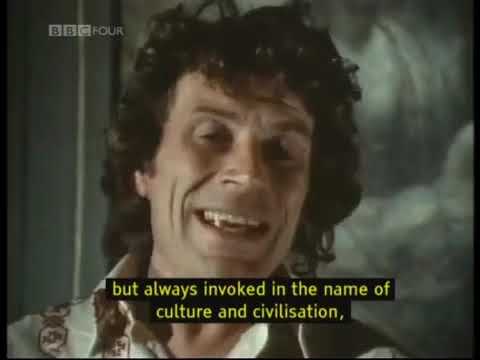
[9:10]For this drawing by Leonardo, the Americans wanted to pay £2.5 million. Now it hangs in a room by itself like a chapel behind bullet-proof Perspex. The light are kept low so as to prevent the drawing from fading. But why is it so important to preserve and display this drawing? It's acquired a kind of new impressiveness, but not because of what it shows, not because of the meaning of its image. It's become mysterious again because of its market value. This market value depends upon it being genuine. And now, it is here, like a relic in a holy shrine. I don't want to suggest that there is nothing left to experience before original works of art except a certain sense of awe, because they have survived, because they are genuine, because they're absurdly valuable. A lot more is possible, but only if art is stripped of the false mystery and the false religiosity which surrounds it. This religiosity, usually linked with cash value, but always invoked in the name of culture and civilization, is in fact a substitute for what paintings lost when the camera made them reproducible.
[10:48]The National Gallery sell more reproductions of this Leonardo cartoon than of any other picture, but what are the meanings these reproductions acquire in each home when they are hung or pinned to the wall? And how different are all these meanings from its original one, when Leonardo first worked on it, to work out an idea for a painting? The camera, by making the work of art transmittable, has multiplied its possible meanings and destroyed its unique original meaning. Have works of art gained anything by this? They have lost and gained. Let me try to explain how. The most important thing about paintings themselves is that their images are silent, still. I can't demonstrate the stillness, for the lines on your screen are never still, and in a sense, the pages of a book are never still. But I can demonstrate the silence.
[11:56]Occasionally, this uninterrupted silence and the stillness of a painting can be very striking.
[12:41]The experience of this has almost nothing to do with what anybody teaches about art. It's as if the painting, absolutely still, soundless, becomes a corridor, connecting the moment it represents with the moment at which you are looking at it, and something travels down that corridor at a speed greater than light, throwing into question a way of measuring time itself. Because paintings are silent and still, and because their meaning is no longer attached to them, but has become transmittable, paintings lend themselves to easy manipulation. They can be used to make arguments or points which may be different, very different, from their original meaning. And because paintings are essentially silent and still, the most obvious way of manipulating them is by using movement and sound. The camera moves in to remove a detail of a painting from the whole. Its meaning changes. An allegorical figure becomes a pretty girl anywhere. From being part of a strange, poetical word of metamorphosis, a dog can be turned into a pet, not unlike the dog of his master's voice. The meaning of a painting shown on film or television can be changed even more radically. This is a painting by Brueghel, or rather a reproduction of a painting by Brueghel, of The Road to Calvary. If you look at the whole painting, Brueghel's intention is fairly clear. In the right foreground are Mary and John and the mourners of Christ. Christ carrying the Cross is in the middle distance, carried forward by the crowd, which is making its way to the place of the crucifixes, far away on the right, where a circle of onlookers has already gathered. If you look at the whole picture, you will see that it is about grief, about torture, and above all, about the callousness, the are eager inquisitiveness, the superstitious drive of the crowd. If it sets out to be a religious painting, it is an oddly secular one. But the difficulty is that on a screen, if you keep the whole painting in view, you don't see very much. You have been waiting impatiently for the camera to go in to examine details. Yet as soon as this happens the comprehensive effect of the painting can be changed. It is possible to isolate and show the details in a way that makes the painting look like a straightforward devotional picture.
[15:24]With a different camera movement again, it can be shown as an example of landscape painting. Or details can present it to you in terms of the history of costume or social customs. Most easily, it can be presented as a story. The two thieves being carted to the place of crucifixion. Christ carrying the Cross.
[15:52]In a film sequence, the details have to be selected and re-arranged into a narrative, which depends on unfolding time. Yet in the painting as a whole, all these elements are there simultaneously. In paintings, there is no unfolding time. As well as by the movement of the camera, paintings are modified and changed by the sounds you hear when looking at them. Here is a landscape - a cornfield with birds flying out of it. Look at it for a moment in silence.
[16:30]Now supposing I say whilst you look at it, this is the last picture Van Gogh painted before he killed himself.
[16:58]Words you notice consciously, music is subtler. It can work almost without your noticing it. How often do you consciously notice the music played over paintings on television? Yet music and rhythm changed the significance of picture. Here's a painting by Caravaggio. Here are details of this painting cut to music from an Italian opera.
[17:59]Now cut to a religious choral.
[18:40]I've said that as soon as the meaning of the painting becomes transmittable, this meaning is liable to be manipulated and transformed. It's no longer a constant. It's changed by the camera which moves, by words put around it, by music played over it. Now lastly, paintings can be changed in another way. When paintings are reproduced they become a form of information which is being transmitted and so there they have to hold their own against the other information which is jostling around them to appear on the same page or the same screen.
[19:28]The meaning of an image can be changed according to what you see beside it or what comes after it. Let's try our last experiment. We put the image of this well-known painting by Goya on your screen. You look at it in the context of what I'm saying. In the context of my image in relation to it.
[20:00]Some years ago, up in the mountains that were wide with snow. Inside a cavern, he was planning, there's gonna be a show with somebody he knows.
[20:20]And supposing now you turn off from our channel on to one of the others.
[20:48]Each time the impact of the Goya is modified.
[20:56]I've now emphasized the ways in which reproduction makes the meaning of works of art ambiguous. This is not as negative as it necessarily sounds if we realise what is happening. What it means, in theory, is that the production of works of art can be used by anybody for their own purposes. Images can be used like words, we can talk with them. Reproduction should make it easier to connect our experience of art directly with other experiences. You can sometimes see how naturally this begins to happen when, for instance, children or adults pin up reproductions alongside snapshots, or their own drawings, or pages from magazines.
[21:47]There, everything belongs to the same visual language. Used for describing or recreating experience.
[22:04]What so often inhibits such a spontaneous process is the false mystification which surrounds art. For instance, the art book depends upon reproductions, yet often what the reproductions make accessible, a text begins to make inaccessible. What might become part of our language is jealously guarded and kept within the narrow preserves of the art expert. These last two great paintings by Frans Hals portray the governors and the governesses of an alms house for old paupers in the Dutch 17th century city of Haarlem. Hals an old man of over 80, was destitute. Most of his life he had been in debt. During the winter of 1664, the year he began painting these pictures, he obtained three loads of peat on public charity otherwise he would have frozen to death. Here, he paints the official portrait of the administrators of such public charity.
[23:21]Reproductions in colour or in black and white, showing the whole or showing details, make these two paintings easily accessible. Yet this is how these images are introduced.
[23:35]Each woman stands out with equal clarity against the enormous dark surface, yet they are linked by a firm rhythmical arrangement and the subdued diagonal pattern formed by their heads and hands. Subtle modulations of the deep, glowing blacks contribute to the harmonious fusion of the whole and form an unforgettable contrast with the powerful whites and vivid flesh tones where the detached strokes to reach a peak of breadth and strength. In the portrait of the men, Hal's old tendency of creating an impression of casual informality and the instantaneousness recurs. But the pictorial unity appears less successful found in earlier works. The intense light areas of the flesh tones, the great expanses of white linen and the daringly brought red touch on the knee of the man on the right tend to jump and are not fully integrated into a coherent design. That is a quotation from the most comprehensive book on Hal's in English. It was published last year. It's as though the author wants to mask the images, as though he fears for the direct this and accessibility. As in so many other pictures by Hal's the penetrating characterisations almost seduces us into believing that we know the personality traits and even the habits of the men and women portrayed. And in the case of some critics, the seduction has been a total success. He speaks of seduction disparagingly, yet what is this seduction? It's nothing less than the painting working on us. If the characterisation is, as he says, penetrating, it penetrates to reveal something. It's as though he doesn't want us to make sense of it in our terms. And when he sums up, he resorts to meaningless generalisations. We attempt to control the powerful impact his paintings make upon us, by considering the tradition in which he worked and the range of possibilities open to him. The effort only increases our admiration for Hal's unwavering commitment to his personal vision, which enriches our consciousness of our fellow men and heightens our awe for the ever-increasing power of the mighty impulses that enabled him to give us a close view of life's vital forces. This is mystification. Children, until they're educated out of it and are forced to accept mystifications, look at images and interpret them very directly. They connect any image, whether from a comic or from the National Gallery, directly with their own experience. I showed a reproduction of a Caravaggio to a group of school children. I think it couldn't be they stole the food and one of them is saying they're not going to eat it, it's stolen food. And he's going, "Why not?" Do you think he wants to get up? Yeah. He looks as if he's just about to push the table over. That lady's being all romantic and... I think it might be Jesus. What makes you think it might be Jesus? Well, he's in the center of the table and he looks like he might be a leader of some kind. It looks like a she to me. And they've got the food on the table there. But they haven't got bread or wine. What do the rest of the think about in saying that it might be Jesus? I don't think it's Jesus. He's got his own opinion. It could be. Some of you think it's a man, and some of you think it's a woman. I think it's a woman because she's got curls. It looks as though they're all going to jump up and kiss her. She sitting there, he's got his arm out to cuddle her, and he's jumping up to run round. I think it's a man. It's a woman. It is a woman. There's no bristles even. Yes, but he hasn't got any bristles. He's got a moustache. Yes, but he hasn't got any bristles here. All of... No, not quite all, but most of the boys thought that he was a man and most of the girls, you thought she was a woman. And you said she was perhaps both. Because they were really looking and really relating what they saw to their own experience, they recognised something that must adults wouldn't. Without knowing the artist's name, let alone anything about Caravaggio's life, or the fact that he was a homosexual, they immediately saw how sexually ambivalent the principal figure was. I can't pretend to the clairvoyance of children, but in the next three programs I'm going to try to relate the experience of art directly to other experiences, and to use the means of reproduction as though they offered a language, as though pictures were like words rather than holy relics.
[28:28]How we see women, possessions, advertisements and their promises, which surround us on every side. But remember that I am controlling and using for my own purposes the means of reproduction needed for these programs. The images may be like words, but there is no dialogue yet. You cannot reply to me. For that to become possible in the modern media of communication access to television must be extended beyond its present narrow limits. Meanwhile, with this programme, as with all programmes, you receive images and meanings which are arranged. I hope he will consider what I arrange, but be skeptical of it.