[0:00]Hey everyone, welcome back. I'm Mike. And I'm Sarah. Hey Mike, how are you today? I'm great, Sarah. So today we're talking about something really cool. Oh yeah? What is it? Engineering. Engineering. Wow, that sounds big. It is big. But don't worry, we're going to make it super simple and fun. And I promise you, by the end of this episode, you'll understand what engineers actually do. And you'll learn some words you can use every day. Perfect, because honestly, like, I hear the word engineer all the time. But what is an engineer? Good question. Okay, so an engineer is a person who designs things. They build things. They solve problems. So like, they make things? Exactly. They make things. They create things. Bridges, buildings, phones, cars, all of that. Oh, so engineers are everywhere? Yes, engineers are everywhere. You use things made by engineers every single day. Really? Like what? Like your phone. My phone? Yes, an engineer designed your phone. The shape, the screen, the buttons, everything. Wow, I never thought about that. Right? And your car, engineers designed that too. So engineers are super important. Super important. Without engineers, we wouldn't have most of the things we use. Okay, but Mike, there are different types of engineers, right? Oh yes, many types. So many types. Can you tell me some? Sure. Let's start with civil engineers. Civil engineers. What do they do? Civil engineers build big things, like bridges, like roads, like tunnels. Oh, so they work outside a lot. Sometimes. They design the project first, then they watch the construction. Construction. That's when people build something, right? Exactly. Construction means building. So civil engineers plan it, and then workers build it. Got it. So bridges, roads, tunnels, what else? Big buildings, tall buildings, like skyscrapers. Skyscrapers? Those super tall buildings in the city? Yes, those are amazing. Civil engineers make sure they don't fall down. That's a very important job. Very important. Imagine if a bridge fell down. Oh no, that would be terrible. Exactly. So civil engineers have to be very careful, very smart. Okay, so that's one type. What's another type? Mechanical engineers. Mechanical engineers. What do they do? They work with machines. Machines? Like cars, like airplanes, like robots? Robots? Wow. Yeah, mechanical engineers design the parts, the moving parts. The moving parts? You mean like wheels, like engines, gears? Yes, wheels, engines, gears, all the parts that move. So if I have a problem with my car engine, a mechanical engineer knows how to fix it? Well, they know how it works, but usually a mechanic fixes it. Oh, what's the difference? An engineer designs it, a mechanic repairs it. Ah, so the engineer creates it, and the mechanic fixes it. Exactly. Good way to say it, Sarah. Thanks. Okay, so we have civil engineers and mechanical engineers. What else? Electrical engineers. Electrical. That's about electricity, right? Yes. Electrical engineers work with electricity and electronics. Electronics? Like computers? Yes, computers, phones, TVs, radios, all of that. So they understand how electricity works. Exactly. They design circuits. Circuits? Circuits are like paths for electricity. The electricity travels through the circuit. Oh, like a road for electricity. Perfect. Yes, like a road for electricity. That's a great way to think about it. So inside my phone, there are tiny roads for electricity. Yes, very tiny roads, very complicated roads. Wow, that's so cool. It is. Electrical engineers are amazing. Okay, Mike, I have a question. Sure, what is it? Do you need to be good at math to be an engineer? Oh, that's a great question. Yes, you do. Really? Really? Engineers use math every day. What kind of math? All kinds, addition, subtraction, multiplication. Oh, those are easy. Well, they also use harder math, like algebra, like calculus. Calculus? I've heard that word. That sounds difficult. It is difficult, but engineers study it in university. They practice a lot. So they go to university to learn. Yes, most engineers go to university for four years, sometimes more. Four years? That's a long time. It is, but it's worth it. Engineering is a good career. A good career? You mean they make good money? Usually, yes. Engineers often have good salaries. Salaries? That's the money you make at your job, right? Exactly. Your salary is your pay, how much money you earn. Got it. So engineers study hard, but then they get good jobs. That's right. Okay, Mike, let me ask you something else. Go ahead. What about software engineers? Are they the same? Oh, good question. Software engineers are a bit different. Different how? They don't build physical things. They build programs. They build apps. Apps? Like on my phone? Yes, every app on your phone was made by a software engineer. So they write code? Exactly. They write code. Code is like instructions for the computer. Instructions for the computer. So they tell the computer what to do. Yes, that's a perfect way to say it. They tell the computer what to do. That sounds fun. It is. Many people love software engineering. Do software engineers also go to university? Many do, but some learn by themselves. They practice at home. Really? They can learn by themselves? Yes. There are many online courses, many free resources. Free resources? You mean like websites, like videos? Exactly. You can learn coding on YouTube, for example. Wow, that's amazing. It is. Technology is changing everything. So, Mike, tell me, what do engineers actually do every day? Like at work? Good question. It depends on the type of engineer. Okay. Let's say a civil engineer. What does a civil engineer do every day? They might design a new bridge. They use computer programs. Computer programs? Yes, special programs for drawing and designing. So they sit at a computer? Sometimes, and sometimes they visit the construction site. Construction site. That's where they build things, right? Exactly. They go there to check the work, to make sure everything is correct. So they don't just sit in an office all day? No, they go outside. They talk to workers. They solve problems. That sounds interesting. It is. Every day is different. What about a mechanical engineer? A mechanical engineer might test a new car part or design a new engine. So they work with real objects, real things? Yes, they work with prototypes. Prototypes? A prototype is like the first version, the test version. Oh, so they make the first one and then they test it? Exactly. They test it to see if it works, if it's safe. And if it doesn't work? They fix it. They redesign it. They try again. So they have to be patient? Very patient. Engineering takes time. Mike, I'm curious. Can anyone become an engineer? Well, it's not easy. But yes, if you study hard. So you need to be really smart? You need to be willing to learn. You need to like solving problems. Solving problems? That's important, right? Super important. Engineering is all about problems. Finding solutions. Solutions. That means answers, right? Exactly. Solutions are answers. If there's a problem, you find a solution. So engineers are like problem solvers. Yes, that's exactly what they are. Problem solvers. I like that. Me too. Okay, Mike, let's talk about something fun. Sure. What do you want to talk about? Famous engineers. Do you know any famous engineers? Oh, yes. There are many. Let's see. Do you know Nikola Tesla? Nikola Tesla. I think I've heard that name. He was an electrical engineer. A genius. A genius. That means super smart, right? Exactly. Tesla invented many things. He worked with electricity. What did he invent? He invented the AC motor. AC means alternating current. Alternating current? That sounds complicated. It is. But basically, it's a type of electricity. The electricity in your house is AC. Really? In my house? Yes. Tesla's work helps power your home. Wow. That's amazing. It is. Tesla was incredible. Who else? Any other famous engineers? How about Steve Wozniak? Steve Wozniak. Who's that? He co-founded Apple with Steve Jobs. Oh, Apple. I know Apple. Right. Well, Wozniak was the engineer. He built the first Apple computer. Really? He built them himself? Yes, in a garage. Can you believe it? In a garage? That's crazy. I know. And now Apple is one of the biggest companies in the world. So he started small and became huge. Exactly. That's the power of engineering. That's so inspiring. It is. It shows that anyone can do great things. Mike, let me ask you something personal. Okay, go ahead. Did you ever want to be an engineer? You know what? When I was a kid, yes. Really? Yeah, I loved building things. I had these toy blocks. Toy blocks? Like Lego? Exactly, like Lego. I would build houses, cars, spaceships. That's so cute. Thanks. I thought I would be a civil engineer, build bridges and buildings. So what happened? Why didn't you? Well, I wasn't great at math. Oh, no. Yeah, I tried, but it was really hard for me. So you gave up? I changed my path, but I still respect engineers so much. I understand. Math can be difficult. It can. But if you love it, you can do it. That's true. What about you, Sarah? Did you ever think about engineering? Honestly, no. No? No, I always liked art, drawing, painting, music. Oh. So you're creative. I try to be. But you know what's interesting? What? Engineers are creative, too. That's so true. I never thought about it that way. Right? They create new things. They imagine solutions. Exactly. Engineering is art and science together. Art and science. I love that. Me too. It's the perfect combination. Mike, let's talk about tools. Tools? Yeah, what tools do engineers use? Oh, great question. Well, it depends on the type of engineer. Let's start with civil engineers. Okay. Civil engineers use measuring tools, like rulers, tape measures. Tape measures. Those long yellow things. Exactly. They measure distances, lengths. What else? They use levels to make sure things are straight. Levels. Oh, those bubble things. Yes, with the little bubble in the middle. If the bubble is in the center, it's level. Oh, I've seen those. My dad has one. Nice. They're very useful. What about mechanical engineers? What do they use? They use wrenches, screwdrivers, drills. So, like, regular tools? Kind of. But they also use special machines, like lathes. Lathes? What's a lathe? A lathe is a machine that spins metal. You can shape the metal while it spins. Wow. That sounds dangerous. It can be. Engineers have to be careful. They wear safety equipment. Safety equipment, like helmets? Yes, helmets, gloves, safety glasses. Safety glasses. To protect the eyes. Exactly. Safety is very important in engineering. What about electrical engineers? What do they use? They use computers and special programs. Programs for writing code? Yes. Like Visual Studio or Python or JavaScript. Those are strange names. I know. But they're just names of programming languages. Programming languages. Like English, but for computers. Perfect. Like English, but for computers. Mike, this is all so interesting. I'm glad you think so. But tell me, is engineering dangerous? Sometimes it can be. Really? Yeah. Think about it. If you're building a tall building, you're working high up. High up. That's scary. It can be. That's why safety is so important. What about electrical engineers? Is that dangerous? It can be. Electricity is dangerous if you don't know what you're doing. So they have to be trained? Very well trained. They learn how to work safely with electricity. That makes sense. And they follow safety rules. Always. Good. I'm glad they're careful. Me too. Mike, let me ask you something. Sure. What's the most amazing thing engineers have built? Oh wow, that's a tough question. I know. There are so many things. Let me think. Maybe the Golden Gate Bridge. The Golden Gate Bridge in San Francisco. Yes, it's beautiful and incredible. Engineers built it in the 1930s. In the 1930s? That's a long time ago. It is, and it's still standing. Still strong. That's amazing. What about you? What do you think is amazing? Hmm, maybe the International Space Station? Oh, the ISS. That's a great answer. Right? It's in space. People live there. I know. Engineers from many countries work together to build it. Together. That's so cool. It is. Engineering brings people together. I love that. Me too. Mike, let's talk about the future. The future? Yeah. What will engineers build in the future? Oh, great question. Well, right now, engineers are working on many exciting things. Like what? Like electric cars. Electric cars. Cars that don't use gas. Exactly. They use batteries. They're better for the environment. The environment. You mean the Earth? Nature? Yes. Electric cars don't pollute the air. That's wonderful. It is. Tesla makes electric cars. Other companies, too. What else are engineers working on? Renewable energy. Renewable energy. What's that? Energy from the sun, from the wind, from water. Oh, so not from oil or gas. Exactly. Renewable means it doesn't run out. The sun doesn't run out. Right. So solar panels use energy from the sun. Solar panels. I've seen those. On roofs. Yes. Engineers design better solar panels every year. That's so important for our planet. Very important. What about robots? Are engineers making more robots? Oh, yes. Robots are huge right now. Really? Really? Robots are helping in hospitals, in factories, even at home. At home? Like what? Like robot vacuums. They clean your floor automatically. Oh, I've seen those. They're so funny. They are. And they're getting smarter. Smarter? How? They use artificial intelligence, AI. AI. I hear that word everywhere. It's very popular. AI helps machines learn and think. Wow. So robots can learn? Kind of. They can recognize patterns and improve. That's incredible. It is. Engineers are making amazing things. Mike, do you think kids should learn about engineering? Absolutely. Why? Because it teaches you how to think, how to solve problems. Problem solving again. Yes. It's such an important skill. Even if you don't become an engineer? Even if you don't, problem solving helps you in life, in any job. That's true. Plus, it's fun. Building things is fun. I agree. I used to love building sandcastles. See, that's engineering. Small scale, but still engineering. Huh, I never thought about it that way. Everything's connected. Mike, we should probably start wrapping up. Oh, you're right. Time flies. It does. This was such a fun conversation. I had a great time. Me too. Me too. So let's recap quickly. Good idea. So, everyone, today we talked about engineering. We learned that engineers design and build things. There are many types of engineers, civil, mechanical, electrical, software. They all do different things, but they all solve problems. Exactly. They use math, science, and creativity. And they make the world better. They really do. From bridges to phones to robots. Engineers are amazing. So, if you're interested in engineering, go learn more. Watch videos, read books, try building something. And remember, everyone can learn. You just need to practice. That's right. Keep practicing your English, keep asking questions, keep being curious. And if you enjoyed this episode, please like and subscribe. Yes, subscribe to our podcast. It really helps us. And leave a comment. Tell us what you want to hear next. We love hearing from you. Alright everyone, thank you so much for listening. Thank you. Keep practicing your English. And keep being awesome. And keep being awesome. See you next time. Bye, everyone. Bye.
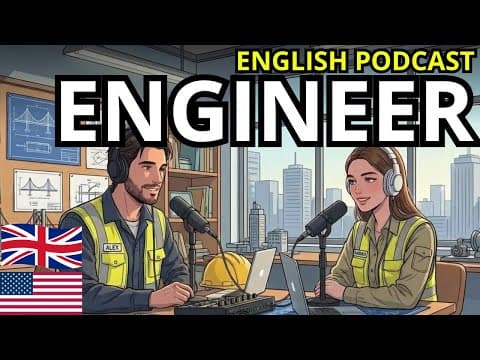
Learn About Engineering Conversations | Easy English Listening for Beginners
English Vocabulary Lab
18m 47s2,616 words~14 min read
YouTube auto captions
Transcript source
YouTube auto captions
This transcript was extracted from YouTube's auto-generated caption track. The transcript below is server-rendered so it can be read, searched, cited, and shared without opening the original YouTube player.
Pull quotes
Use this transcript
Related transcript hubs
Watch on YouTube
Share
MORE TRANSCRIPTS


