[0:10]Have you been to an interview recently, been perfectly qualified for the role, you've answered all the questions correctly, but still been rejected? Well, the answer could lie in your body language. Recent studies suggest that only 7% of your communication are the actual words you say. 38% are certain vocal elements like your intonation, but 55% is your non-verbal. Things like your facial expression, your gestures, your posture. So this video is going to look at the messages you've been sending out with your body language, and how to tweak those to make sure you're sending out all the right signals at your next interview. So, think about your body posture. A very natural thing for people to do is to slouch in the chair or fold their arms. And this looks like you're making yourself smaller, wrapping yourself up. And the signal you're giving off to the interviewer is that you're defensive or nervous. Instead, open up your body, don't cross your legs or fold your arms, and, but engage slightly forward from the waist. And this will give the appearance to the interviewer that you're interested. If you um, jigglin' about a lot in the chair, um, keeping changing your body posture, or you're playing with the button on your shirt, or the ring or other objects, um, you're going to appear anxious and nervous. And certainly the interviewer is going to be less inclined to have confidence in you. So, a really good tip is to, first, slow your breathing down. This will slow your heart rate and make you feel less nervy. Keep your hand gestures steady and only to emphasize a point. Palm upwards signifies that what you're saying is honest and trustworthy. Um, touching your heart signifies that what you're saying is genuine. Steepling is a sign of confidence. Conversely, clasping your hands is a sign of self-comfort and anxiety, so make sure you avoid these. Mirroring the interviewer is a, an effective technique, but it needs to be done very subtly. Mirroring hand movements or positive gestures, waiting 10 seconds though before you do it yourself. Um, you can also mirror your speech, so, um, their vocabulary, their jargon, um, the rate or volume, um, of their speech. People trust those that are similar to themselves, so this makes the interviewer, um, feel at ease and you're more likely to build rapport with them. This is so important. Interviewees often avoid the gaze of the interviewer or they look down. Um, by looking at the interviewer's eyes, you're asserting your confidence, your trustworthiness. Instead of staring at the interviewer, alternate your gaze between the left eye, the right eye, the mouth, maybe every three seconds, just enough to see the color of the interviewer's eyes. For panel interviews, make sure you look at everybody, but specifically focus your attention on the person who's asking you the question or is speaking at the time. To avoid lying signals, um, the main rule is avoid touching your face. So, especially your nose, your mouth, your ears, your sideburns. These are all signs that will suggest to your interviewer that you're being dishonest with the way that you're answering the questions. So the the handshake is an obvious one, um, but so many people get this wrong. It's the unspoken word that initiates conversation in any social or professional get together. Too firm and you'll seem too dominant. Too weak and you'll seem underconfident. Instead, always initiate the handshake, match the interviewer's grip, apply the one, two second rule, smile, and repeat their name. By putting these body language tips into practice, you'll be giving off the right impression at your next interview. Now all you need to worry about is what you're actually going to say.
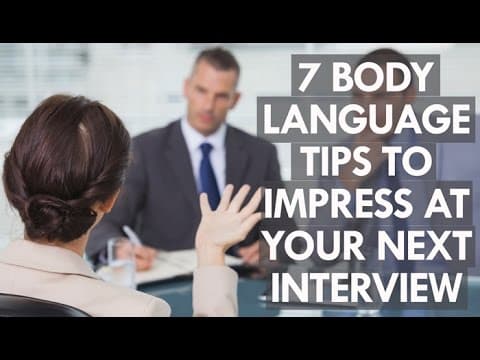
7 body language tips to impress at your next job interview
Cognitive Group | Recruiting For Your Future
3m 55s632 words~4 min read
YouTube auto captions
Transcript source
YouTube auto captions
This transcript was extracted from YouTube's auto-generated caption track. The transcript below is server-rendered so it can be read, searched, cited, and shared without opening the original YouTube player.
Pull quotes
[0:10]Have you been to an interview recently, been perfectly qualified for the role, you've answered all the questions correctly, but still been rejected?
[0:10]Recent studies suggest that only 7% of your communication are the actual words you say.
[0:10]38% are certain vocal elements like your intonation, but 55% is your non-verbal.
[0:10]So this video is going to look at the messages you've been sending out with your body language, and how to tweak those to make sure you're sending out all the right signals at your next interview.
Use this transcript
Related transcript hubs
Watch on YouTube
Share
MORE TRANSCRIPTS


