[0:01]Saint Augustine, a story of America by Cynthia Benjamin.
[0:10]You might assume that the oldest city in the United States is in Virginia or Massachusetts. If so, you might be surprised to learn that this is much further south. St. Augustine, in Northeast Florida, has a rich and interesting history as our country's oldest city. The Timucua in St. Augustine. About 5,000 years ago, Native Americans were living in the northeast and north central areas of Florida. Centuries later, French and Spanish explorers who encountered these people called the Timucua or T E M U Q U A. This name may come from the word for "chief" in the Timucua language. However, even today, we don't know the true name of these native people.
[1:03]Timucua culture. The Timucua were made up of thirty-five groups, and a different chief ruled each one. The Timucua all spoke the same language, but their way of life depended on their location. In coastal villages, more people were hunters and fishers; further inland, more Timucua were farmers. Village life. In the St. Augustine area, the principal chief in 1565 was a man named Soloy, and a village was named after him. A visitor to Soloy in the 1500s would find villagers living in small, round houses with cone-shaped roofs. These roofs were covered with palm tree leaves, and the walls were made of woven vines. Family members sat or slept on low benches that lined the walls. Although the families each lived in their own homes, they ate their meals with the community in a central area in the village. A round council house was large enough for all of the residents of Soloy to meet together. At these meetings, villagers discussed community issues, danced, and held special ceremonies. These ceremonies celebrated the planting or harvesting of crops or occasionally honored a dead leader.
[2:35]The villagers' clothing was made from animal hides and cloth woven from plant fibers. The people decorated themselves with paint and colorful tattoos. Both men and women wore jewelry made from shells, beads, and animal bones.
[2:56]The founding of St. Augustine. French and Spanish exploration. On April 2, 1513, Juan Ponce de Leon, an explorer sailing from Spain, arrived in a Timucua village. Because it was Easter, he named the new land La Florida to honor the Festival of Flowers, a Spanish celebration held during Easter.
[3:22]For almost 50 years Spanish explorers continued to sail to the Americas. They faced serious problems, including extreme heat, dangerous animals, and new diseases. Finally, in 1561, King Philip II of Spain ended Spanish colonization in Florida. In 1564 French colonist arrived in Florida. The colonists built their own settlement, Fort Caroline, named for the reigning French King, Charles V. Fort Caroline was located near the St. John's River, about twenty miles west of the Atlantic coast in what is now the city of Jacksonville. The City of St. Augustine. France and Spain were great rivals. Fort Caroline posed a serious threat to Spain. To secure Spain's own land in the Americas, King Philip II of Spain decided to send another expedition to Florida. This group, led by Pedro Menéndez de Avilés, sailed from Spain on July 28, 1565, and reached the Florida coast a month later. The majestic fleet of five ships carried 800 soldiers, sailors, colonists, and enslaved people. On September 8, 1565, the city of St. Augustine was founded at the Timucua village of Soloy. In a letter to King Philip II, Menéndez wrote, "There were many Indians present, including the principal men among them. They showed us friendship. It seemed to us that they were enemies of the French." St. Augustine became the first permanent European settlement in what is now the United States. Unfortunately, the European settlers brought war and disease, which greatly decreased the Timucua population.
[5:33]The Spanish defeat the French. And what about the rivalry between the Spanish and French? Soon after landing in Florida, the Spanish attacked Fort Caroline, killed many French soldiers, and took many others captive. Never again did France try to establish colonies in Florida. The English attack Florida. Spain had driven their rivals, the French, from Florida in 1565. However, by 1586 Spain and England were at war. That year, the English explorer and commander Sir Francis Drake sailed into the harbor at St. Augustine and attacked the Spanish settlers. The Spanish fought hard, but the English burned the buildings and the crops in the fields. The furious Spanish settlers refused to give up and rebuilt their town. Almost a hundred years later, St. Augustine was once again attacked. In 1668 English pirate Robert Searles and his soldiers captured a Spanish ship. A doctor aboard the captured ship told Searles that there was a large amount of silver stored in St. Augustine.
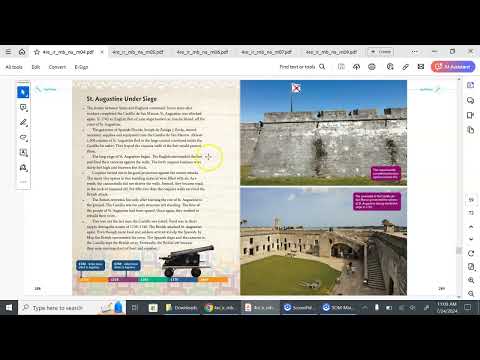
[7:03]Searles waited until nightfall to sail the ship into the St. Augustine harbor. Since the ship was flying the Spanish flag, the settlers thought it was friendly, but after midnight, Searles' soldiers attacked the town, stole the silver, and killed many settlers. Building a strong fort. To be better protected, Queen Mariana of Spain ordered a stronger fort to be built. Work began in 1672 when engineers and stonecutters arrived from Spain. They built the new fort from a local stone called coquina, a soft yellow limestone made up of coral and broken sea shells. No one had ever built a large building like a fort from coquina, so the builders did not know if coquina would be strong enough to hold up against an attack. However, workers could easily cut and shape coquina into blocks. After drying in the open air, the soft blocks became strong and hard. The new fort was designed to protect St. Augustine's citizens. Soldiers would be able to fire cannons from any of the four diamond-shaped projections that extended from the fort walls. These projections are called bastions.
[8:24]It took twenty-three years to build the new fort. Spanish workers, Native Americans, free Africans, and enslaved Africans worked together on the project. Finally, in 1695 the Castillo de San Marcos was finished. The name means "St. Mark's Castle" in Spanish. Would the Castillo and its coquina walls be enough to protect the people of St. Augustine if an attack came?
[9:00]St. Augustine under siege. The rivalry between Spain and England continued. Seven years after workers completed the Castillo de San Marcos, St. Augustine was attacked again. In 1702 an English fleet of nine ships landed on Amelia Island, off the coast of St. Augustine.
[9:24]The governor of Spanish Florida, Joseph de Zúñiga y Zarda, moved necessary supplies and equipment into the Castillo de San Marcos. Almost 1,500 citizens of St. Augustine fled to the large central courtyard inside the Castillo for safety. They hoped the coquina walls of the fort would protect them. The long siege of St. Augustine began. The English surrounded the fort and fired their cannons against the walls. The fort's coquina bastions were thirty feet high and fourteen feet thick. Coquina turned out to be good protection against the enemy attacks. The many tiny spaces in the building material were filled with air. As a result, the cannonballs did not shatter the walls. Instead, they became stuck in the rock or bounced off. For fifty-two days the coquina walls survived the British attack. The British retreated, but only after burning the rest of St. Augustine to the ground. The Castillo was the only structure left standing. The lives of the people of St. Augustine had been spared. Once again, they worked to rebuild their town.
[10:43]This was not the last time the Castillo was tested. Food was in short supply during the winter of 1739-1740. The British attacked St. Augustine again. Even though more food and soldiers arrived to help the Spanish, by May, the British surrounded the town. The Spanish ships and the cannons in the Castillo kept the British away. Eventually, the British left because they were running short of food and supplies.
[11:16]Free Africans at Fort Mose. Both free and enslaved Africans had lived in St. Augustine since 1565. Some were skilled blacksmiths. Others were carpenters, farmers, and cattle ranchers. Working with Native Americans and the Spanish, they helped to build the Castillo de San Marcos. In the 1600s, some enslaved Africans escaped from the English colony of Carolina. They traveled south to Spanish Florida to find freedom. In 1693 the Spanish King offered them liberty on two conditions. First, the enslaved people who had run away had to become Catholic. Second, they had to declare their loyalty to Spain. In 1738 the governor of St. Augustine created a town for the enslaved people who ran away. This settlement included a fort and farmland. Fort Mose was the first settlement in North America for free Africans. The governor hoped Fort Mose would help defend St. Augustine against British attack. He also wanted the villagers to grow food that could be sold to St. Augustine. Almost one hundred people lived in a walled village at Fort Mose. The twenty-two families worshipped in a wooden Catholic church. Some villagers were farmers and hunters. Others worked in St. Augustine as carpenters, builders, and ironsmiths. Women grew vegetables and raised farm animals. In June 1740, a year and a half after Fort Mose was founded, the British attacked St. Augustine and took control of the fort. The men of Fort Mose were part of a military force, or militia, that helped protect St. Augustine. Early in the morning two days later, the men of Fort Mose led a surprise attack on the sleeping British soldiers. The Fort Mose militia fought bravely alongside their Spanish and Native American allies and caused the British soldiers to flee. Unfortunately, Fort Mose was destroyed in the battle. Twelve years later, free Africans built a new Fort Mose a short distance from the first settlement.
[13:46]St. Augustine today. Every year more than one hundred million people visit Florida. About six million of these tourists come to St. Augustine. They stay in hotels, eat in restaurants, and visit historic sites. The money they spend boosts Florida's economy and provides jobs for many St. Augustine residents. Visiting St. Augustine is like walking through a living history museum. Many parts of the city still look like an 18th-century Spanish colony. Visitors can watch people act out the lives of St. Augustine's colonial citizens. Unfortunately, no wooden buildings built before 1702 are still standing. What did a Spanish colonial house look like? To find out, tourists visit the Gonzalez Alvarez House. It is the oldest Spanish colonial house in the city. Workers began building the original home around 1723. The one-story house had two large rooms. The thick coquina walls kept the house cool in summer and warm in winter. The windows were covered with pieces of wood instead of glass. A Spanish soldier and his family lived there for almost forty years. Over time, new owners added more rooms to the house.