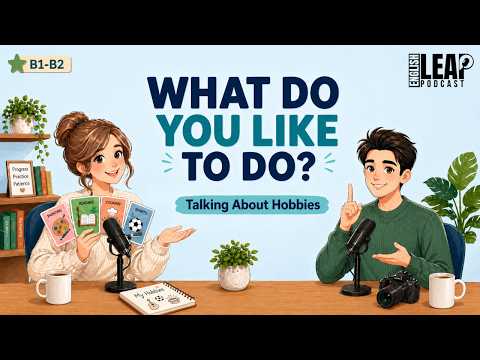
[0:00]English Leap Podcast. From Speak English with Class. Okay, I want to try something. Right now? Right now. Simple question. Are you ready? Yeah, go ahead. What do you like to do? Why did my brain just leave? There it is. No, no, I know the answer. I have hobbies, I have things I enjoy. I just... Why is this hard? And if you are listening right now and your mind also went a little blank when I asked that question, don't worry, you are in exactly the right place. Hello, and welcome back to the English Leap podcast. Your cozy little place to learn easy English through real everyday conversations. I'm Anna. And I'm Jake. And if you are new here, hello. Genuinely, hello. We are so glad you found us. And if you have been with us before, welcome back. We missed you. Not in a dramatic movie way. No, no. Just in a quiet, "Oh, good, they're here," kind of way. Exactly. The best kind of missing. So, today, we're spending the whole episode on one question. Six little words. Six little words. Sounds completely harmless. Completely harmless. What do you like to do? And before you say, "I watch movies," and move on, we see you. We see you, and we love you. We see you, and we love you, and we're asking you to stay a little longer with this question today. Because this question is not just about hobbies. It is about your personality, your free time, your energy, the things that make you feel like yourself again. And for English learners, it is also one of the most useful questions you can learn to answer naturally. This is a B2 level episode, so we will keep the English natural, clear, and easy to follow. You will hear real conversation, useful phrases, and simple ways to talk about yourself with more detail and confidence. Not just short answers like, "I like music," or, "I watch TV." The classic emergency answers. Exactly, the emergency answers, the answers we give when our brain panics and leaves the room. You know, Anna, I think this question does something strange to people. What do you mean? It arrives so casually. Someone asks it at a dinner or in a job interview or when you meet someone new, very friendly, very light, "So, what do you like to do?" Yes. But suddenly, you are not just listing hobbies. You are representing yourself in real time with no preparation. And you wanna get it right. And you want to sound interesting. And you want it to actually be true. Yeah. I had a moment recently, very embarrassing, I will tell you now. Oh, I am listening. Someone asked me this question, a colleague, very nicely, just making conversation, and I stood there and said, "I don't know." You said, "I don't know." I said, "I don't know," about my own life, about things I enjoy. I stood there like someone had asked me to solve a very difficult math problem. But the worst part is, you do know. I do know. It was all in there somewhere, behind the work emails, the grocery lists, the messages I needed to reply to, the things I had to finish. It was all there. I just could not reach it. I think a lot of people live exactly there, knowing, but not being able to reach it. And maybe you know that feeling too. Maybe you have hobbies, memories, interests, dreams, and small joys inside you, but when someone asks about them in English, everything suddenly feels far away. So today, we want to help you talk about yourself in English with warmth, with detail, with personality. The way you actually are, not the flat, safe, two-word answer. The real one. And along the way, because this is the English Leap podcast, and we cannot help ourselves. We genuinely cannot. We are going to pick up some beautiful and useful English words and phrases. Words that help you describe your hobbies, your personality, your feelings, and the things that light you up. And we'll explain the important words inside the conversation as they come up, so you won't feel lost, you won't feel left behind. Just listen like you're sitting with two friends, not studying too hard, not performing, just listening. And if something we say makes you think, "That is exactly my life," tell us in the comments. We would love to hear from you. All right, let us begin. Let us begin. Okay, Anna, let us start with the real problem. Why does, "What do you like to do?" make so many people go quiet? I think it is because the question sounds casual, but it actually asks something quite personal. Personal how? Well, when someone asks what you like to do, they are not only asking about an activity. They are quietly asking, "What kind of person are you? Are you creative, social, quiet, adventurous?" It's a tiny personality test in normal clothes. And nobody warned us, so people give the safest answer possible. Like, "I like watching movies." Or the classic, "Nothing much." "Nothing much" is where conversations go to sleep. Poor conversation, it tried its best. But I understand why people do it. Some people feel shy talking about themselves. They think, "Is this interesting? Am I talking too much? Will they care?" And some people have a lot of modesty. Tell me what you mean by modesty there. So, modesty means not wanting to draw too much attention to yourself or your abilities. A modest person does not like to sound proud or boastful, even when they are genuinely good at something. Hmm, so someone might bake the most beautiful cakes and say, "Oh, it's nothing really," while the cake is sitting there looking like it belongs in a bakery window? The cake is doing a lot. The person is doing very little credit. Modesty is lovely, but sometimes it makes our answers too small, and talking about what you enjoy is not showing off. It's just opening a small window into your life. And when you open that window, people can actually connect with you. So today we want to move from short answers to real answers, not complicated, just warmer. Hmm, instead of "I like music," you say, "I love soft music in the evening because it helps me wind down after a long day." Same idea, but now it feels like a person said it. Less robot. Yes, much less robot. And actually, that makes me think of something. Sometimes when people ask what we like to do, we answer with the things we do often. Like our habits? Exactly, but a habit is not always the same as a hobby. Oh, that's true. So, Anna, I have a slightly uncomfortable question. That sounded serious. Just a little. Do you think everything we do in our free time is really something we enjoy? No, not always. If I am really truthful with myself, no. Same, because sometimes I say I am relaxing but really I'm just lying on the sofa scrolling through my phone, watching videos I didn't even choose. The phone chose them for me. The phone says, "Here, you need a video of a dog wearing sunglasses." Maybe I do need that, but after 30 minutes, I feel a little empty. Not refreshed, not happy, just, like, time passed. Yes, and I think that is the difference between a hobby and a habit. A real hobby gives you something back, energy, joy, peace, a feeling of creativity. A habit can just fill time. You're going through the motions. Going through the motions. Let's slow down on that one. What do you mean? So, when you're going through the motions, you're doing something without real feeling or attention. Your body is doing the action, but your heart is not really there. You're doing it mechanically. Yes, like going to the gym and touching three machines, looking around, checking your phone, and leaving. Jake, that is very specific. I have seen things, Anna. I have witnessed things at gyms. Or sitting with a book but reading the same paragraph five times because your mind has gone somewhere else entirely. So, when we ask, "What do you like to do?" maybe the better question underneath it is, "What makes me feel better afterwards?" Because if I spend an hour drawing, walking, cooking, talking with a friend, and afterwards I feel lighter, then that activity really matters to me. Oh, for me, walking does that. Not always. Some days it's just walking to get somewhere, but when I walk slowly with no destination, just to think, something shifts inside. Hmm. And cooking can do that for me too. When I have time and I'm making something slowly with music in the background, it stops being a task. It becomes something closer to an experience. And that's the thing, a real hobby doesn't have to be impressive. It just has to make you feel connected to yourself. That's the only requirement. Now, can I share something a little personal? Always. When I was younger, I used to draw a lot. Not for school, not for anyone, just for myself. Flowers, faces, little cartoon characters in the corners of my notebooks. I could sit for hours and not notice the time passing. That sounds very you. It was, and then slowly life got busier. School became serious, then work, then responsibilities, and somewhere along the way, I stopped drawing. Not because I decided to. I just drifted away from it. Drifted away. That's a beautiful and a little sad phrase. What does it mean exactly? So, when you drift away from something, you slowly lose connection with it over time. Not suddenly, not because of one big decision. It just happens quietly, little by little, like a small boat moving away from the shore without anyone steering it. I think so many people have that, a sport they used to love, a craft, a place they used to go, a version of themselves that just got quieter as life got louder. And adult life arrives with a very heavy bag. Work, bills, family, messages, cleaning, remembering passwords. Remembering passwords is essentially a full-time job now. A terrible, thankless job. But yes, when life gets full like that, the first things we let go are usually the things that made us feel alive because they do not feel urgent. Right. Work is urgent. Food is urgent. Bills are urgent. But painting, walking for pleasure, playing music, those feel optional, and optional starts to feel like later, and later becomes never. So, when someone asks, "What do you like to do?" and a person goes quiet, they are not boring. They are tired, or they have simply not asked themselves that question in a very long time. They are not boring. They are tired. I want our listeners to really hear that. So maybe this episode is a small, gentle reminder. Think about the things you drifted away from. Maybe one of them is still waiting for you somewhere. Maybe your old hobby is sitting there like, "Hello. I have been here the whole time." With a tiny cup of tea, waiting very patiently. And actually, that takes us somewhere interesting. Sometimes the things we loved before are connected to the things we enjoy now. Yes. Childhood hobbies can be like small clues from the person we used to be. Small clues. I like that. And that word childhood already feels a little nostalgic, doesn't it? It does, but let's explain nostalgic first for anyone who's not sure. So, nostalgic is the feeling you get when you think about the past, happy memories, childhood moments, old songs, places you have not been in years. It's warm and a little sad at the same time, happy and tender together. Like when you hear an old song and suddenly you're 12 years old again. One second you're a responsible adult. The next second you want cereal and cartoons. That happens so fast. So, Jake, what did you love doing as a child? Football. No hesitation. None at all? None at all. Every day after school, rain, heat, mud, bad shoes. It didn't matter. We used bags as goalposts, sometimes an old shoe. Once, I'm fairly certain, a rock. A rock? We were professionals with limited equipment. But what I remember most is not even the game itself. It is the feeling of running until it got dark, hearing someone's mother call from far away, and everyone pretending they did not hear because nobody wanted to stop. That is such a childhood thing, and I think it explains something about you now, why you still need to be outside, to move, to feel space around you. That child is still in there somewhere. I think you are right. What about you? Stories, always stories, books, made-up characters, little plays with my cousins. I was an avid reader. Avid, say more about that word. So, avid means very eager and enthusiastic about something. An avid reader doesn't just read sometimes. They love reading. Books are a real, regular part of their life. You can say avid reader, avid traveler, avid football fan. So, you were the child reading under the blanket with a torch after bedtime. Yes, committing very serious crimes against sleep. A tiny rebel. A very tired rebel, but I think stories still shape who I am, the love of conversations, films, podcasts, hearing how people see the world. It all started in those books under the blanket. And I think that's the point for our listeners. If you don't quite know what you enjoy now, look back. Ask yourself, "What did I love before I cared what other people thought? What made me lose track of time completely?" Maybe the hobby doesn't need to restart exactly as it was, but it tells you something. If you loved building things as a child, maybe creating still matters to you. If you loved stories, maybe imagination is still important. Childhood hobbies are like little clues. Small clues from the person you were before life got too noisy. Okay, from the past to the future. Very smooth, Jake. Thank you. Anna, what's one thing you've always wanted to try, but keep putting off? Pottery. That came out fast. Because I've thought about it many times. I want to sit at a pottery wheel with clay and make a bowl that is probably not straight. A bowl with personality. Yes, a bowl that says, "I tried." But you said putting off. Let's explain that. Yes, to put something off means to delay it. You want to do it, you intend to do it, but you keep saying, "Later, next week, maybe next month." And I keep putting pottery off. I look at classes online, I get close to booking, and then I close the page. I tell myself, "I will do it when I have more time." And then time says, "No, thank you. I am busy." Exactly. What about you? Mm. Swimming, properly swimming, I mean. I can survive in water. Let us say that. Surviving is not the same as swimming, Jake. No, it is not. I want to learn the actual technique, breathing, movement, rhythm. Some people swim like dolphins. I swim like I am negotiating with the water. Please, water, let me pass. I mean no harm. Very polite, very desperate. But I wanna get into it properly this year. Get into something, that is a lovely, useful phrase. To get into something means to start becoming genuinely interested in an activity and begin doing it more seriously. Your interest is growing. You are giving it real attention. So, you could say, "I recently got into baking," or, "I want to get into pottery this year." "I want to get into pottery this year." That already sounds better than, "I keep meaning to try it." And I think learning something new as an adult is brave in a quiet way because you have to be bad at something again. That is the hard part. As adults, we like control. We like knowing what we're doing. A new hobby says, "Hello. You are a beginner again." And your ego says, "I do not like this room. I would like to leave." But there is something lovely about doing something just because it lights you up. Lights you up, explain that one. When something lights you up, it gives you energy and excitement. You can almost see it happen to a person. Their face changes. Their voice becomes warmer. Their eyes look more alive. Something has switched on inside them. Like you just now talking about pottery. Your voice turned into sunshine, Anna. That is very dramatic, Jake. But it's true, and that's the kind of answer people actually enjoy hearing, not a perfect answer, a real one, the one that lights you up. Okay, Anna, let's make this practical because this question will come up in real life at work, in a class, at a social event. On a first date, if everyone survives the awkward beginning. Very important situation. So, here's a simple idea that helps. Think of it as a small structure, activity, then reason, then one small detail or feeling. So instead of saying, "I like reading," you say, "I love reading mystery stories because I enjoy trying to figure out what happens before the end." And instead of, "I like walking," you say, "I go for evening walks because it helps me decompress after a long day." Decompress, that is such a useful word. What does it mean? To decompress means to slowly release stress or pressure after a busy or difficult time. Your mind has been tight all day holding everything together, and then slowly, it loosens. It breathes again. So, you can say, "I need time to decompress after work," or, "Cooking helps me decompress in the evening." Very natural, very honest. And there's some other phrases that make your English sound really natural here. Things like, "I am really into," meaning, "This is something I am genuinely interested in right now." "I have recently got into," meaning, "I started this not long ago, and I'm enjoying it." "I find it really relaxing," or, "It helps me clear my head." "I prefer doing it alone," or, "I enjoy it more with people around." These are simple phrases, but they give your answer shape. They give it warmth. They make the person listening feel like they're getting a real piece of you. And remember, you do not need an impressive hobby. You don't need to say, "In my free time, I climb mountains and make my own cheese." Make your own cheese? Someone out there does it. I deeply respect them. But your answer can be quiet. Maybe you like morning tea with no phone, maybe you like organizing your room, maybe you like old comedy shows that make you laugh without thinking. If it is honest, it's interesting, because good conversation is not about sounding impressive. It's about sounding real. So next time someone asks, don't panic. Don't let your brain quietly leave the room. Bring it back gently. Choose one activity, say why you like it, add one small detail. That's enough. That's more than enough. All right, shall we go into the word tour? Mm. Let's tour the words. Okay, let's begin with the word that describes a person who doesn't like to show off even when they're good at something. Modesty, or the adjective modest. Yes. Modesty means you don't want to draw too much attention to yourself, your talents, or your achievements. Right. You can say, "She's an amazing singer, but she's very modest about it." Or, "His modesty makes him easy to talk to, because he never shows off." So, modesty is a lovely quality, but sometimes it can make us give answers that are too small. Let's repeat it. Modesty. Modesty. Now let's look at a phrase for when you are doing something, but without real feeling or attention. The phrase is, go through the motions. Yes. When you go through the motions, you do the action, but your heart is not really in it. You can say, "I was so tired at work that I was just going through the motions." Or, "He still goes to guitar practice, but he is only going through the motions now." So going through the motions means your body is doing something, but your mind and heart are somewhere else. Good. Let's repeat it. Go through the motions. Go through the motions. Okay, now let's look at a phrase for slowly losing connection with something over time. Drift away. Yes. Drift away means to slowly move away from something or someone, not suddenly, but little by little. You can say, "She drifted away from painting after she started working full-time." Or, "Old friends sometimes drift away when life gets busy." So, drift away is quiet. It is not one big goodbye. It happens slowly. Nice. Let's repeat it. Drift away. Drift away. Now let's look at a word that means you really, really love something and do it often. Avid. Avid means very enthusiastic or passionate about something. We usually put it before a noun. Avid reader, avid traveler, avid cook. Right. You can say, "She is an avid reader. She reads every night." Or, "He is an avid football fan. He watches every match." So, avid is stronger than just, "I like it." It means this thing is a real part of your life. Nice. Let's repeat it. Avid. Avid. Now let's look at a phrase many of us know very well. It describes delaying something again and again. The phrase is, put something off. Yes. To put something off means to delay doing something even though you know you should do it or you want to do it. You can say, "I keep putting off cleaning my room." Or, "She put off joining the class for months." So, put something off is the official English phrase for, "I'll do it later, many, many times." Very true. Let's repeat it. Put something off. Put something off. Okay, now let's look at a phrase for starting to become interested in a new hobby or activity. The phrase is, get into something. Yes. To get into something means to start becoming interested in it and begin doing it more seriously. You can say, "I recently got into baking." Or, "He wants to get into photography this year." So, get into something, it means your interest is growing. It is moving from maybe to, "I actually want to do this." Nice. Let's repeat it. Get into something. Get into something. Now let's look at a beautiful expression for something that gives a person energy and excitement. Light someone up. Yes. When something lights you up, it makes you feel excited, alive, and full of energy. You can say, "Talking about music really lights her up." Or, "His face lights up whenever he talks about his children." So when something lights you up, people can often see it in your face, your eyes, and your voice. Good. Let's repeat it. Light someone up. Light someone up. Okay, now let's look at a word for relaxing after stress or pressure. Decompress. Decompress means to slowly release stress and tension after a busy or difficult time. You can say, "I need time to decompress after work." Or, "Walking in the evening helps me decompress." So decompress is when your mind finally gets space to breathe again. Nice. Let's repeat it. Decompress. Decompress. And our final word describes the feeling when you cannot relax or sit still. The word is restless. Yes, restless. It means you feel unable to relax because you need movement, change, or something different. You can say, "I feel restless if I stay indoors all day." Or, "She felt restless in her job and wanted a new challenge." So, restless is that feeling inside your body or mind that says, "I need to move. I need a change." Good. Let's repeat it. Restless. Restless. And that is the end of today's word tour. 10 expressions, all from one real conversation. You did not just study today. You listened to Language Living. Now it is your turn. Tell us in the comments, what do you like to do? Try using one of the phrases from today. "I'm really into," or, "I recently got into," or, "It helps me decompress." We would genuinely love to read it. And if this episode helped your English or reminded you of something you drifted away from, please share it with one person who might need it today. Take care of your English. And take care of yourself. This is Anna. And this is Jake. And you have been listening to the English Leap Podcast. Bye.
[26:21]Your progress doesn't end here. To continue advancing your English skills, click on the next video or explore the additional videos we've thoughtfully selected for you.