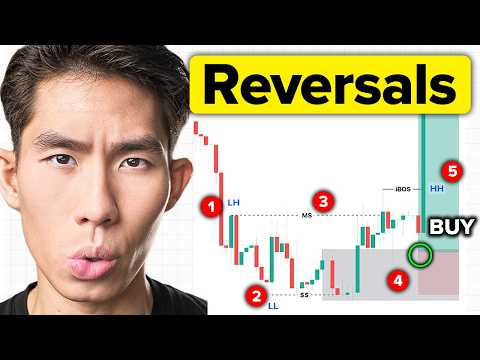
[0:00]Most traders lose not because they have a bad strategy. But because they're trying to be a hero. They want to call tops and bottoms, catch to the perfect reversal, get that insane sniper entry, predict the next market crash, and feel like a genius. But here's the thing. The market doesn't pay you to be a hero. It pays you for being right often enough over time. And this is exactly why most traders get destroyed trading reversals. Because let's be honest, all of us love the idea of buying the exact bottom and selling the exact top. But most of the time, that's not skill talking, that's just your ego talking. Most traders get wiped out because they try to predict the top or the bottom way too early. They see price getting extended, they assume that it has to reverse, and then they jump in before the market has actually confirmed anything. So, in this video, I'm going to show you how to trade reversals properly. Not based on hope, not based on guessing, not based on lagging indicators like the moving average or Bollinger Bands, or whatever BS, and definitely not based on some random candlestick or chart pattern. I'm going to break down the exact framework that I personally use to identify high probability reversals. Understand higher time frame narrative, read price action properly, and wait for real confirmation before entering. My name is Brad Go, I've been trading for seven years. Last month alone, I made nearly $1 million in trading profits. With every single trade documented live on my second channel, Brad Trades. I'm the founder of 1% Club, which is a mentorship program that has helped hundreds of students become funded traders, and I'm also the founder of EdgeFlo. The trading app that I personally use to plan, execute, journal, and review my trades, which has already helped hundreds of traders execute with more discipline and structure. So quite simply put, I don't want your money. I want you to become a better trader. Now that you know who I am, let's get straight into it. Now, before you can even think about identifying reversals, you must understand the objective of price right now. What is the market doing right now? Who's in control of price? The sellers or the buyers? And what is the overall sentiment of the market right now? Those are the questions that you must constantly ask yourself to figure out the higher time frame narrative. Because that determines the institutional flow of money, which is what we want to be trading with. So, to put it in English, basically, what you want to do is to identify the overall market context, the overall higher TFL trend direction before you can even think about trading reversals. So, if I'm looking at a market just like this on NQ, Nasdaq, you can see that right now it's very obvious that the sellers are in control of price. Right, price is heavily bearish, you know, price has just been collapsing for the past few hours or so. So, ideally, I want to actually look for shorts. But the thing is you must understand that whatever goes up will eventually come down. When price keep on going up, eventually it will start pulling back to fair value. It's the same exact concept when the market is in a downtrend. If the market came on going down, eventually there's going to be some demand, eventually there's going to be some buyers that cause price to start going up and start to pull back. So, this is where we can potentially expect price to reverse, maybe make like a short-term pullback just like this to create like a new lower high for price to continue going down even further. Right, so if I'm looking at this chart right now, that's what I'm assuming price would do next. Since price has essentially lost momentum right here, you can see price did not want to go down anymore, it started pausing over here, and then started creating this swing low, and then later on it came down, creating this another swing low and then started reversing. Right, so price has literally tested this area right here twice. Okay, first here, failed to take out that level, second time again, failed to take out that level again, which signaled to us that this $24,000 level right here is a institutional level where there's a lot of buy orders, there's a lot of demand. So, right now, since there's not enough selling pressure, not enough selling momentum in the market, we can expect price to actually start pushing to the upside. Okay, so in this particular case, you can see price is potentially pulling back, and this is where you can try to identify where price is going to pull back to. Right, so you can just map out all the supply zones that we can see on the left hand side right here. Right, so there's a supply zone right here, there's another supply zone right here, and then there's also another supply zone right here. So, our hypothesis right now is that right now price is heavily bearish and it's just shifting bullish in the short term to facilitate the pullback into any one of these supply zone. And the minute price actually mitigate this supply zone right here, we can expect price to reverse and just continue with the higher time frame downtrend. That's our hypothesis. So, at this point of time, I'm just going to be doing nothing until price mitigate each one of these zone. The minute price actually mitigate each one of these zone, then this is where I'm going to be paying attention to what price is doing to see whether it actually give me the signs of reversal to give me the confirmation that I need to short the market down. So, that's how you want to be trading reversals. You don't want to try to predict reversals all the time in the market. You only want to focus on the reversals that actually matters, which more often than not is going to be at some form of supply or demand zone. So, basically what we are doing right here is that we are trying to understand where price is likely moving to word, and whether the reversal makes sense there or not. So, once again, you don't want to try to trade reversals in the middle of nowhere. Like for example, right here, you don't want to enter for a sell right here, because this is price being in the middle of nowhere, so it's incredibly low probability. There's a very low chance that price will reverse right here, compared to price actually reversing right here, because this is actually where there is going to be sufficient sell orders that can allow price to shift in the trend direction in the short term. So, that's the first step, right? Is to just identify the higher time frame narrative, develop your daily buyers, and to just determine where price is moving towards next. So that you can pay attention to those point of interest that actually matter where we can actually spot the reversals that actually matter, which brings us to step two. Right, so step two, do nothing. Just wait for price to reach the supply zone. Okay, so as you watch price reach the supply zone, I want you to pay attention to the candlesticks that is being formed near the zone itself. Okay, so once again, you don't want to do anything until price reach some form of zones just like this. And then the minute price actually reach the zone, you want to pay attention to the candlestick momentum and pressure. That is step three. Okay, so once again, step one, develop higher time frame buyers, right, just try to identify the higher time frame narrative. Step two, do nothing and wait for price to mitigate a supply and demand zone. Step three is to observe the candlestick momentum and pressure. This will give you all the signs you need to know whether price is actually going to reverse right here or not, or is it just going to continue to just move up even further and just blast right through that zone. The answer lies in the candlesticks that's being formed. Now, what does reversal means? Reversal basically means that at some point in time, the buyers has overwhelmed the sellers, or the sellers has overwhelmed the buyers, and it caused the prevailing trend to actually change from bullish to bearish or to bearish to bullish. That's what reversal essentially means. It basically means a shift in the trend direction. So, when we are observing the candlestick momentum and pressure, what we want to see is a shift in sentiment. A shift in trend direction. What we want to see is whether the candlesticks are actually changing at the point of interest right here. Because that could signal the changing of hands between the sellers and the buyers. Okay, so what you want to see is the candlesticks to start getting smaller and smaller as price enters the zone. Because that signal to us that what is going on right now is that the buyers are losing momentum. There is not enough buy orders in the market for price to continue bullish. So, as a result, this is where we can have the sellers to start stepping into the market at this point of interest to short the market down and just take back control of the market and cause price to move to the downside. So, in this particular case, let's zoom in to like what's going on right here. So obviously, price has blast right through this point of interest over here.
[9:09]You can see when price actually mitigated this first supply zone that we have mapped up, there was not enough selling pressure right here. Okay, still, there is a lot of bullish momentum, big fat juicy candlestick right here, big bullish candlestick, causing price to continue going up even further. And then next thing you know, price just blast right through it. So, like I said, candlesticks are literally everything, they tell you all the story you need to know. So, at this point of time, this point of interest has already been disrespected, price just absolutely demolished it and just blast right through it, so you can just get rid of that. Now, let's pay attention to next, this next supply zone that we have mapped out right here. Okay, let's once again, pay attention to the candlesticks. So, at this point of time, you can see what happens is that there's a big bullish candlestick, another big bullish candlestick, but the minute price actually mitigate this supply zone, what we saw was that there was this upper wick being formed right here. What does upper wick tells us is that at some point in time, the buyers tried to push price all the way up here to this 24840 level right here, but they failed to do so. The candlestick failed to close at that price point. As a result, the sellers actually stepped into the market at this supply zone and caused price to come all the way down, push price all the way down, and it ended up closing at this 24.8k level right here, which pretty much indicate that there is indeed sell orders within this point of interest. There is indeed selling pressure, selling momentum at this point of interest. And then let's look at the next candlestick right here. It's followed by a doji candlestick just like this, which signals indecision in the market. So, this is potentially the next sign that tell you that, okay, right now we are about to reverse. Because you can see this candlestick, there is long upper wick, long lower wick, and then there's like a small candlestick body, which indicate that sellers and buyers that are playing this tug of war right now, and they are at a stalemate. Nobody is winning, nobody is losing, they are just at a stalemate. So, at any point of time right now, what can potentially happen is that if there is enough sell orders in the market, it's going to cause price to start dumping. But with that said, like I said, this signals indecision. It does not affirm that price is going to reverse straight away. Because what can happen also is that the buyers can still end up gaining back control of price, and price can just continue going up as well. Okay, so this is where it's important for you to like just continue to observe what price is doing next. Right, so as a result right here, you can see bearish candlestick over here at this supply zone. So, this is where we kind of know that potentially, what can happen is that price can start shifting bearish a little bit. Okay, once again, these are just signs that the market is potentially reversing. It's not a confirmation, it is just signs, it is just signals. Now, let's continue to observe what price does next. Right, so as you can see, price just continue consolidating around here, right, nothing actually happened, until it starts coming down and take out the last structural low right here, which brings us to the next step, which is to wait for some form of liquidity sweep. You must understand that it requires a lot, a lot of money for price to break a strong structure. What I basically means by that is that in a bullish internal flow just like this, when price goes up, pull back, create a higher low, and then goes up, pull back, and then goes up just like this, it requires a lot, a lot of money, a lot of sell orders for price to come down and take out the last strong low at this last higher low. Because when that happens, this is our market shift, and this tells us that the market is reversing. But it also tells us that at this point in time, there's a lot of sell orders in the market, so much sell orders that price actually took out strong structure. A liquidity sweep is usually like a very sharp V-shaped reaction, where the market go out fast and come in fast. Right, so the minute we see like this very sharp V-shaped reaction, reversal, this indicate to us that there is some form of liquidity sweep. Once again, this is more of like an advanced sort of concept, which I've covered a lot in my YouTube videos. So if you don't understand this, please go and check out those other liquidity concepts videos. But for now, I'm not going to go through the entire liquidity concept. I'm just going to tell you that in this particular case, there was liquidity sweep because price actually went up there, pull back, created like an inducement right here at this swing high. Guess what, that is available liquidity. Later on, price went up there, swept the liquidity above that high, started reversing. Same thing, there's also some liquidity right here above this lower high here as well. So, this pretty much was another sign that tells us that a reversal could potentially happen. Right, because reversals tends to happen after the market grabs liquidity. Remember that. Write that down somewhere. Reversal cannot happen unless there is liquidity sweep. And this is the step where a lot of traders miss. Because a lot of traders think that, oh, I met up this supply zone right here, so the minute price actually mitigate this supply zone somewhere around here, I'm just going to happily enter for a sell. Or maybe I wait for my doji candlestick right here. After all, the candlestick pattern should, should not be wrong, right? Okay, so good old John decided to enter for a sale right here and place the stop loss above this high right here, before the liquidity has been swept, and as a result, John gets stopped out and he become the liquidity instead. All because he doesn't understand market mechanics. All because he doesn't understand all the flow. All because he doesn't understand liquidity concepts. Remember, if you cannot spot the liquidity, then my friend, you are the liquidity. So do not forget to wait for step four, which is wait for the damn liquidity sweep. And that brings us to step five, right? So, after you get a liquidity sweep, what you want to see is a structural shift, a market shift to indicate to us that, yes, smart money has indeed use the liquidity to cause the entire trend direction to shift bearish. So, like I said, earlier on, this is the last higher low, right? Because this is the last internal break of structure right here, which makes this the last higher low. So, the minute price actually took out the last higher low, what we do have is a market shift, which signal to us that the sellers has officially took control of price.
[15:46]The sellers have officially kicked the buyers out of the arena. The order flow has essentially changed from demand to supply. So, that is step five, is to wait for some form of market shift. Because when you get that, that is the confirmation you need that price has officially shifted bearish, and right now, we are pushing to the downside. Okay, so let's just continue to play price forward and see what price does. Right, later on, price actually made like a little pullback just like this, and then started reversing, and then went all the way up here. Okay, so in this case, you can see after the market shifted bearish, really pull back to, it pulled back to like somewhere around here, right, which is this demand zone right here on the 15 minute time frame as well. And once again, this is an opportunity for you to apply the five steps that I've just covered right here. Okay, that is essentially how you look for reversals. You need all five steps. You cannot just miss one step itself. Now, as you can see, what happens is that as price started shifting bearish right here, after the market ship is formed, it came down to this next 15 minute demand zone. And when it came down to like a 15 minute demand zone right here, we can expect some form of demand to step into the market to cause price to reverse. And once again, you want to observe, you want to pay attention to what the market is trying to tell you. Pay attention to the candlesticks that is being formed as it approached this demand zone. Because if you look at these candlesticks right here, you will start to see that the bearish momentum start fading away. Right, the sellers are starting to exit the arena because the buyers are coming into the market and just pushing them out. Right, the buyers are taking back control of price right here. Guess what, we have next, we got a good old liquidity sweep right here. After the bearish candlestick started getting smaller and smaller and started consolidating right here, which signaled a loss of selling momentum, selling pressure, and then that is followed by a liquidity sweep right here where price came down and swept the liquidity below this low right here. And then, later on, price went up there and took out the last lower high giving us a market shift, which tells us that the market is once again about to reverse. Right, so you can literally see me just apply those five steps in like under five minutes. Because it's really just as simple as that. Because I fundamentally believe that a simple framework is repeatable, that means it's scalable, which means it's profitable. So, those are the five steps you need to actually identify and trade reversals. So, with that being said, since you're still watching this video right here, I think you deserve a bonus team. So, here's a bonus team. Listen up. Timing matters. Reversals often happen around the opening of London or New York session.
[19:00]So, in this particular case, guess when the market actually reverse. This was literally just right when the market is actually open. Right, so around 15 minutes before London session actually open, the market actually reversed and start heading down. And then let's look at another example. Right, so maybe this is another example. So, this was doing the New York session. Price was going up. Before New York session, start coming down. Right before New York session, the market start reversing, or during the New York session, the market actually start reversing and start hitting up again. So, that's like a little tip that you can actually use. The reversal tends to form either a few minutes before the session opens or when the session opens. Because this is where the volume start kicking in, the institution start trading, start dumping their big buy and sell orders. So you want to make sure that you are able to capitalize on this huge reversal move by ensuring that you are well prepared before the session opens, before the London or New York session open. You want to sit down, do step one to step five, right, just go and map out your point of interest, identify your trend direction, determine which point of interest you want to look out for the reversals. So basically, in order to catch sniper entries, what you want to do is to combine timing with location, with liquidity and structure. If you have all of these aligned, I can triple guarantee, you'll make a lot of money in the market. You will get sniper entries, and you are going to have a lot of fun in this market. So, with that being said, I'm just going to end off this video by just telling you guys exactly when not to trade. It's important to know when to trade, when to spot these reversals, but it's even more important to know when to stay out of the market so that you can avoid the unnecessary losses. Please, ladies and gentlemen, for the love of God, do not try to predict the reversal too early. Like I said, you want to wait for the confirmation, you want to wait for the liquidity sweep, you want to wait for the market shift. You don't want to confuse slow momentum with actual confirmation. Just because the candlestick are getting smaller, just because there's a doji candlestick just like this, does not necessarily mean that price is going to reverse straight away. So if you are actually hoping that that actually happens, then my friend, you are going to be in for a surprise, a lot, a lot, a lot of times. Just like what happened right here, you got a doji candlestick, but there was not enough selling pressure, as a result, price went up there, swept the liquidity before the real move actually happens. So do not confuse slowing momentum with actual confirmation. And also, do not ignore the higher time frame narrative. The only reason why this trade idea worked out is because of the fact that the higher time frame is bearish as well. Higher time frame is bearish, internal order flow is bearish, everything is aligned, that is what allowed this trade to actually play out so nicely. Entering before liquidity gets swept, like I said, if you do not spot liquidity, then you will become the liquidity. And last but not least, wanting to be a hero instead of following a process. So, stop trading your ego and start trading price.
[23:01]So, if you want to trade reversals properly, stop trying to predict the exact top or bottom just to feed your ego. Stop trading your pride and start trading price. Start with the higher time frame narrative, wait for price to reach a supply and demand zone, observe the candlestick momentum and pressure, let liquidity get swept, wait for the market shift, and then enter on confirmation. And that, my friend, is how you stop forcing reversals and start trading them with actual structure. Because, remember, at the end of the day, the traders who win with reversals are not the ones trying to look the smartest, not the ones trying to predict the exact top or bottom. They are simply the ones patient enough to let the market confirm everything first. So, if you want to learn more about market mechanics, how to think and trade like big banks and professional traders, check out this playlist right here. And as always, remember, you're just one trade away.


